

If you have three children or are expecting a third, you already know the dealership brochure bends the truth a little. It says "5 seats" or "7 seats" and assumes that three child seats fit wherever three slim adults would. They don’t. The real bottleneck isn’t the nominal number of seats: it’s the physical width of the rear seat in millimetres and how many ISOFIX anchorages the manufacturer genuinely homologates, not how many the catalogue promises.
Why rear seat width matters more than the number of seats
A group 0+/1 child seat with an ISOFIX base measures between 440 and 480 mm wide at its bulkiest point. Put three in a row and you need, at a minimum, 1,400 mm of shoulder-to-shoulder space free of obstructions (central armrests, a raised transmission tunnel, airbag curtains that intrude into the space). Below that figure, the third seat will go in, yes, but the child in the middle travels with their shoulder pressed against their sibling’s. That isn’t a question of comfort: it’s a question of the belt or harness working at the correct angle in a side impact.
The uncomfortable truth about "three ISOFIX"
Here we have to be honest, because almost no family SUV sold in Spain homologates three ISOFIX anchorages in the same row. The norm is two, in the outer rear seats, and a centre seat secured with a three-point belt. The real solution for a third seat isn’t to hunt for the "3 ISOFIX" unicorn: it’s to check that the centre seat has a three-point belt (not a two-point one, which still exists in some older city cars) and that the width allows a non-ISOFIX seat to be fitted there without encroaching on the other two.
What exactly to check before paying the deposit
- Width between the trim panels of the second row, not the overall width of the bodywork.
- Actual number of homologated ISOFIX points per row, checked against the technical data sheet and not the advertising.
- Type of belt in the centre seat: three-point is mandatory if a child seat is going there.
- Height of the central tunnel: on all-wheel-drive cars it tends to steal centimetres of footrest space for the centre child seat.
Peugeot 5008 (second generation): the 7-seat SUV that best solves the width problem
The current 5008 abandoned the MPV format and became an SUV, but it keeps a sliding second row that helps a great deal when you have to share space between three seats and a loaded boot. Two ISOFIX points in the outer seats, a three-point belt in the centre and a width that, while not a class record, lets you fit three group 1/2/3 seats without fighting the armrests.
| Power | Consumption | Label | Fuel |
|---|---|---|---|
| 100 kW / 136 CV | 5.3 l/100 km | ECO | Hybrid |
Starting price 37,700 €.
Skoda Kodiaq (second generation): the widest from shoulder to shoulder
Here is the pleasant surprise of the comparison. The Kodiaq has for years been one of the few mid-size SUVs still designed with the idea that the second row should seat three real people, not decorative ones. The result shows in everyday use: the third seat goes in without forcing anything, and the side head restraints don’t intrude into the centre seat’s space as they do in several rivals.
| Power | Consumption | Label | Fuel |
|---|---|---|---|
| 110 kW / 150 CV | 6.0 l/100 km | C | Diesel |
Starting price 39,900 €.
KIA Sorento (fourth generation): the best at combining width with a usable third row
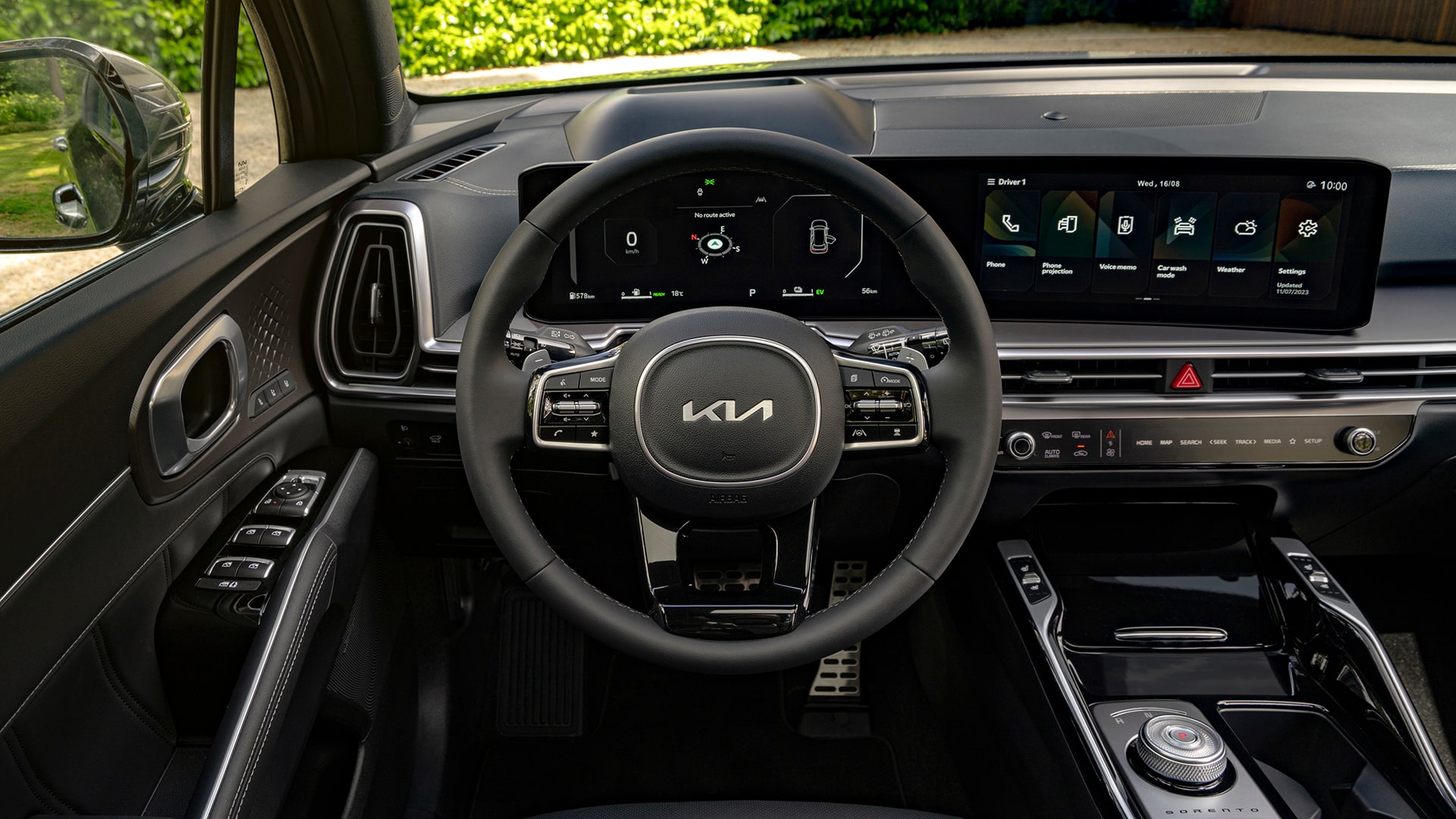
The Sorento plays in a different league on price, but if you genuinely use all seven seats (not as a trump card now and then but every weekend), it’s one of the few that offers comfortable access to the third row without having to remove a child seat installed in the second. That’s something the 5008 and the Kodiaq don’t solve as well.
| Power | Consumption | Label | Fuel |
|---|---|---|---|
| 169 kW / 230 CV | 6.0 l/100 km | ECO | Hybrid |
Starting price 45,500 €.
Nissan X-Trail e-Power: an alternative to consider if you prioritise the hybrid system over width
The X-Trail enters the conversation thanks to its e-Power, a series hybrid that drives almost like an electric car, with fairly modest real-world motorway consumption. The drawback, compared with the Kodiaq, is slightly less usable width in the centre seat, something you notice if all three seats have bulky harnesses.
| Power | Consumption | Label | Fuel |
|---|---|---|---|
| 150 kW / 204 CV | 6.0 l/100 km | ECO | Hybrid |
Starting price 42,000 €.
Other options in the segment: SEAT Tarraco and Volkswagen Touran
The SEAT Tarraco, a cousin of the Kodiaq on the Volkswagen Group’s MQB platform, shares almost the same second-row width but with somewhat more aggressive pricing. The Volkswagen Touran, although increasingly scarce in stock at Spanish dealerships, remains a benchmark in the pure MPV format for anyone who prioritises absolute width over an SUV image: its rear seat gains centimetres over any of the SUVs compared here, precisely because it doesn’t have to give up space to a tall bodywork design.
MPV or SUV: which format best suits three child seats
If all that matters is width in mm, the MPV still wins this fight; the problem is that almost nobody wants to buy one in 2026. 7-seat SUVs such as the Peugeot 5008 have been narrowing that gap without quite closing it.
Plan Auto+ and the real cost after incentives
The hybrid and plug-in hybrid models in this comparison may benefit from the Plan Auto+ currently in force in Spain. The exact amount changes with each call, so before signing it’s worth checking the up-to-date figure on the plan’s official website: it isn’t worth making a purchase decision based on figures from six months ago.
Summary table and score
| Model | Starting price | 2nd row width | Real ISOFIX | Score /10 |
|---|---|---|---|---|
| Peugeot 5008 | 37,700 € | Adequate | 2 + centre belt | 7.5 |
| Skoda Kodiaq | 39,900 € | Very wide | 2 + centre belt | 8.5 |
| KIA Sorento | 45,500 € | Wide, better 3rd row | 2 + centre belt | 8 |
| Nissan X-Trail | 42,000 € | Adequate | 2 + centre belt | 7 |
Verdict: which car to choose for your situation
For the real width of three seats with no compromises, the Skoda Kodiaq wins this comparison: it’s the only one of the three main contenders that solves the centre seat without sacrificing shoulder room. For families who use the third row every week and don’t mind the price jump (more than 15% over the 5008), the KIA Sorento takes the decision thanks to its rear access and its 230 CV of power. If budget rules and third-row use is occasional, the Peugeot 5008 offers the best balance between price and usable space for two or three seats in the second row.
Frequently asked questions
Is there any family car with three real homologated ISOFIX points in the same row?
Practically none in the SUV segment or MPV segment sold in Spain in 2026. The norm is two ISOFIX points in the outer seats and a three-point belt in the centre, suitable for fitting a third, non-ISOFIX seat.
What minimum width do I need for three child seats that don’t touch?
As a practical guide, 1,400 mm free between the door trim panels across the second row is usually enough for three group 1/2/3 seats without forcing the children’s shoulders.
Is the Skoda Kodiaq better than the Peugeot 5008 in everything?
No. The 5008 costs less up front and has lower hybrid consumption. The Kodiaq clearly wins on second-row width, but with a diesel engine that is costlier to maintain if you do little motorway driving.
Is it worth paying more for the KIA Sorento just for the third row?
If you use the third row daily or every weekend, yes. If it’s an occasional resource twice a year, the extra cost over the 5008 or the Kodiaq isn’t justified.
