

Choosing the best compact EV 2026 is not decided by the WLTP cycle or by the spec sheet on the dealership door. It is decided in the left lane of the A-3 at 120 km/h, with the climate control on, and in the time it takes you to recover 10-80% at a fast charger from Iberdrola or Ionity. Those two numbers —real consumption on the highway and DC charging curve— matter more than anything else.
The rest is noise. A car with 600 km WLTP and a 400 V architecture that charges at a 100 kW peak can end up slower on a Madrid-Valencia trip than another with 500 km WLTP and 800 V sustaining 220 kW. On a long trip, the winner is the one that loses the least time plugged in, not the one that promises the most kilometres on paper.
Why WLTP range is no good for deciding
The WLTP cycle is measured at low average speeds, with gentle acceleration and controlled temperature. On a real Spanish motorway —120 km/h cruising, wind, 5 °C in winter or air conditioning at full blast in August— consumption rises between 30% and 45% compared with the homologated figure. A compact rated at 15 kWh/100 km ends up at 20-22 kWh/100 km in real driving without breaking a sweat.
In other words: that car rated at “600 km WLTP” delivers between 380 and 430 real km at 120 km/h. If the usable SoC is 10-80% (nobody leaves home at 100% or reaches the charger at 0%), we are talking about 270-300 km between stops. That is the figure that matters.
The three variables that matter on long trips
Three numbers decide it:
- Net battery kWh: what you can actually use, not the gross capacity.
- Real consumption at 120 km/h: measured in independent tests, not the catalogue figure.
- Average DC charging power between 10% and 80%: not the marketing peak.
The peak is irrelevant. A car that reaches 250 kW for 90 seconds and drops to 70 kW for the rest of the session charges worse than one that sustains a clean 150 kW. The electrical architecture —400 V versus 800 V— and battery cooling are what set apart a “long-distance” car from a “city car with pretensions”.
Tesla Model 3 Long Range (from 44.990 €)
The Model 3 Long Range remains the benchmark to beat for pure efficiency. Real consumption at 120 km/h hovers around 17-18 kWh/100 km with the aerodynamics working in its favour, a usable battery close to 75 kWh and access to the Supercharger network, which in Spain already has dense coverage on the main corridors. Peak charging is around 250 kW, but what matters is that it keeps consistent curves: 10-80% in around 25-27 minutes on V3/V4.
The interior remains minimalist to the extreme —everything on the central screen, no instrument cluster behind the steering wheel—. In our view it works well on long trips, but not everyone likes it.
| Power kW | Power CV | WLTP Range | WLTP Consumption | Label | Fuel |
|---|---|---|---|---|---|
| 324 kW | 440 CV | 629 km | 14,0 kWh/100 km | Cero | Electric |
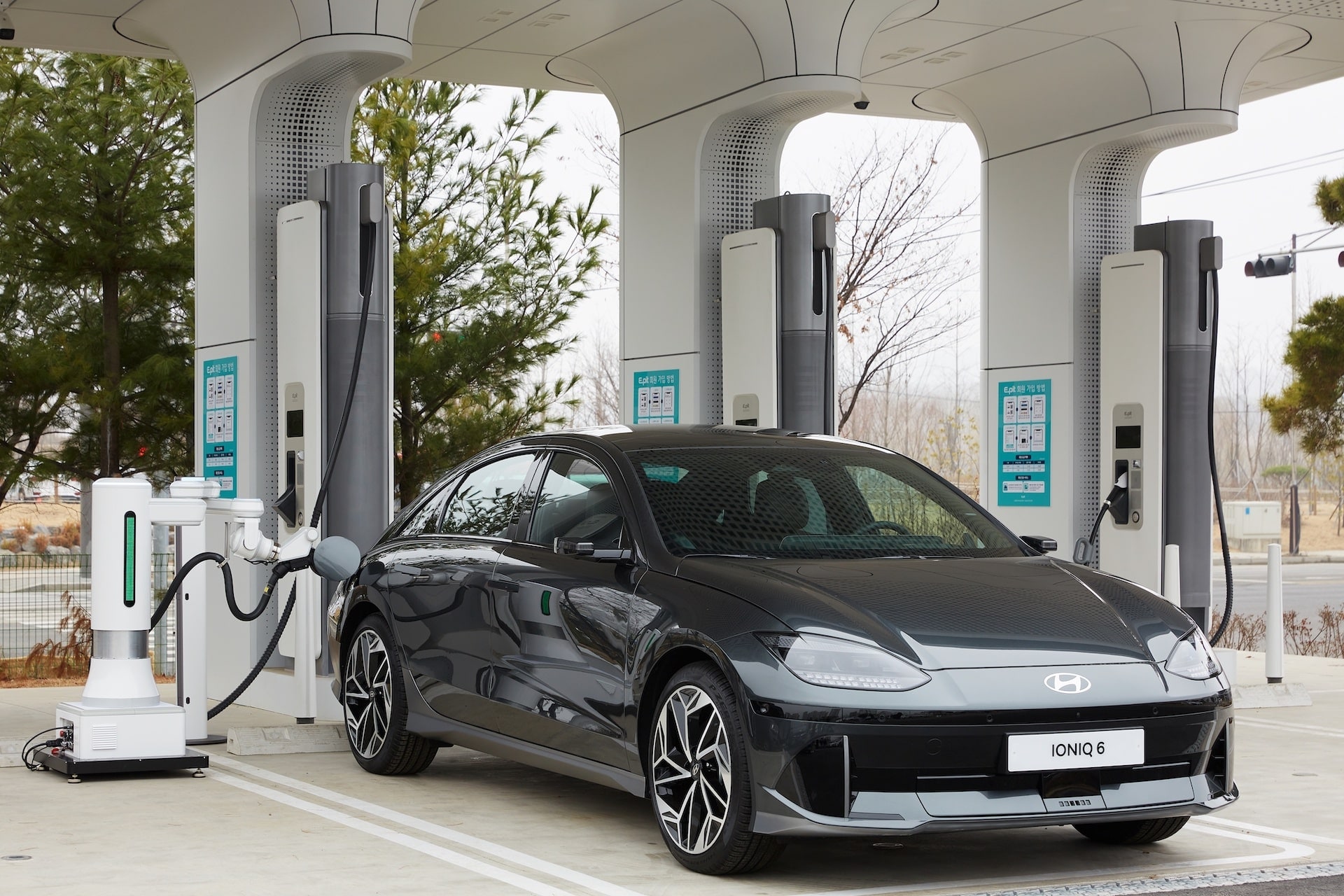
Hyundai IONIQ 6 77 kWh RWD (from 47.400 €)
Here we are talking about the most efficient compact EV on the European market, full stop. The teardrop shape is not a design whim: its 0,21 Cx means that at 120 km/h the IONIQ 6 uses less energy than cars with half its power. 16-17 kWh/100 km real on the motorway is a figure almost no rival can match.
And on top of that, an 800 V architecture. That means 10-80% charging in 18 minutes on a 350 kW charger, with a stable curve around 200-220 kW. On a Madrid-Valencia trip (about 350 km) you can do it with a single short stop of 12-15 minutes. It is probably the most long-trip-ready compact EV you can buy in Spain today. That said, rear seat access is a bit tight for a car that is 4,85 metres long.
| Power kW | Power CV | WLTP Range | WLTP Consumption | Label | Fuel |
|---|---|---|---|---|---|
| 168 kW | 229 CV | 614 km | 13,9 kWh/100 km | Cero | Electric |
Volkswagen ID.3 Pro S (from 42.880 €)
The ID.3 Pro S has a 77 kWh net battery and is the most “European car” of the three: a genuinely compact format (4,26 m), well-calibrated suspension and ergonomics that don’t force you to relearn how to drive. It consumes more than the IONIQ 6 on the motorway —between 19 and 21 kWh/100 km real at 120 km/h— and charges more slowly: a 170 kW peak, but a curve that drops earlier, leaving 10-80% at around 28-30 minutes.
For someone who doesn’t leave home every weekend and mostly uses the car in town and on secondary roads, it is the most balanced proposition. For those who hit the motorway every Saturday, it falls short compared with the Hyundai. If you are interested in the VW group’s approach, we have already analysed Cupra Born versus the Volkswagen ID.3 in detail.
| Power kW | Power CV | WLTP Range | WLTP Consumption | Label | Fuel |
|---|---|---|---|---|---|
| 170 kW | 231 CV | 559 km | 15,9 kWh/100 km | Cero | Electric |
Real example: Madrid-Valencia (355 km via the A-3)
Departing at 90% and aiming to arrive at 15%, assuming 120 km/h cruising:
- IONIQ 6 77 kWh: one 13-15 min stop near Motilla del Palancar. Total time: ~3 h 25 min.
- Model 3 Long Range: one 18-20 min stop at a Supercharger in Atalaya del Cañavate. Total time: ~3 h 30 min.
- ID.3 Pro S: one 28-32 min stop, probably two if there is a queue or the charger doesn’t deliver full power. Total time: ~3 h 45-50 min.
Real difference between the best and the worst: 20-25 minutes. On one trip. Multiply that by the number of trips you make a year.
Summary table and score
| Model | Price from | Usable battery | Real consumption 120 km/h | Charging 10-80% | Architecture | Trip score |
|---|---|---|---|---|---|---|
| Hyundai IONIQ 6 77 kWh | 47.400 € | ~74 kWh | 16-17 kWh | 18 min | 800 V | 9,2 |
| Tesla Model 3 LR | 44.990 € | ~75 kWh | 17-18 kWh | 25-27 min | 400 V | 8,7 |
| Volkswagen ID.3 Pro S | 42.880 € | ~77 kWh | 19-21 kWh | 28-30 min | 400 V | 7,5 |
Verdict
- For frequent long trips (more than 1.500 km/month on the motorway): Hyundai IONIQ 6. Its combination of 800 V, aerodynamics and real consumption has no rival in the segment. You pay the premium.
- For mixed use with the charging network as the priority: Tesla Model 3 Long Range. The Supercharger remains the most reliable and dense network in Spain, and the car is more than efficient enough. It is the safe choice.
- For urban-metropolitan use and occasional trips: Volkswagen ID.3 Pro S. European size, a more conventional feel and the lowest entry price. It loses out on long trips, yes, but if that is not your main use, it won’t hurt you.
The RRP difference between the ID.3 and the IONIQ 6 is around 10%, within a reasonable margin. Between the Model 3 and the IONIQ 6, just over 2.000 € separates two different philosophies: your own network versus pure efficiency.
Frequently asked questions
What real range do I need to avoid trouble on a trip?
As a practical rule: 300 real motorway km between charges is enough to avoid stress. That implies a minimum usable battery of 65-70 kWh and real consumption below 20 kWh/100 km at 120 km/h.
Does the 800 V architecture pay off in a compact?
If you make more than one long trip a month, yes. The difference between charging in 18 minutes or in 30 is very noticeable when you have children in the back or the charger is busy. If you only charge at home, you won’t make use of it.
How much does it cost to charge a compact EV on the motorway?
At fast chargers (Ionity, Iberdrola, Repsol) the kWh ranges from 0,39 € to 0,69 € depending on the operator and tariff. A 10-80% charge on a 75 kWh battery costs around 25-35 €, compared with the 3-5 € it would cost at home on an off-peak tariff.
Does the Plan Auto+ cover these three models?
Yes, all three fall within the Plan Auto+ framework as pure electric vehicles with the Cero label. The specific amounts and deadlines are best checked on the official website, as they are updated periodically.
