

When someone asks "how much charging power do I need?", they are usually asking the wrong question. What really decides whether a 600 km trip takes one 20-minute stop or two 40-minute ones is the combination of two things: the sustained DC charging power and the real kilometres the car gains between those stops at motorway speed. The peak kW on the spec sheet is marketing. The 10-to-80% curve is physics.
What charging power really means in an electric SUV in 2026
An electric SUV can advertise 240 kW peak and charge at that power for barely ninety seconds, just when the battery is almost empty. The rest of the curve drops sharply. What matters is the average power between 10% and 80%, the range where you actually stop to charge on a trip. That figure is what makes the difference between 18 minutes and 35.
400V vs 800V architecture: why it matters more than the peak kW figure
800-volt systems (Kia, Hyundai) deliver the same power with less current, which reduces cable and battery heating and keeps the high part of the charging curve going for longer. 400V systems (Volkswagen, Skoda, Peugeot) need more current for the same power, which limits the peak and, above all, how long it can be held. It is not a matter of technical prestige: it is the difference between 18 and 28 minutes for the same recharge.
Real kilometres between stops, the metric you should really look at
It does not matter how fast a car charges if it consumes 24 kWh/100 km on the motorway: it will drain the battery sooner and need more stops even if it charges faster. You have to cross real consumption at 120 km/h with sustained charging power. A slightly slower-charging but more efficient car can gain more kilometres per hour of travel than one with a spectacular peak and high consumption.
Kia EV6 (from €44,900): the 800V benchmark of the segment
| Power | WLTP range | Consumption | Peak DC charging | Label | Fuel |
|---|---|---|---|---|---|
| 168 kW / 229 CV | 506 km | 16.5 kWh/100 km | 240 kW | CERO | Electric |
Charges from 10 to 80% in about 18 minutes when it finds a charger above 150 kW, something that in Spain is still not guaranteed outside the major corridors. It is, by a wide margin, the one that best sustains the high part of the curve.
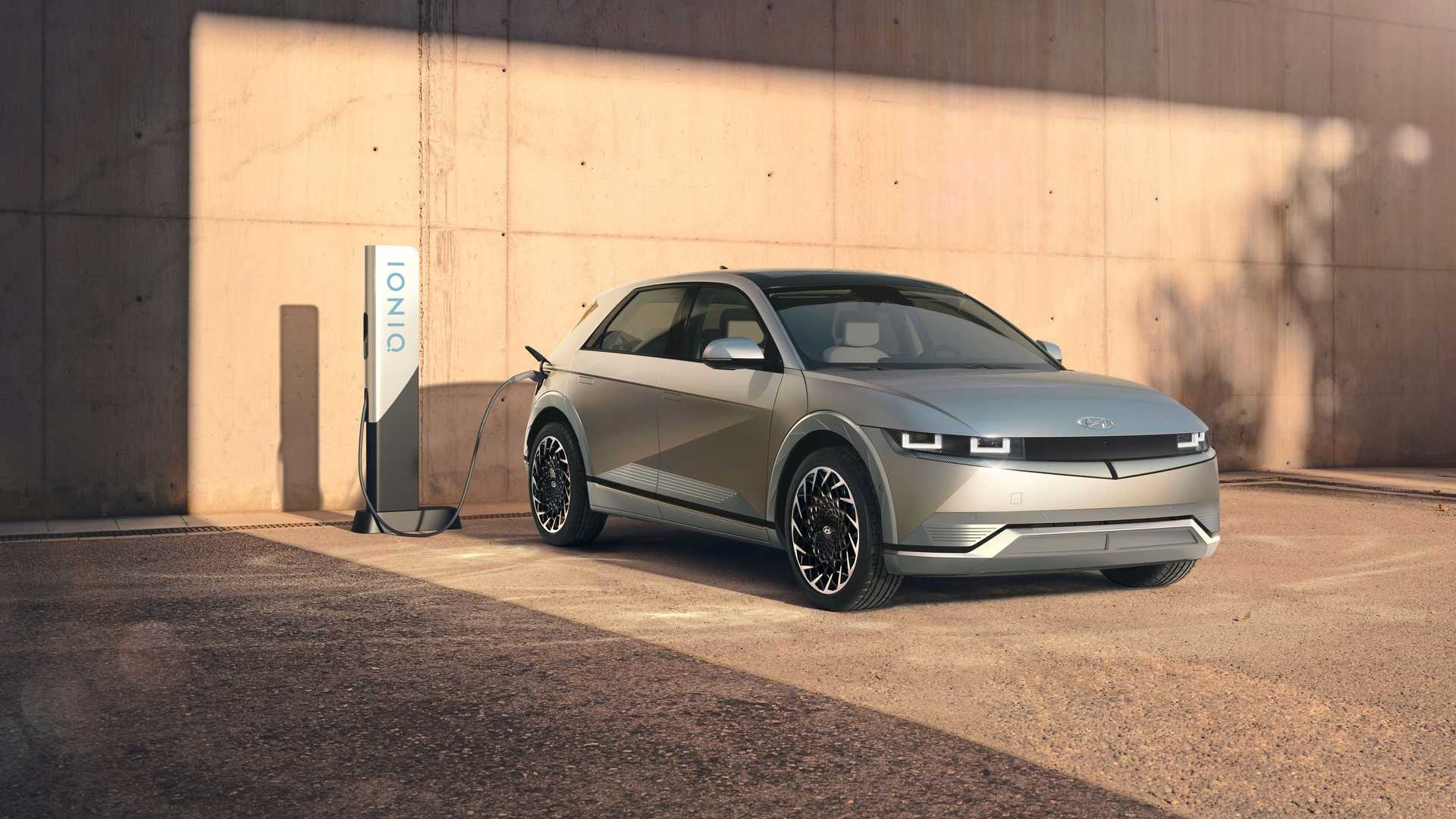
Hyundai Ioniq 5 (from €43,700): the other face of Korean 800V
| Power | WLTP range | Consumption | Peak DC charging | Label | Fuel |
|---|---|---|---|---|---|
| 170 kW / 231 CV | 570 km | 17 kWh/100 km | 230 kW | CERO | Electric |
It shares the E-GMP platform with the EV6 and behaves almost identically when charging. It gains some homologated range thanks to a larger battery, but in real motorway driving that difference narrows considerably.
Volkswagen ID.4 (from €42,300) and a well-executed 400V architecture
| Power | WLTP range | Consumption | Peak DC charging | Label | Fuel |
|---|---|---|---|---|---|
| 170 kW / 231 CV | 550 km | 16.3 kWh/100 km | 175 kW | CERO | Electric |
Its peak is lower than the Koreans’, but its real consumption is among the lowest in the group, which offsets part of the time lost while charging. For anyone who does not make 500 km trips back to back, the difference is barely noticeable.
Skoda Enyaq iV (from €40,200): the group sibling with a different approach
| Power | WLTP range | Consumption | Peak DC charging | Label | Fuel |
|---|---|---|---|---|---|
| 210 kW / 286 CV | 560 km | 16.8 kWh/100 km | 175 kW | CERO | Electric |
Same MEB mechanics as the ID.4, but with more motor power and a noticeably lower entry price. On fast charging it performs the same: the platform is what matters, not the badge.
Peugeot e-3008 (from €45,300): when range makes up for slower charging
| Power | WLTP range | Consumption | Peak DC charging | Label | Fuel |
|---|---|---|---|---|---|
| 157 kW / 213 CV | 526 km | 15.9 kWh/100 km | 160 kW | CERO | Electric |
The lowest peak in the group, but also the tightest consumption. On moderate motorway journeys it needs to stop almost as often as the ID.4, only a little more slowly on each charge.
Real consumption at 120 km/h: the figure that debunks the WLTP spec sheet
No electric SUV in this group drops below 16-17 real kWh/100 km at 120 km/h with the air conditioning on, even though the WLTP label promises less. That 15-20% overconsumption is what really cuts the kilometres between stops, more than any difference in peak kW.
10-80% charging curve: why the peak is not what counts
The EV6 and Ioniq 5 hold more than 200 kW for a good part of the curve. The ID.4 and Enyaq average around 150 kW in real use. The e-3008 ranges between 120 and 140 kW. The practical difference on a 600 km trip: between 15 and 20 extra minutes of total charging for the 400V cars compared with the 800V ones.
Comparative summary table
| Model | Price from | Architecture | Peak DC charging | WLTP range | Charging/travel score (1-10) |
|---|---|---|---|---|---|
| Kia EV6 | €44,900 | 800V | 240 kW | 506 km | 9 |
| Hyundai Ioniq 5 | €43,700 | 800V | 230 kW | 570 km | 9 |
| Volkswagen ID.4 | €42,300 | 400V | 175 kW | 550 km | 7 |
| Skoda Enyaq iV | €40,200 | 400V | 175 kW | 560 km | 7 |
| Peugeot e-3008 | €45,300 | 400V | 160 kW | 526 km | 6 |
Verdict: which electric SUV to choose according to your use case
For those who often make long trips, Madrid-Málaga or Barcelona-Valencia once a month, the Kia EV6 or the Hyundai Ioniq 5 win without question: their 800V architecture turns a 30-minute stop into an 18-minute one, and over a year that adds up to real hours. For mixed use, city driving during the week and the occasional weekend getaway, the Skoda Enyaq iV delivers almost the same practical result as the ID.4 at a price up to 11% lower, which makes it the option with the best performance-to-price ratio in the group. The Peugeot e-3008 is more convincing for its design and interior comfort than for charging speed, and it is the reasonable choice if trips over 400 km are not your routine. Anyone who charges almost always at home and uses fast charging only two or three times a year does not need to pay the 800V premium: the Enyaq or the ID.4 more than suffice there. To complete the decision it is also worth reviewing the real range you need according to your weekly use, because charging power only matters if range first fits your usual journeys. And if budget is the deciding factor, the review of electric SUVs with the best balance of range, charging and price below €50,000 widens the field beyond these five. Don’t forget to check the current Plan Auto+ on the official website: it can shift the price balance between these options.
Frequently asked questions
How much DC charging power do I really need in an electric SUV?
For mixed use with the occasional long trip per year, a sustained peak of 150-175 kW is enough. Only those who travel on the motorway very often notice the difference of moving to 800V.
Why do two cars with the same peak kW charge in different times?
Because the peak is held for only a few seconds. What defines the real time is the average power between 10% and 80%, which depends on the electrical architecture and the battery’s thermal management.
Does the 800V architecture justify its extra cost over a 400V one?
If you make long trips often, yes: it saves between 15 and 20 minutes per stop. If you almost always charge at home, the price difference is not justified by real use.
Which electric SUV loses the least range at 120 km/h?
Among those compared, the Peugeot e-3008 and the Volkswagen ID.4 show the most contained real consumption on the motorway, although none avoids the typical 15-20% overconsumption versus the WLTP figure.
