


Two Korean cousins, same base platform, same family vocation — and yet two very different cars when you sit behind the wheel. The Hyundai Santa Fe has reinvented itself with a squared-off, almost brutalist design that leaves no one indifferent. The KIA Sorento keeps a more sober line, more of a traditional SUV, but hides a plug-in drivetrain that completely changes the usage equation. If you want seven real seats and serious electrification, these two are a must-see.
Let’s get down to it. There is no universal winner here, but there is a clear winner for your specific case.
Two philosophies, one segment
The starting approach already sets the pace of the comparison. Hyundai bets on a full hybrid (HEV) of 240 CV, no cables, no plug, no dependencies. KIA goes for the PHEV route with 250 CV, all-wheel drive and CERO label — with all the good and all the inconvenience that implies.
This is no minor difference. It is probably the most important decision you will make before looking at anything else.
Hyundai Santa Fe HEV 1.6 TGDi 239 Maxx (from ≈56,000 €)
The current Santa Fe is, in our view, the most stylistically bold family SUV in the mainstream market. Straight lines, very wide rear doors, door handle integrated into the C-pillar, vertical tailgate. Inside you can tell: the third row is decent for adults on medium journeys, not just for children, and the boot with all seven seats folded easily eats the luggage of a family of five going away on holiday for two weeks.
The 1.6 turbo HEV with ECO label delivers 240 CV combined. It is not a sports car, but it pushes with ease. And best of all: you don’t have to think about plugging anything in. For someone who drives many varied kilometres, without a clear daily routine, it is a relief.
| Power kW | Power CV | Top speed | Consumption | Label | Fuel |
|---|---|---|---|---|---|
| 180 kW | 240 CV | 200 km/h | 6.5 l/100 km | ECO | Petrol hybrid |
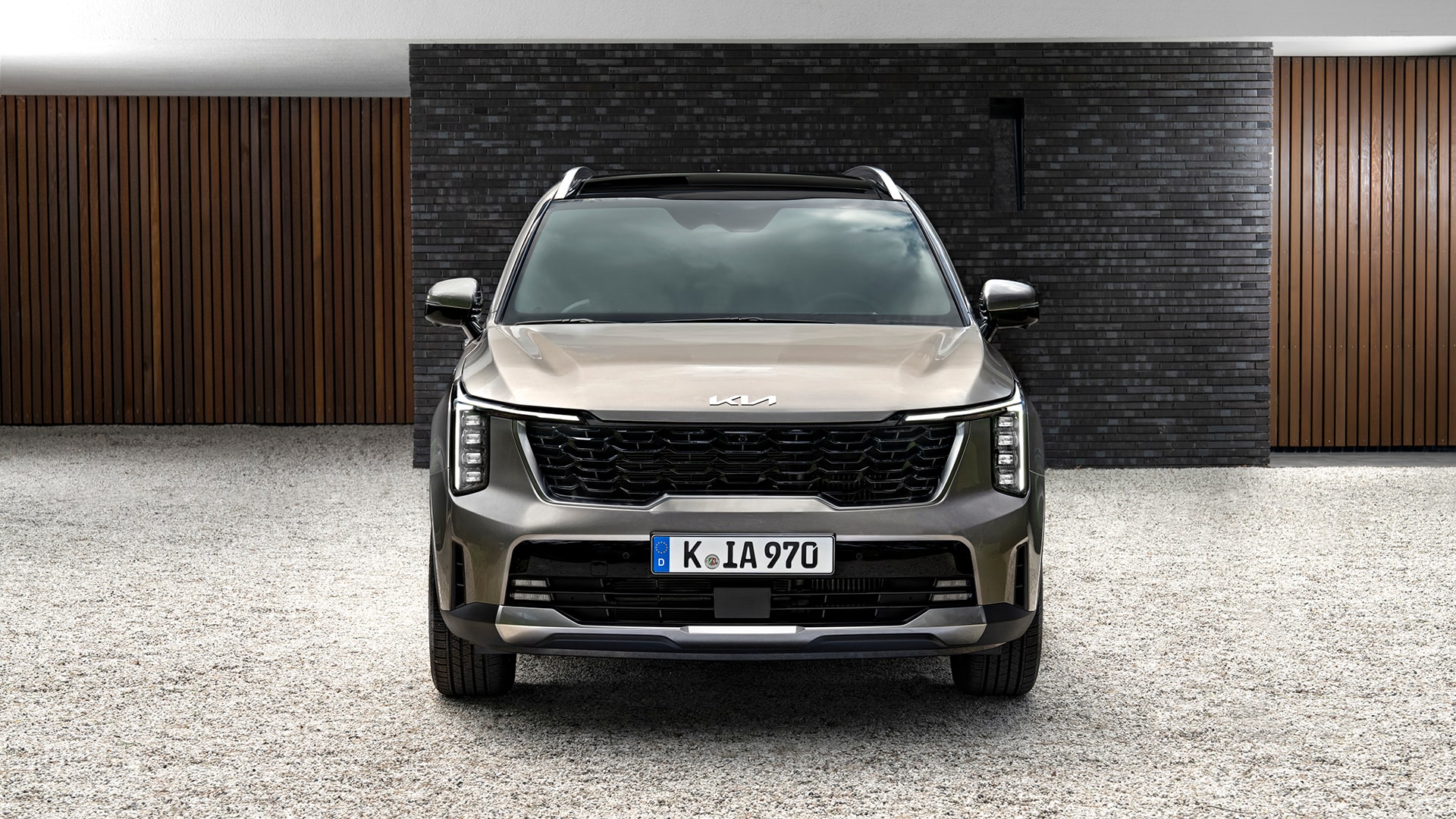
KIA Sorento Hybrid PHEV 1.6 T-GDi 252 Drive 4×4 7 seats (from ≈61,400 €)
The Sorento plays in a different league in terms of approach. It is a PHEV, with all-wheel drive as standard in this version and a battery of around 14 kWh that gives roughly 60 km of homologated electric range. This means two things: CERO label to enter low-emission zones without worries and, if you have a plug at home or at work, ridiculous consumption during the week — that ≈1.5 l/100 km homologated only makes sense if you keep up with daily charging.
Visually it is more classic than the Santa Fe. Less daring, more consensual. Inside, the finishes seem a bit behind the Hyundai in perception, although the ergonomics of the physical climate controls are better resolved in the KIA. These are nuances.
| Power kW | Power CV | Top speed | Electric range | Consumption | Label | Fuel |
|---|---|---|---|---|---|---|
| 190 kW | 250 CV | 180 km/h | 60 km | 1.5 l/100 km | CERO | Petrol PHEV |
Design: where each one wins
The Santa Fe wins on personality. It is impossible not to notice it. It conveys that “capsule car” idea in the style of a Land Rover that appeals to many people — and turns off just as many, it must be said. The Sorento is more lukewarm on the outside, but it will age better for those who don’t want to draw attention.
Inside, the Santa Fe brings a double curved screen that impresses the first time; the Sorento is more conventional but more intuitive once the novelty wears off. In my view, the Hyundai takes more risks and gets them right.
Real space for long trips
This is where the comparison gets interesting. The Santa Fe, not carrying a large traction battery, offers a more generous boot and a slightly more usable third row. The Sorento PHEV pays a space toll for its battery: the boot with all seven seats in use is tighter and the central tunnel area steals some habitability.
If you travel three in the back and two in the third row with luggage for a week, the Santa Fe is the one that asks you to give up the least. It is an objective fact, not an opinion.
Consumption on the road: the great truth of the PHEV
A fact worth being clear about, and which we explain in depth in this guide on PHEVs when the battery runs out: the Sorento PHEV on long motorway stretches, with the battery empty, consumes more than the Santa Fe HEV. It is hauling an extra 150-200 kg of battery that no longer contributes anything. On 600 km trips in a row with no option to plug in along the way, the Hyundai wins on real consumption.
That said, if your pattern is school-work-home from Monday to Friday with overnight charging and occasional long trips, the Sorento can leave you with average annual consumption below 3 l/100 km. Unbeatable.
Price: a 5,400 € difference
The Sorento PHEV costs roughly 10% more than the Santa Fe HEV. It is not a minor difference, but it is not an abyss that invalidates the comparison either. What you get for those extra 5,400 € is: all-wheel drive, CERO label and potential fuel savings if you charge in a disciplined way.
Important warning: these figures are the manufacturer’s recommended RRP, without dealer discounts, one-off campaigns or aid such as Plan Auto+. In practice, the real difference after negotiating may narrow.
Summary table and scoring
| Criterion | Hyundai Santa Fe HEV | KIA Sorento PHEV 4×4 |
|---|---|---|
| Power | 240 CV | 250 CV |
| DGT label | ECO | CERO |
| Electric range | Not applicable (HEV) | ≈60 km |
| Homologated consumption | 6.5 l/100 km | 1.5 l/100 km (with battery) |
| Traction | Front-wheel drive | All-wheel 4×4 |
| Price from | ≈56,000 € | ≈61,400 € |
| Exterior design | 9/10 | 7/10 |
| 7-seat space | 9/10 | 7.5/10 |
| Long-trip consumption | 8/10 | 6.5/10 |
| Daily use with charging | 7/10 | 9.5/10 |
| Price-equipment ratio | 8.5/10 | 7.5/10 |
Verdict by use case
- Frequent long trips without reliable charging at the destination: Hyundai Santa Fe HEV. Full stop. It consumes less on long motorway stretches, costs less and offers more usable space.
- Urban/metropolitan use with a home wallbox: KIA Sorento PHEV. The CERO label and the 60 electric km make it almost free to run during the week.
- Best price-performance ratio: Hyundai Santa Fe HEV. With almost 5,400 € of difference (more than 10%), the Sorento only pays off if you make the most of the plug.
- If you prioritise design and the “wow effect”: Santa Fe, no debate.
- If you need all-wheel drive for snow, mountains or towing: Sorento, by elimination.
Frequently asked questions
Is the extra cost of the KIA Sorento PHEV over the Santa Fe HEV worth it?
Only if you charge the battery daily. Without a regular home or work plug, the PHEV becomes a heavy hybrid that is less efficient than the HEV. With disciplined charging, the extra pays for itself in 3-4 years through fuel savings.
Which one has the more usable third row for adults?
The Santa Fe, by a noticeable margin. The wider rear doors and the absence of a bulky battery under the boot floor free up more legroom in the last row.
Does the Hyundai Santa Fe HEV have an all-wheel-drive version?
Yes, there is an HTRAC variant in the range, but the Maxx trim we have used as reference here is front-wheel drive. If you need 4×4 in the Santa Fe HEV, you have to move up a trim and the price gets close to that of the Sorento.
What warranty do these models offer in Spain?
Both Korean brands offer a 7-year general warranty (with a mileage limit), a strong argument against European rivals in the same segment, which usually stop at 2-3 years.
