

Choosing a hybrid family SUV in 2026 is no longer a matter of counting horsepower or trusting the WLTP. The real question a Spanish family asks is more uncomfortable: how much does this car really use at 120 km/h with four suitcases and the kids in the back? And, no less important, do we travel comfortably or do we end up hearing the engine on every incline?
Here we put three references from the segment head to head: the Toyota RAV4 Hybrid as a pure full hybrid, the Hyundai Santa Fe Hybrid as a 7-seat alternative, and the Kia Sorento Hybrid as its technical cousin with a different set of priorities. No trick versions: we compare equivalent trim levels and comparable powertrains.
Why the WLTP is no help for deciding
The WLTP cycle measures city and gentle mixed driving well, but it penalises sustained motorway driving very little. A full hybrid shines when it can recover energy — braking, traffic queues, descents — and suffers when the combustion engine works alone at 120 km/h with no chance of help from the electric motor. That is why a RAV4 homologated at 5.8 l/100 km ends up showing 7.2–7.8 l/100 km real on a flat motorway. It is not a fault of the car: it is the physics of the system.
To decide well you need to look at three figures the brochure does not highlight: real consumption at 120 km/h with air conditioning on, noise level at that speed (dB), and the car’s wheelbase, which determines second-row comfort on journeys of more than two hours.
Toyota RAV4 Hybrid 2.5 AWD Advance — from €42,900
The RAV4 is the gold standard of the full hybrid. Its fourth-generation powertrain is well proven: smooth, predictable, with a combustion-to-electric transition that no longer feels as it once did. In mixed use, dropping below 6 l/100 km is trivial. The problem appears exactly where it hurts travellers most: on long motorway stretches the real consumption sits between 7.0 and 7.5 l/100 km at 120 km/h, and the engine audibly revs up when you ask for an overtaking manoeuvre uphill.
Acoustic comfort is adequate, not brilliant. At 120 km/h aerodynamic noise seeps in through the mirrors and rolling noise from the rear wheel arches. The second row works well for two adults; for three, it is tight. Generous boot (580 litres VDA) and a reliability that, in my view, remains the number-one argument for a family that does not want surprises.
| Power kW | Power CV | WLTP consumption | Label | Fuel |
|---|---|---|---|---|
| 163 kW | 222 CV | 5.8 l/100 km | ECO | Hybrid |
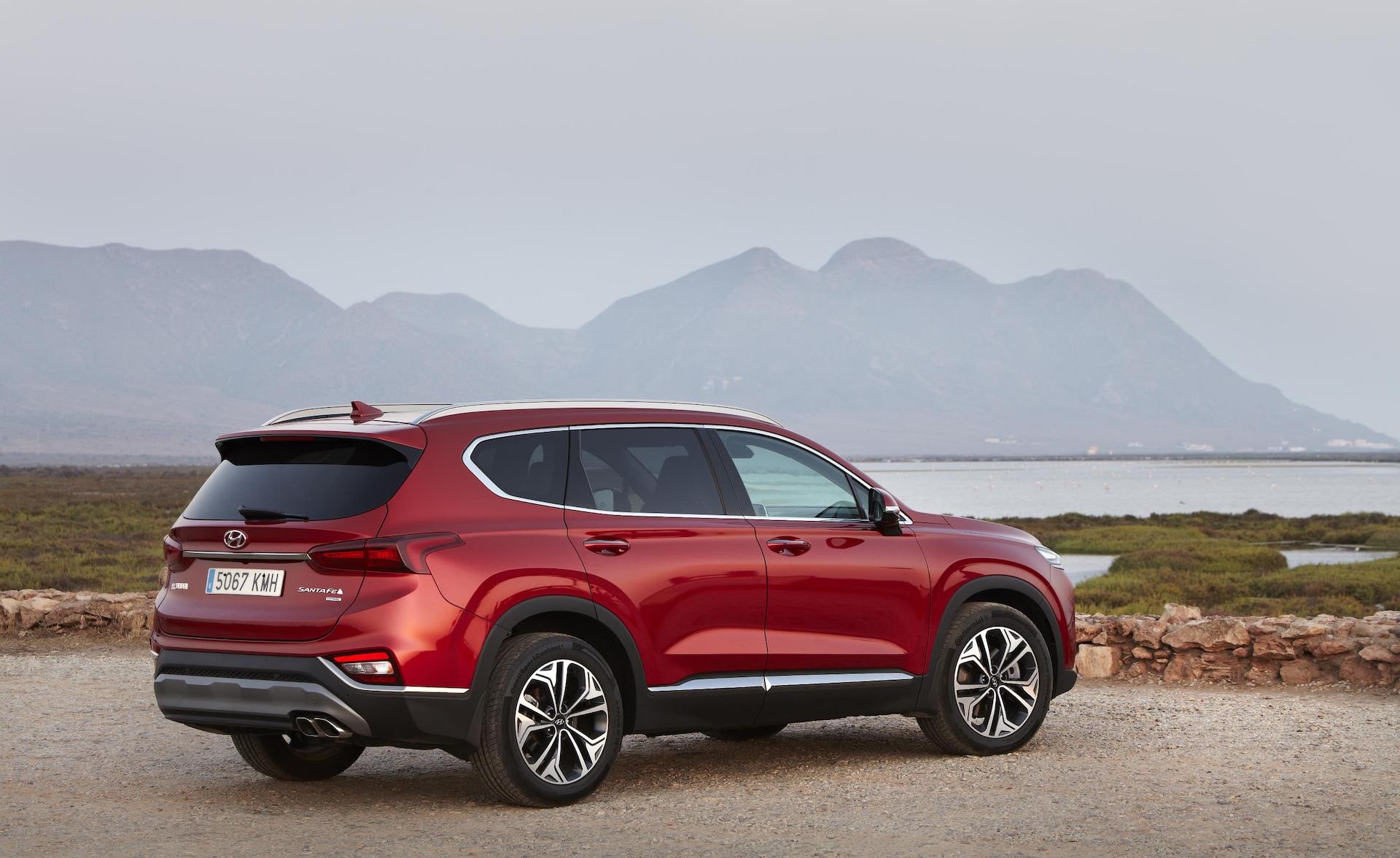
Hyundai Santa Fe Hybrid 1.6 T-GDi HEV 4×4 — from €47,100
The new Santa Fe plays in another league: 7 seats as standard, 4.83 m long and a presence that places it almost in SUV-D territory. Mechanically it is a 1.6 turbo petrol with electric assistance, and here comes the nuance: with less displacement than the RAV4 and 400 extra kilos of car, on long motorway stretches the real consumption rises to 7.8–8.5 l/100 km at 120 km/h. It is not a terrible figure for a seven-seater, but do not expect any savings.
What it offers in return is long-distance comfort that none of the other two matches. Softer suspension without being soft, long wheelbase, front seats with good support over 500 km stages, and a third row genuinely usable for children up to 1.55 m. The acoustic insulation at 120 km/h is, in our view, the best of the trio: rolling noise well filtered and an engine that barely makes itself heard at cruise. If your case is journeys of more than 400 km with a large family, the Santa Fe wins on points — and on space.
| Power kW | Power CV | WLTP consumption | Label | Fuel |
|---|---|---|---|---|
| 172 kW | 235 CV | 7.2 l/100 km | ECO | Hybrid |
Kia Sorento Hybrid 1.6 T-GDi HEV Drive — from €48,400
The Santa Fe’s technical cousin, the Sorento shares engine, gearbox and platform, but changes the tuning and the approach. Firmer suspension, slightly more consistent steering, a less exuberant interior but better finished at the contact points. On the motorway, consumption is practically identical to the Hyundai (7.8–8.4 l/100 km real), with dynamic behaviour closer to a conventional SUV and less like a saloon on wheels.
The 7 seats also come as standard. When does the Sorento make more sense than the Santa Fe? When you value driving more than absolute comfort, or when the specific trim you are interested in comes better equipped from Kia for the same money. If you prefer the family-oriented approach of the Santa Fe on long trips, we have already analysed it in depth in another article.
| Power kW | Power CV | WLTP consumption | Label | Fuel |
|---|---|---|---|---|
| 169 kW | 230 CV | 6.9 l/100 km | ECO | Hybrid |
Where each one wins (without false equivalence)
- RAV4: best real consumption in mixed and city use (getting below 6 l/100 km is easy) and proven long-term reliability. But it struggles on the motorway compared with what its label suggests.
- Santa Fe: best ride comfort and best acoustic insulation at 120 km/h. Genuinely usable third row for children.
- Sorento: more consistent driving feel and, depending on the trim, better equipment-to-price ratio within the Korean pair.
Summary table and scoring
| Model | Price from | Real consumption 120 km/h | Boot | Seats | Long-trip comfort | Motorway consumption | Overall score |
|---|---|---|---|---|---|---|---|
| Toyota RAV4 Hybrid AWD | €42,900 | 7.0–7.5 l | 580 l | 5 | 7/10 | 7.5/10 | 8.0/10 |
| Hyundai Santa Fe Hybrid 4×4 | €47,100 | 7.8–8.5 l | 628 l (5 seats) | 7 | 9/10 | 6.5/10 | 8.3/10 |
| Kia Sorento Hybrid | €48,400 | 7.8–8.4 l | 608 l (5 seats) | 7 | 8/10 | 6.5/10 | 8.1/10 |
Verdict by use case
- Mixed use with lots of city driving and a family of 4: Toyota RAV4 Hybrid. It saves fuel where you need it and you will not regret it at 150,000 km.
- Many long trips with a large family (5+): Hyundai Santa Fe Hybrid. Comfort and insulation that make the difference from the third hour of motorway driving onwards. The 10% premium over the RAV4 is justified if the 7 seats and comfort are a real priority.
- Price-performance ratio with 7 seats and a dynamic streak: Kia Sorento Hybrid. Almost the same as the Santa Fe on the outside, with a slightly more down-to-earth tuning — choosing it or not depends on the specific trim you look at in each brand.
If your pattern is under 15,000 km/year and mostly in the city, even a family compact SUV PHEV with real plug-in use may be more interesting than any of these three. But if you have no charging point, the full hybrid remains the sensible answer.
Frequently asked questions
Which of these three hybrid SUVs uses the least fuel on the motorway at 120 km/h?
The Toyota RAV4 Hybrid, with 7.0–7.5 l/100 km real, compared with the 7.8–8.5 l/100 km of the Santa Fe and Sorento. The RAV4 weighs around 300–400 kg less and has a powertrain more optimised for sustained cruising.
Is it worth paying €5,000 more for the Santa Fe over the RAV4?
Only if you will use the third row regularly or often make journeys of more than 400 km. For a family of 4 with mixed use, the RAV4 is more car for the money.
Are these hybrids eligible for the Plan Auto+?
The Plan Auto+ focuses mainly on electric and plug-in vehicles. Full hybrids usually fall outside it or qualify for very limited aid. Check the official website for the call in force in your region.
What real consumption should I expect in the city with the RAV4 Hybrid?
Between 5.2 and 5.8 l/100 km on urban routes, dropping even below 5 l/100 km in pure traffic thanks to the high share of electric-mode running. This is where this system truly shines.
