

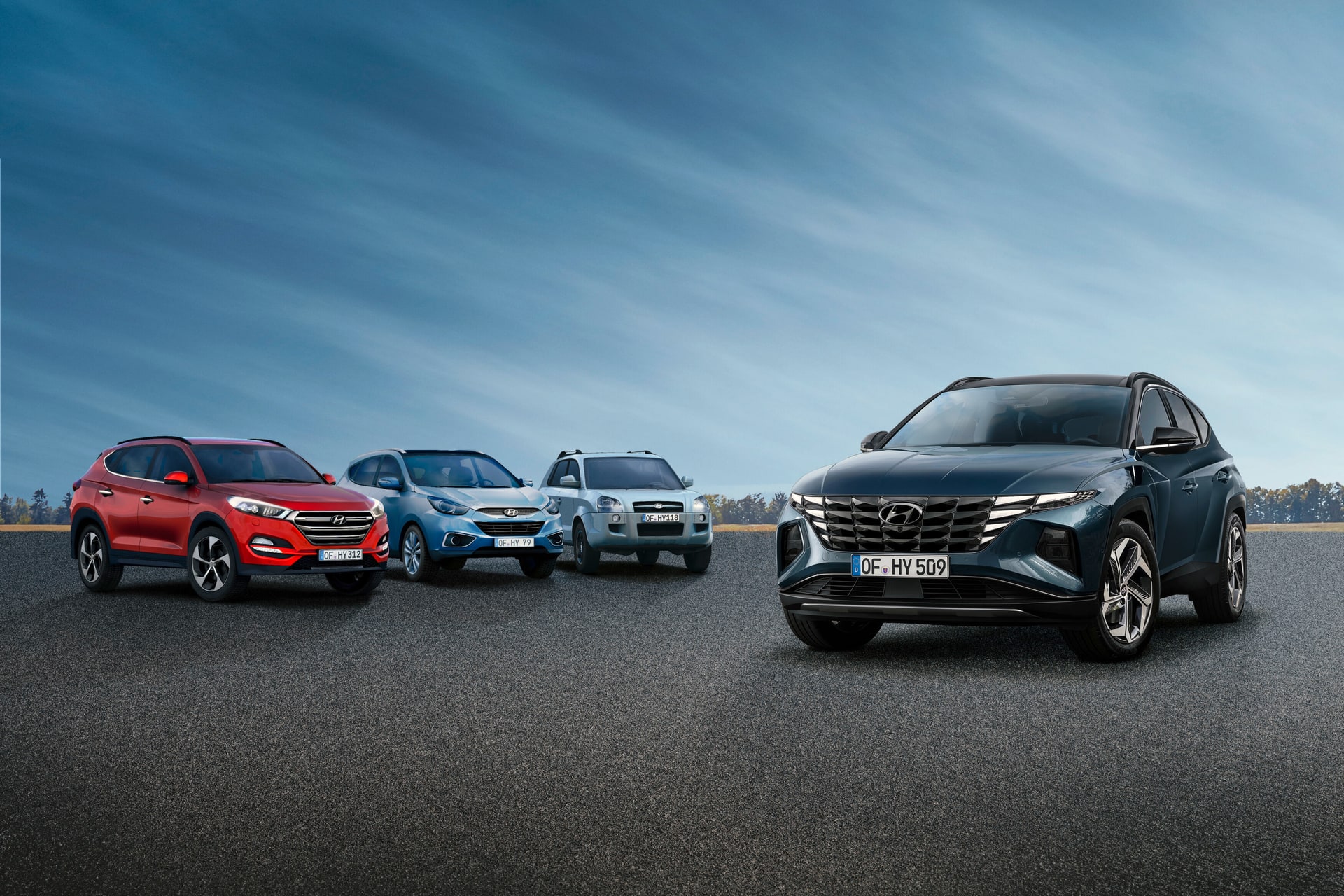
The Hyundai Tucson PHEV has been on the Spanish market for a while, but the question we always get in the newsroom is the same: does it work as a car for a family of four doing 20,000 km a year, mixing city errands with the odd long trip, and wanting the CERO label without paying what a German premium costs? That is the yardstick we use for this review, not the manufacturer’s spreadsheet.
Many models compete in the SUV-C PHEV segment, but this analysis focuses on the Tucson and its three most direct rivals by volume and price: the Kia Sportage PHEV (its Korean twin), the Cupra Formentor e-Hybrid (the dynamic approach of the VW Group) and the Ford Kuga PHEV (the pragmatic best-seller). From the earlier list of candidates we have ruled out alternatives from BYD and Nissan: for this ranking we did not look for the brands with the most media pull, but for the models that in our view best meet the criteria of useful electric range, on-board technology, comfort, safety and value for money within the segment. The Koreans and the European group fitted that template better.
Prior notice: all prices quoted are the manufacturer’s recommended RRP, without dealer discounts, campaigns or Plan Auto+ aid. Treat them as indicative.
Hyundai Tucson PHEV — from ≈43,600 €
The version we put on the table is the PHEV 1.6 TGDi 288 Klass 5p S/S Aut., the entry point to the plug-in range. It combines a 1.6 turbo petrol engine with an electric motor powered by a 14 kWh battery, for a total of 290 CV and all-wheel drive. The homologated electric range is around 70 km, which on paper is enough for a daily “home-work-school” run to be made without starting the combustion engine — provided you have a wallbox, of course.
| Power kW | Power CV | Top speed | Electric range | Consumption | Battery | CO₂ | Label | Fuel |
|---|---|---|---|---|---|---|---|---|
| ≈210 kW | ≈290 CV | ≈190 km/h | ≈70 km | ≈6 l/100 | ≈14 kWh | ≈60 g/km | CERO | PHEV petrol |
What works
In our view, the Tucson PHEV is one of the most coherent plug-ins in the segment as a sole family car. The battery sits under the floor, so the boot is not eaten into as in some European rivals; the rear cabin keeps real space for two adults and three children with their child seats; and the CERO label opens the doors to Madrid Central, Barcelona’s ZBE and regulated car parks without any argument. The six-speed automatic gearbox is not a dual-clutch and it shows: less fuss in town, smoother transitions between electric and combustion.
What doesn’t quite convince
With the battery depleted and on the motorway, real consumption easily strays from the 7 l/100 that the official cycle gives — we have seen 7.5–8 l/100 at a sustained 120 km/h. If the user rarely plugs in, they are paying the PHEV premium to haul dead weight. The WLTP range of a PHEV is almost never achieved as stated, but the Tucson holds up reasonably well if you drive with sense and don’t obsess over Sport mode.
Kia Sportage PHEV — from ≈42,000 € indicative
Same technical skeleton (Hyundai group), same 1.6 TGDi plug-in unit with around 265 CV combined in its most common version, battery of similar capacity and electric range of the same order of magnitude. Real differences: a more angular exterior design, an interior with Kia’s characteristic curved dual screen, and a slightly different base equipment offering.
Better than the Tucson in: interior design that is more resolved in our view, with the integrated panoramic screen giving a sense of a more expensive car. A somewhat lower driving position, for anyone coming from a saloon.
Worse than the Tucson in: the Hyundai after-sales network is slightly denser in Spain, and the Tucson offers entry trims with a little more equipment for the same money depending on configuration.
Cupra Formentor e-Hybrid — from ≈44,000 € indicative
Here we change philosophy. The Formentor e-Hybrid fits the 1.4 TSI with an electric motor from the VW group, in a variant of around 204 CV and another of 272 CV. Similar homologated electric range, but the approach is clearly more dynamic: firmer suspension, front-wheel drive (not all-wheel), DSG dual-clutch gearbox.
Better than the Tucson in: response in corners, steering feel, a sporting character the Korean does not pursue. Interior with a better perceived quality in the upper trims.
Worse than the Tucson in: rear habitability and boot space are clearly inferior — the Formentor is more coupé-SUV than family SUV. For a family of four with child seats and a pram, it is not in the same practical league.
Ford Kuga PHEV — from ≈41,500 € indicative
The Kuga PHEV fits a 2.5 Duratec Atkinson with an electric motor for around 243 CV combined and front-wheel drive. Electric range also in the 60–70 km homologated ballpark.
Better than the Tucson in: motorway driving feel is quite well resolved, and combustion consumption once the battery is depleted is a little more contained in some tests thanks to the Atkinson base.
Worse than the Tucson in: the interior and materials feel a step below, and front-wheel drive only limits versatility on snowy terrain or difficult ramps.
Summary table and scoring
| Model | CV | Electric range | Drive | Price from | Family score /10 |
|---|---|---|---|---|---|
| Hyundai Tucson PHEV | ≈290 | ≈70 km | All-wheel | ≈43,600 € | 8.7 |
| Kia Sportage PHEV | ≈265 | ≈65 km | All-wheel | ≈42,000 € | 8.5 |
| Cupra Formentor e-Hybrid | ≈204-272 | ≈60 km | Front-wheel | ≈44,000 € | 7.4 |
| Ford Kuga PHEV | ≈243 | ≈65 km | Front-wheel | ≈41,500 € | 7.8 |
Verdict by use case
- Family looking for a sole car with mixed city + trip use: Hyundai Tucson PHEV. It is the finest balance between real electric range, useful boot, all-wheel drive and a 5-year warranty with no mileage limit.
- Same profile, but with extra price sensitivity: Kia Sportage PHEV. Indicative saving of 1,500–2,000 € with equivalent mechanics and a 7-year warranty.
- Driver who values dynamics over practicality: Cupra Formentor e-Hybrid. Assuming the family and the child seats also fit.
- Pragmatic buyer who does not need 4×4: Ford Kuga PHEV, especially if the final price after dealer discount drops below 40,000 €.
If you are still wondering how many kilometres a day you will really cover in electric mode before deciding, it is worth reading this guide on how to choose a SUV-C PHEV according to daily plug-in use before signing anything.
FAQ
Is the Hyundai Tucson PHEV worth it as a sole family car in 2026?
Yes, provided the user has access to a home plug and does less than 70 km a day on average. In that scenario the cost per kilometre drops sharply and the CERO label makes everyday urban life easier. Without a wallbox, the premium over a non-plug-in hybrid does not pay off.
What is the real consumption of the Tucson PHEV with the battery depleted?
In mixed use it stays between 6.5 and 7.5 l/100 km; on the motorway at a sustained 120 km/h it can rise to 8 l/100. It remains below the diesel equivalent, but far from the official 6 l/100.
What is the real difference between the Tucson PHEV and the Kia Sportage PHEV?
Mechanics and platform are practically identical. What changes is the exterior and interior design, the distribution of equipment by trim and the warranty policy (5 years Hyundai vs 7 years Kia). The decision usually comes down to aesthetics or the final price after discount.
Is the Tucson PHEV eligible for Plan Auto+ aid?
As a PHEV with electric range above 40 km and a CERO label it falls within the plan’s criteria, although the specific amounts and conditions should be checked directly on the plan’s official website, as they are updated frequently.
