

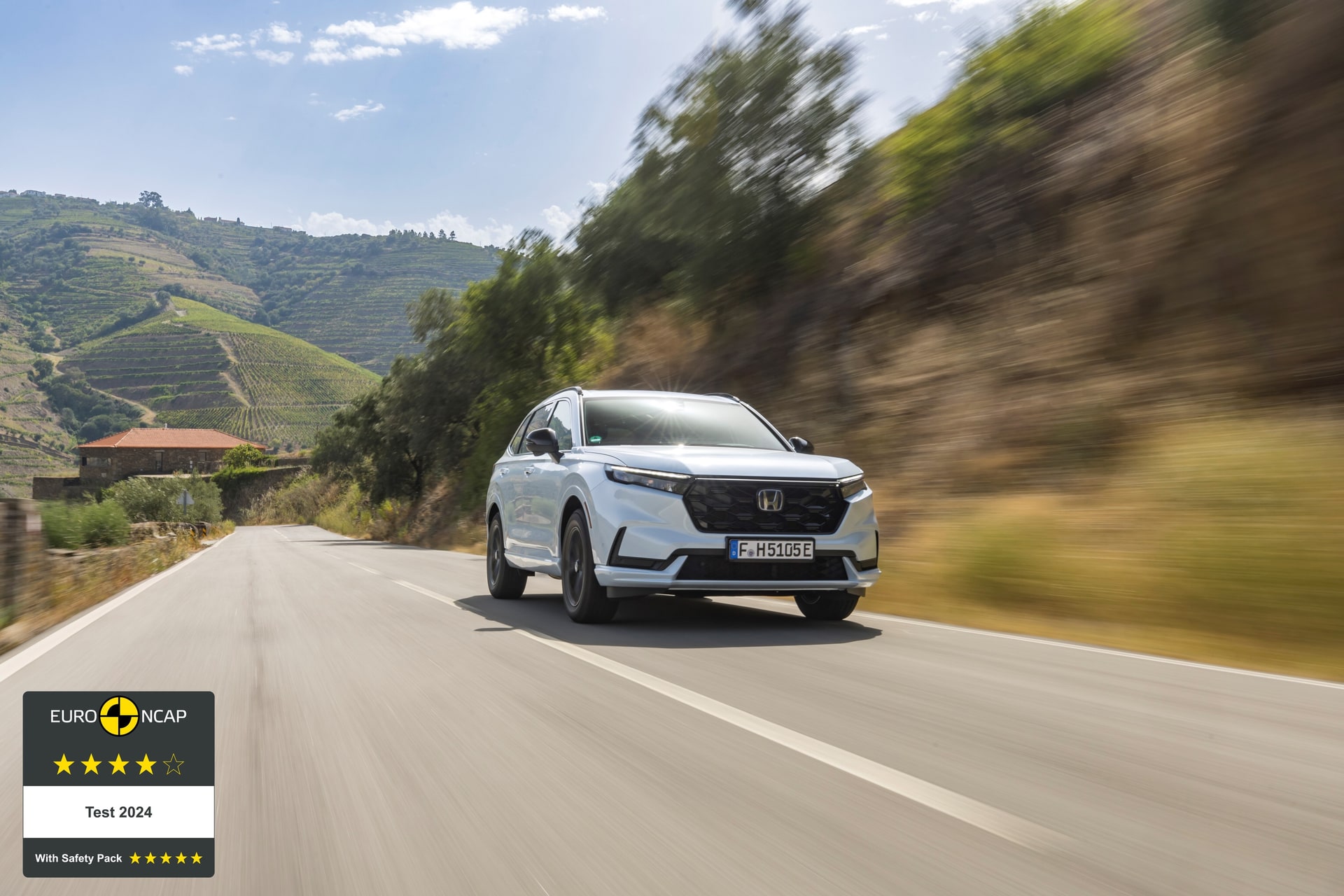
The Honda CR-V has quietly reinvented itself. While half of Europe debates whether the future is 100% electric or PHEV, Honda keeps refining its e:HEV system and fitting it into a compact SUV that is nearly the size of a D-segment model. The question is simple: is it worth paying from around €51,500 for a non-plug-in hybrid when the Toyota RAV4 Hybrid and the Hyundai Tucson Hybrid cost clearly less?
Let’s get to the point, because this car holds its own in some areas and falls short in others.
What the Honda CR-V Hybrid offers in 2026
The version sold in Spain is the Hybrid 2.0 i-MMD 184 Elegance CVT, with 184 CV combined (around 140 kW), a homologated consumption of roughly 6 l/100 km and an ECO label. Front-wheel drive at entry level, with AWD available on higher trims. It is a large compact SUV: 4.70 m long, which brings it close to D-segment territory and explains why it costs what it does.
| Power kW | Power CV | Top speed | Consumption | Label | Fuel |
|---|---|---|---|---|---|
| 140 kW | 184 CV | 190 km/h | 6 l/100 km | ECO | Petrol/electric hybrid |
How the e:HEV system works on long journeys
This is the key to the CR-V. The i-MMD is not a conventional series-parallel hybrid: for most of the time the petrol engine acts as a generator and the electric motor drives the wheels. Only at sustained motorway speeds does the combustion engine couple directly to the wheels, because that is when it is most efficient.
What does this mean in practice? In town and on winding roads the CR-V behaves almost like an electric car: smooth, linear, without the drone of a fake CVT. Honda has managed to tame the “four-stroke motorbike accelerating without moving forward” effect that plagued Toyota hybrids a few years ago. On the motorway, however, you do notice the 2.0 naturally aspirated engine revving up during overtaking. It is not abrupt, but it is not silent either.
Real-world motorway consumption: the acid test
The homologated figure of around 6 l/100 km is believable in mixed use. On the motorway at a sustained 120 km/h, reality sits around 6.5-7 l/100 km with four occupants and luggage, depending on the terrain profile. It is not the outright champion of the segment: the Toyota RAV4 Hybrid edges it by a tenth or two over very long cycles, but it is within reach.
The weak point, as with almost all large non-plug-in hybrids, comes when you climb to German autobahn speeds or load the car to the roof. Consumption then easily rises above 8. This is not a flaw of the CR-V; it is physics.
Interior space and boot: where the CR-V shines
In our view, this is the car’s main argument. The rear bench is among the best in the segment: a reclining backrest with several positions, legroom at D-segment SUV level, and easy access for fitting child seats. The boot holds around 580 litres in the hybrid version, less than the Tucson but sufficient for a family of four on a two-week trip.
The interior feels a step above the previous CR-V, with materials that no longer look out of place next to a Tucson, although they do not reach the assembly quality of a Mazda CX-5 or a Peugeot 3008. The ergonomics are very Honda: physical buttons for climate control, clear steering-wheel controls and a legible digital instrument cluster. For travelling, it is appreciated.
Honda CR-V Hybrid vs its direct rivals (from around €51,500)
The two obvious rivals in non-plug-in hybrid form are the Toyota RAV4 Hybrid and the Hyundai Tucson Hybrid. Same segment, same family vocation, different philosophies. For context, we have already analysed that duel in our head-to-head between the RAV4 and Tucson hybrids.
Toyota RAV4 Hybrid (from approx. €41,000)
The Toyota is the historic benchmark for hybrids. Cheaper to start with, similar or slightly better consumption, and a after-sales network no rival quite matches. It loses to the CR-V on drivetrain refinement at low revs and on perceived interior quality, which feels more utilitarian.
Hyundai Tucson Hybrid (from approx. €36,000)
The Korean attacks on design, equipment and price. €15,000 less than the Honda in comparable specifications, a difference that weighs heavily. It loses on smoothness of the hybrid system (its setup is more conventional, with a 6-speed automatic gearbox that sometimes shows) and on overall composure on long motorway runs.
Comparative summary table
| Model | Power | WLTP consumption | Boot | Price from | Overall score |
|---|---|---|---|---|---|
| Honda CR-V Hybrid 2.0 i-MMD Elegance | 184 CV | ≈6 l/100 | ≈580 l | ≈€51,500 | 8.2/10 |
| Toyota RAV4 Hybrid | 218 CV | ≈5.8 l/100 | ≈580 l | ≈€41,000 | 8.5/10 |
| Hyundai Tucson Hybrid | 215 CV | ≈6.3 l/100 | ≈620 l | ≈€36,000 | 8.0/10 |
Manufacturer’s recommended retail prices, without dealer discounts, promotions or aid schemes such as Plan Auto+. Score weighting consumption, interior space, long-journey comfort, equipment and price.
Verdict: who is the CR-V Hybrid for?
The CR-V plays in an unusual league. It is larger than a typical compact SUV, better finished than a Tucson, more refined than a RAV4, and more expensive than both. The price gap with the Hyundai clearly exceeds 15%, so it is not a minor detail.
- For family long-distance travel with priority on comfort and drivetrain refinement: the Honda CR-V Hybrid wins. It is the quietest in urban and suburban driving, has the best rear bench and gives the feel of a higher-category car.
- For those seeking the best consumption and the most reliable after-sales service: Toyota RAV4 Hybrid. €10,000 less and proven reliability that gives peace of mind to those who rack up the miles.
- For the best price-performance ratio: Hyundai Tucson Hybrid. If budget is the priority, it is unbeatable and sacrifices nothing essential.
The CR-V is not for those who compare price lists, but for those who have already decided they want a large, well-built hybrid designed for travelling, and are willing to pay the Japanese premium.
Frequently asked questions
How much does the Honda CR-V Hybrid really consume on the motorway at 120 km/h?
Between 6.5 and 7 l/100 km with family and luggage on board on long journeys at the Spanish legal speed limit. In mixed use it easily drops to 5.5-6.
Is the CR-V Hybrid worth it compared with the CR-V Plug-in?
It depends on how you use the plug. If you rarely charge, the Hybrid makes more sense: it costs less, weighs less and you do not carry a battery you will not use. If you have a wallbox and drive fewer than 60 km a day, the PHEV pays off in tax terms.
Does the Honda CR-V Hybrid have all-wheel drive?
Yes, but only on trims above the entry-level Elegance. The Elegance version starting at around €51,500 is front-wheel drive.
What warranty does Honda offer on the CR-V Hybrid?
Honda Spain offers a 3-year general warranty with no mileage limit, extendable, and specific coverage for the hybrid system components. It is advisable to check the exact current coverage at the dealership.
