

The premium compact SUV is probably the most competitive segment in the Spanish market. And within it, the Lexus NX plays a different game from its German rivals: a pure full hybrid, no cable, no charging anxiety and a running cost proposition that, in our view, remains one of the most coherent of 2026. But does it hold up against a BMW X3 PHEV or a plug-in Audi Q5? Let’s look at it with all the cards on the table.
Why the Lexus NX deserves an honest review in 2026
Because it’s unusual. In a segment where every German premium brand has moved to the PHEV with 20-30 km of real useful electric range, Lexus sticks with the classic full hybrid. It also offers the plug-in 450h+, true, but most sales go to the 350h. And that’s where the conversation gets interesting: does a hybrid without a plug still make sense in a premium car costing 55,000 €?
The short answer: yes, for many drivers. The longer answer requires putting it up against specific rivals.
Lexus NX 350h Premium+ — from approximately 54,100 €
The version we tested is the Lexus NX 350h 2.5 243 Premium+ CVT, the trim that we believe best balances price and equipment within the range. Self-charging hybrid system with a 2.5 naturally aspirated Atkinson-cycle engine, electric assist motor and e-CVT transmission. No plugging in. No searching for a charger on a journey.
| Power kW | Power CV | Top speed | Consumption | Label | Fuel |
|---|---|---|---|---|---|
| 180 kW | 243 CV | 200 km/h | 5.5 l/100 km | ECO | Hybrid |
What really sets it apart isn’t on the spec sheet, but in everyday use. The NX 350h returns real-world consumption of between 6 and 7 l/100 km in mixed driving, a figure that an X3 or Q5 PHEV only achieves if it is plugged in every day. If it isn’t—and here’s the catch—they easily go above 8 l/100 km, carrying the extra weight of the battery.
And then there’s the Lexus Relax warranty: up to 10 years or 185,000 km, renewed with each service carried out at an official dealer network. Nobody in the premium segment offers anything similar. Toyota has been selling hybrids for two decades without serious transmission failures, and the NX inherits that peace of mind.
The drawbacks? The e-CVT is still what it is: when you accelerate hard, the engine revs up and stays there while the car speeds up. Drivers coming from a German turbo will find this jarring. And the infotainment improved with the latest generation, but it doesn’t match a recent iDrive.
BMW X3 xDrive30e — from approximately 72,000 €
The classic rival. A PHEV with around 50 km of WLTP electric range, all-wheel drive and handling that remains a benchmark in the segment. The xDrive30e combines a 2.0 petrol engine with an electric motor, delivering around 292 CV combined.
On long journeys with a depleted battery, it consumes around 7.5-8 l/100 km in real use—more than the Lexus. But if your life is 40 km a day and you have a home wallbox, you can go weeks without using petrol. That’s its territory.
Where the X3 wins without question: driving feel, infotainment quality and performance. Where it loses: starting price (more than 30% above the NX, well beyond the 15% threshold that makes a real difference), post-warranty maintenance costs and the complexity of maintaining two propulsion systems.
If you’re interested in this premium plug-in territory, we’ve already broken down the BMW X3 xDrive30e versus Volvo XC60 Recharge in more detail.
Audi Q5 TFSI e — from approximately 68,000 €
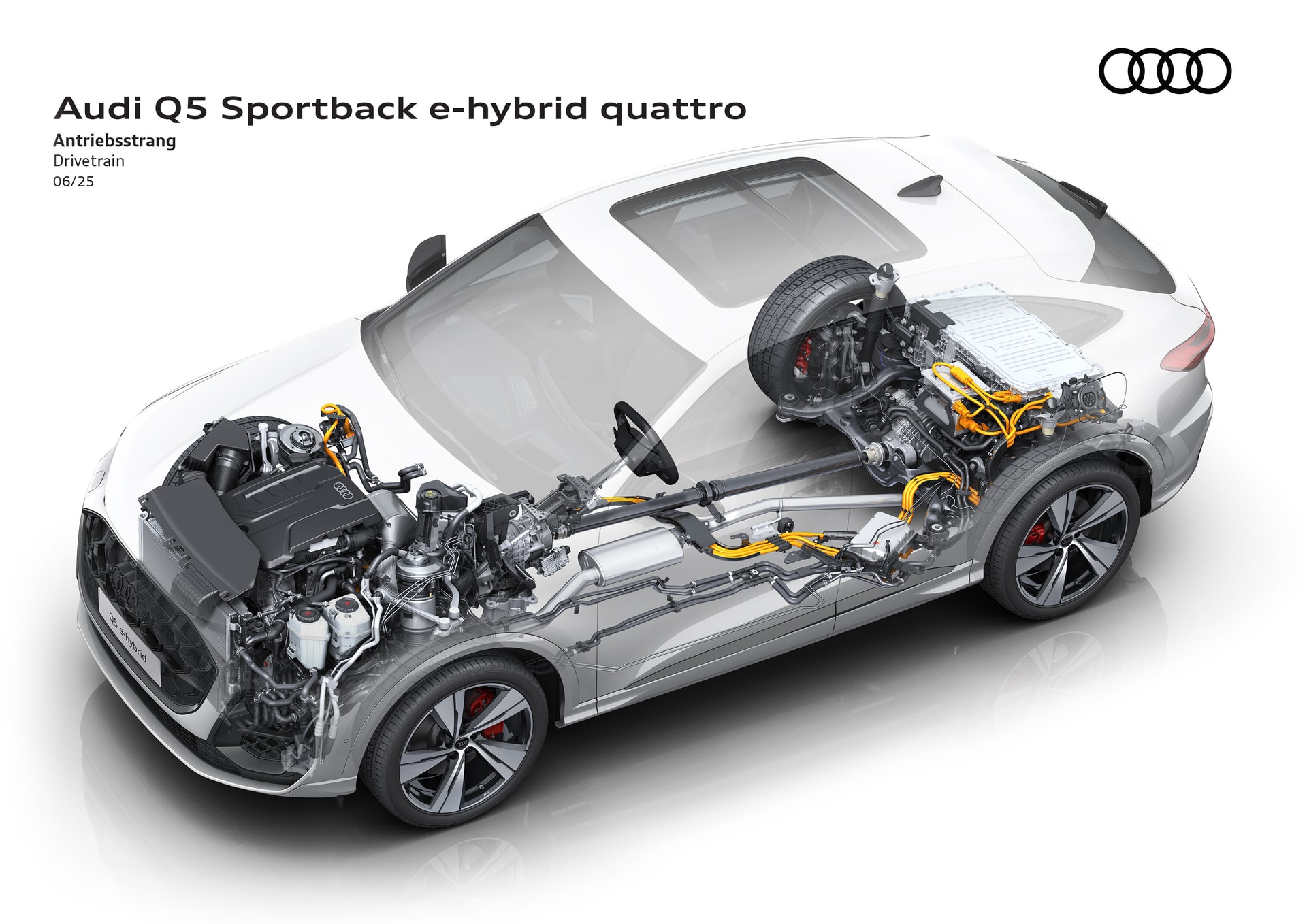
Audi’s offering follows the X3’s lead: a PHEV, 2.0 TFSI with electric assistance, similar electric range and probably the best interior finish of the trio. The Q5 is the most comfortable on the move and the one that lets in the least road noise.
Downsides: the same problem as the BMW. If you don’t plug in daily, you’re hauling 300-400 kg of extra battery and electric motor for nothing. And Audi maintenance costs at an official dealer remain what everyone knows them to be.
Comparison table and ranking
| Model | Power | Real consumption | Label | Price from | Warranty | Overall score |
|---|---|---|---|---|---|---|
| Lexus NX 350h Premium+ | 243 CV | ≈6.5 l/100 | ECO | 54,100 € | Up to 10 years (Relax) | 8.7 |
| BMW X3 xDrive30e | 292 CV | ≈7.5 l/100 unplugged | ZERO | 72,000 € | 2 years | 8.2 |
| Audi Q5 TFSI e | 299 CV | ≈7.8 l/100 unplugged | ZERO | 68,000 € | 2 years | 8.0 |
Manufacturer’s recommended retail prices (RRP), excluding dealer discounts, promotions or Plan Auto+ aid in force. Check the official website for updated amounts.
Where each one wins, without false equivalence
- Lexus NX 350h: winner on real running costs, proven reliability and warranty. Full stop.
- BMW X3 xDrive30e: winner on handling, performance and the ZERO label (access to Madrid Central and Barcelona ZBE without time restrictions).
- Audi Q5 TFSI e: winner on perceived interior quality and motorway ride comfort.
Verdict
For those who can’t charge at home or do a lot of mixed mileage: Lexus NX 350h, without hesitation. It uses less, costs less and breaks down less. The price gap with the German models exceeds 25%, which is argument enough on its own.
For those with a wallbox who drive 40 km a day in a large city with a ZBE: BMW X3 xDrive30e. The ZERO label and real electric range change the equation.
For those who prioritise pure premium comfort and don’t look at the maintenance bill: Audi Q5 TFSI e.
Our general recommendation for 2026 for the rational buyer: the Lexus. It’s less exciting than an X3, less refined than a Q5, but it wins on what really matters over a 5-year horizon.
Frequently asked questions
Does the Lexus NX 350h need to be plugged in?
No. It is a self-charging hybrid: the battery charges itself through the combustion engine and regenerative braking. It has no external charging port.
What is the real consumption of the Lexus NX 350h on the motorway?
Around 6.5-7.2 l/100 km at a constant 120 km/h. In town and mixed driving it easily drops to 5.8-6.3 l/100 km.
How long does the Lexus Relax warranty last?
Up to 10 years or 185,000 km, provided maintenance is carried out at an official Lexus network. It is renewed annually with each service.
Is the NX 350h worth it compared with the plug-in 450h+?
If you’re not going to plug in almost every day, yes. The 450h+ costs considerably more and its real advantage only appears with disciplined use of the cable.
