

Choosing an electric SUV in 2026 is not about picking the highest WLTP range figure and buying. It is about answering two honest questions: how many trips of more than 300 km do you make each year? And how much real time do you have to plug it in during the week? Those two variables decide almost everything else.
The two variables that matter: long trips per year and time available to charge
The typical mistake is deciding from the brochure. An SUV with 600 km of official range sounds unbeatable, but if you have a charger at home and make two long trips a year, you are paying for a large battery that you barely use. The reverse is also true: if you only charge on public chargers and make ten long trips, a car with low fast-charging power is going to torture you.
In our view, crossing the two variables gives four very different profiles. And each one has a clear winner.
Profile 1: few long trips (fewer than 5 a year) and a charger at home
Here you don’t need 600 km of range. You need urban efficiency, convenient home charging and a contained price. The Renault Scenic E-Tech and the Peugeot e-3008 fit the bill perfectly.
Renault Scenic E-Tech 220 CV Long Range — from €41,000
With 87 kWh usable and up to 625 km WLTP, the Scenic is one of the most efficient electric cars in the C segment in mixed use. On the motorway at 120 km/h it drops to around 450 km real-world — reasonable, not exceptional. The interesting part: its urban consumption is around 14 kWh/100 km, which is very competitive. With a 7.4 kW home charger you have it full from night to morning without thinking about it.
| Power | WLTP range | WLTP consumption | Label | Fuel |
|---|---|---|---|---|
| 160 kW / 220 CV | 625 km | 16.3 kWh/100 km | 0 emissions | Electric |
Peugeot e-3008 210 CV — from €44,000
More expensive to start with, with 73 kWh usable and 525 km WLTP in its entry-level version. The interior features the panoramic i-Cockpit, which divides opinion: to my taste it looks better than the Scenic’s, but it doesn’t quite convince on ergonomics with the low steering wheel. Fast charging up to 160 kW — enough for the occasional long trips of this profile.
| Power | WLTP range | WLTP consumption | Label | Fuel |
|---|---|---|---|---|
| 157 kW / 210 CV | 525 km | 17.2 kWh/100 km | 0 emissions | Electric |
Profile winner: Renault Scenic E-Tech Long Range. More range for less money and better real-world consumption.
Profile 2: many long trips (10+ a year) and a charger at home
Here the criteria change completely: you need a fast-charging curve that doesn’t collapse at 50% and a real-world motorway range above 400 km. The Tesla Model Y and the Kia EV6 are the two serious candidates.
Tesla Model Y Long Range RWD — from €46,000
Supercharger. That is the answer and you know it. A dense network, plug in and forget about route planning. The Long Range RWD version claims 622 km WLTP and on the motorway at 120 it comes in at around 420 km real-world. It charges at up to 250 kW on a V3 Supercharger. The interior is still polarising — minimalism taken to the extreme — but it works.
| WLTP range | WLTP consumption | Label | Fuel |
|---|---|---|---|
| 622 km | 14.9 kWh/100 km | 0 emissions | Electric |
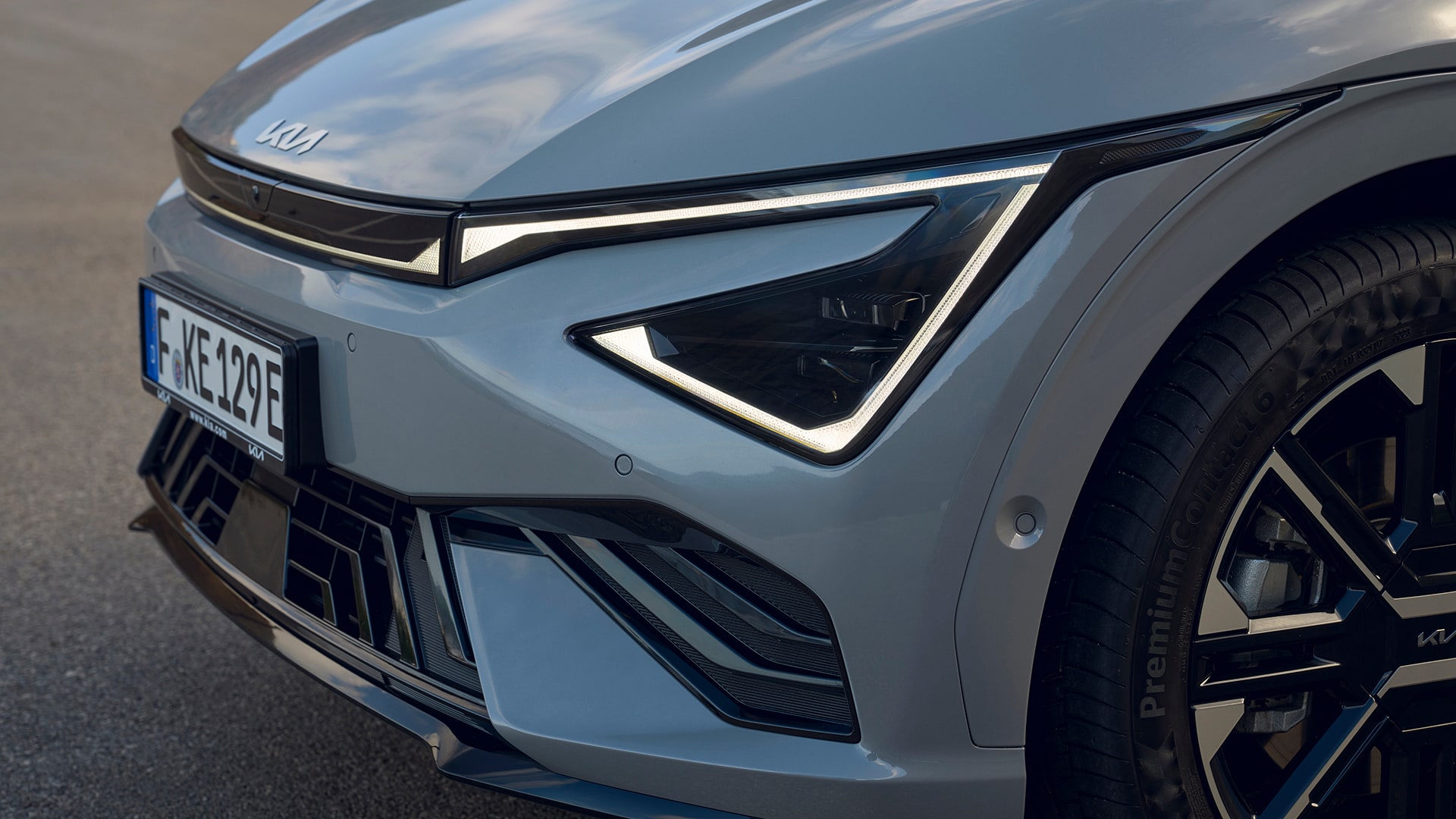
Kia EV6 Long Range RWD — from €48,000
800 V architecture, charging up to 240 kW and a 10-80% in under 18 minutes when the charger keeps up. That is the key: the curve stays flat for longer than on almost any rival. 528 km WLTP with the 84 kWh battery. On a real long trip the EV6 is, to my taste, more relaxing than the Tesla thanks to its acoustics and suspension, although you depend on a public network that isn’t exclusive to the brand.
| Power | WLTP range | WLTP consumption | Label | Fuel |
|---|---|---|---|---|
| 168 kW / 229 CV | 528 km | 17.2 kWh/100 km | 0 emissions | Electric |
Profile winner: Tesla Model Y if you value the Supercharger network above all else; Kia EV6 if you prefer ride comfort and 800 V architecture. The price difference is under 5%.
Profile 3: few long trips and NO charger at home
The most awkward scenario for an electric car. You depend on weekly public charging. Here AC charging power matters as much as DC, because if you charge at a shopping-centre wallbox at 11 or 22 kW, every extra kW saves you half an hour of your time.
Volkswagen ID.4 Pro — from €44,000
77 kWh usable, 544 km WLTP and three-phase AC charging up to 11 kW as standard. Nothing exceptional, but it does the job without scaring you. Decent interior, software better than two years ago but not at the level of the Koreans or Tesla. As we already analysed with the ID.3, the touch-based ergonomics are still debatable.
| Power | WLTP range | WLTP consumption | Label | Fuel |
|---|---|---|---|---|
| 210 kW / 286 CV | 544 km | 16.2 kWh/100 km | 0 emissions | Electric |
Hyundai Ioniq 5 77 kWh RWD — from €46,000
The best option if you charge on public chargers: 800 V architecture here too, 507 km WLTP and a charging speed that gets you out of trouble on any decent network. A design that keeps ageing well.
| Power | WLTP range | WLTP consumption | Label | Fuel |
|---|---|---|---|---|
| 168 kW / 229 CV | 507 km | 17.9 kWh/100 km | 0 emissions | Electric |
Profile winner: Hyundai Ioniq 5. With weekly public charging, 800 V makes the difference.
Profile 4: many long trips and no charger at home — is it viable?
Honestly, in this profile the electric car is still questionable. If you can’t avoid it, you need the brand’s own network and the best possible charging curve. A Tesla Model Y or a premium model with an integrated Ionity network such as the BMW iX3 or the Volvo EX40.
BMW iX3 (new, 2026) — from €68,000
New Neue Klasse platform, 800 V architecture and a target range above 700 km WLTP. Expensive, but it solves the profile. Long battery warranty and the Ionity network with preferential rates for BMW customers.
Volvo EX40 Twin Motor — from €56,000
82 kWh usable, up to 573 km WLTP and fast charging up to 200 kW. Sober interior, good acoustic comfort. It is not the most efficient, but the charging services package from the Geely group helps.
| Power | WLTP range | WLTP consumption | Label | Fuel |
|---|---|---|---|---|
| 300 kW / 408 CV | 573 km | 17.4 kWh/100 km | 0 emissions | Electric |
Profile winner: Tesla Model Y Long Range, thanks to the Supercharger network. If you want premium, the iX3.
Summary table with score by profile
| Model | Starting price | WLTP range | Max. DC charging | Overall score |
|---|---|---|---|---|
| Tesla Model Y LR RWD | €46,000 | 622 km | 250 kW | 9/10 |
| Kia EV6 Long Range | €48,000 | 528 km | 240 kW | 8.5/10 |
| Hyundai Ioniq 5 77 kWh | €46,000 | 507 km | 230 kW | 8.5/10 |
| Renault Scenic E-Tech LR | €41,000 | 625 km | 150 kW | 8/10 |
| Peugeot e-3008 | €44,000 | 525 km | 160 kW | 7.5/10 |
| Volkswagen ID.4 Pro | €44,000 | 544 km | 175 kW | 7.5/10 |
| Volvo EX40 Twin | €56,000 | 573 km | 200 kW | 7.5/10 |
| BMW iX3 (2026) | €68,000 | 700+ km target | 350+ kW target | 9/10 |
Verdict by use case
- Few long trips + charger at home: Renault Scenic E-Tech Long Range. The best price-to-range ratio on the market.
- Many long trips + charger at home: Tesla Model Y Long Range RWD for the network; Kia EV6 for comfort.
- Few long trips + no charger at home: Hyundai Ioniq 5. 800 V is gold on public charging.
- Many long trips + no charger at home: Tesla Model Y. If the budget stretches to €68,000, the new BMW iX3.
- Overall value for money: Renault Scenic E-Tech, with a gap of more than 15% over the premium models.
Remember that the Plan Auto+ can lower the retail price of several of these models; check the current amount on the official website before closing the deal.
FAQ
What real-world range do I need in an electric SUV if I make 5 long trips a year?
400 km real-world on the motorway at 120 km/h is enough. That is equivalent to around 500-550 km WLTP. Models such as the Scenic E-Tech Long Range or the VW ID.4 Pro manage it without strain.
Can I have an electric SUV without a charger at home?
Yes, but prioritise models with 800 V architecture (Hyundai Ioniq 5, Kia EV6) or access to a proprietary network (Tesla Model Y). Weekly public charging is viable if the car really does charge fast; if not, it becomes a constant mental burden.
Is it worth paying for a premium electric SUV if I make a lot of long trips?
It is worth it if you value acoustic comfort and a sustained charging curve. The new BMW iX3 or the Volvo EX40 Twin handle the long trip better than the mainstream models, but the extra cost compared with a Tesla Model Y is hard to justify on range alone.
Is the WLTP range achieved on the motorway?
No. As a rule, subtract 25-30% from the WLTP figure to estimate real-world range at 120 km/h with the climate control on. An SUV with 550 km WLTP comes in at around 390-410 km real-world in those conditions.

1 Comment
Pingback: Los 5 SUV-C eléctricos con mejor autonomía real en autovía por menos de 55.000€ en 2026 – Comparativa de Coches