

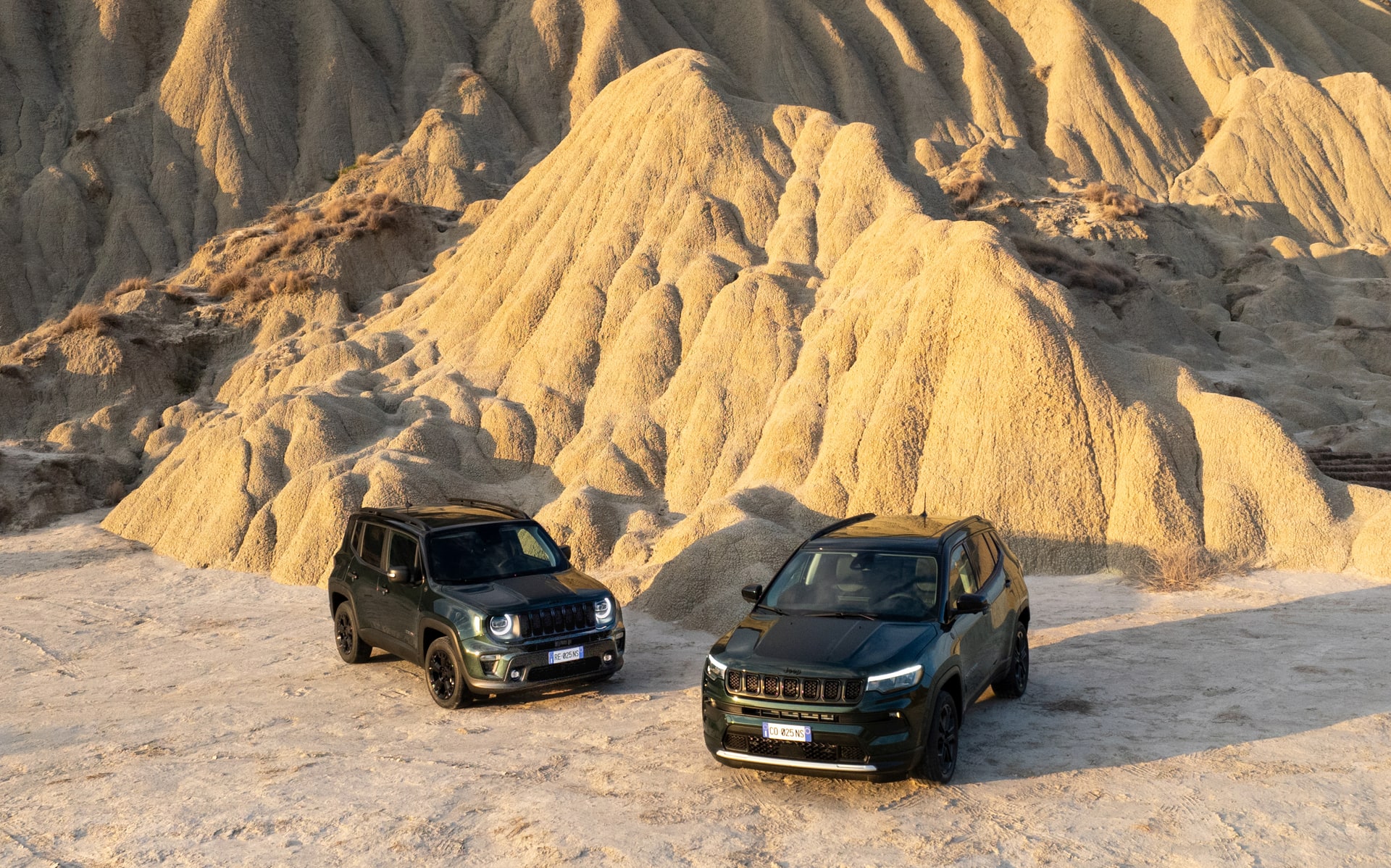
The Jeep Compass 4xe has been on the Spanish market for several years and remains Stellantis’ entry point into the plug-in hybrid C-SUV segment, with four-wheel drive and a CERO label. The question that matters to the 2026 family buyer is simple: with European rivals refining their PHEVs year after year, does the Compass 4xe still make sense as a car for a family that drives in the city from Monday to Friday and takes the occasional weekend trip? We are putting it up against two very sharp rivals in the same segment.
From the initial list of candidates we ruled out the BYD Seal U DM-i and the Nissan Qashqai e-Power. Not for lack of merit, but because this comparison prioritises the models that best match the mixed European family usage pattern and the overnight charging logic that defines the pure PHEV; in our view, other rivals fit that specific profile more naturally. The decision is editorial and was made from the outset.
Jeep Compass 4xe: the PHEV with brand DNA (from ≈€45,000)
The Compass 4xe combines a 1.3 turbo petrol engine with an electric motor on the rear axle, delivering a combined output of around 190 hp and all-wheel drive without a mechanical propshaft. On paper it is an elegant formula: 0-100 km/h in about 7.5 seconds, a homologated electric range of around 50 km and official consumption figures that border on the symbolic (1.5 l/100 km on the WLTP combined cycle). CERO label, a battery of approximately 11.5 kWh and declared CO₂ emissions close to 30 g/km.
In practice, those 50 electric kilometres drop to 35-40 real ones with climate control on and normal driving — something we already explained when discussing how to interpret WLTP range in a PHEV SUV. That is enough for a family with a home charger and an urban commute of under 30 km a day; it is tight for anyone who lives far from work. With the battery depleted, consumption climbs to the 7-8 l/100 km real-world range, a correct but not brilliant figure for a C-SUV.
| Power kW | Power hp | Electric range | Consumption | Label | Fuel |
|---|---|---|---|---|---|
| ≈140 kW | ≈190 hp | ≈50 km | ≈1.5 l/100 km | CERO | PHEV |
Where the Compass 4xe shines: electric all-wheel drive on the rear axle is a real advantage when the surface is in doubt (snow, gravel, a wet garage ramp), and no direct rival offers it with this logic. And the composure on the road, with that small battery, is more noble than the spec sheet suggests.
Where it falls short: the interior. Materials and ergonomics feel a step behind what the segment offers at this price today, and the boot stays at around 420 litres because of the battery — the sensitive point for a family.
Peugeot 3008 Hybrid 195: the rival from within the same group (from ≈€42,500)
A warning first: the current 3008, in its classic PHEV format, is in transition within the Peugeot range towards the new 3008 on the STLA Medium platform (which is already full-electric or light hybrid). The Hybrid 195 version that can be compared directly with the Compass 4xe corresponds to the previous generation, still in residual stock — keep this in mind before signing.
That said, the 3008 Hybrid’s approach is more of a “modern European car” than the Compass: 195 hp combined, front-wheel drive, electric range in the same 50 km homologated bracket, an i-Cockpit with a small steering wheel and a noticeably more refined interior presentation. A boot of approximately 520 litres, clearly larger than the Jeep’s.
The catch is the shared mechanics of the group: the same consumption figures with a depleted battery, the same dependence on daily charging to justify the PHEV premium, and in its case without the Compass’ all-wheel drive. For purely urban use and relaxed motorway driving, it is more than sufficient; for mountain tracks or demanding surfaces, it falls short of the Jeep.
Cupra Formentor e-Hybrid 204: the PHEV with character (from ≈€43,000)
The Formentor e-Hybrid 204 plays in a different emotional league. It shares the 1.4 TSI + electric motor setup from the Volkswagen Group with 204 combined hp, a battery of around 12.8 kWh usable and a homologated electric range of roughly 55 km. A 6-speed DSG gearbox, front-wheel drive and a clearly sportier driving feel — the manufacturer itself uses the word, and here it is not empty marketing.
As a family SUV-coupé it comes with its compromises: the boot is around 345 litres (the battery and the silhouette itself cut into space), and rear accommodation for three children with child seats is tighter than in the Compass or the 3008. In return it offers a better-finished cabin than the Jeep, faster infotainment and a dynamic composure that neither of the other two comes close to matching.
Direct comparison: summary table and score
The prices below are the manufacturer’s recommended RRP, without dealer offers, one-off campaigns or aid from the current Plan Auto+ — for the real figure, visit a dealership and check the official programme website.
| Model | Power | Electric range | Boot approx. | Traction | Price from | Score |
|---|---|---|---|---|---|---|
| Jeep Compass 4xe | ≈190 hp | ≈50 km | ≈420 l | All-wheel (electric rear axle) | ≈€45,000 | 7.3/10 |
| Peugeot 3008 Hybrid 195 | ≈195 hp | ≈50 km | ≈520 l | Front-wheel | ≈€42,500 | 7.5/10 |
| Cupra Formentor e-Hybrid 204 | ≈204 hp | ≈55 km | ≈345 l | Front-wheel | ≈€43,000 | 7.7/10 |
Real cost per kilometre with overnight charging
This is the terrain where the PHEV proves its reason for existing, and where we recommend reading our guide on the real cost per kilometre with overnight charging in a C-SUV PHEV before deciding. With a home charger and an off-peak tariff, all three land in a range of 3 to 5 cents per kilometre in electric mode. Without a charger, the argument collapses: the Compass 4xe becomes a heavy SUV of 1,850 kg hauling a dead battery, and its economic logic falls apart before that of the 3008 or the Formentor.
Verdict
- For a family with a home charger and an occasional need for all-wheel drive (a mountain second home, frequent gravel tracks, harsh winters): Jeep Compass 4xe. No direct rival offers that electric 4×4 formula with a CERO label at this price.
- For an urban family that prioritises boot space and has a tight budget: Peugeot 3008 Hybrid 195. More space, a better-finished interior and a starting price slightly lower — though it is worth confirming the real availability of this version at dealerships.
- For a single driver or a couple without children who wants a PHEV with character: Cupra Formentor e-Hybrid 204. It is the most balanced in driving and perceived quality, sacrificing boot space and rear seats.
As for the Compass 4xe specifically: it remains a coherent car for its niche, but in 2026 the CERO label and the 4×4 are no longer enough to justify the price if the interior and boot do not follow through. For buyers who do not need all-wheel drive, the rivals from inside and outside Stellantis offer a more rounded family package.
Frequently asked questions
How many real kilometres does the Jeep Compass 4xe manage in electric mode?
The 50 WLTP-homologated km translate in practice into 35-45 real km depending on temperature, climate control use and driving style. In winter with heating and motorway driving, the figure drops towards 30 km.
Is the Compass 4xe worth it without a charging point at home?
No, and it is honest to say so. Without daily charging, the car spends most of its time running with a depleted battery, hauls the extra weight of the PHEV system and consumes around 7-8 l/100 km in real use. The premium over a conventional hybrid does not pay off.
Does the Compass 4xe keep the CERO label in 2026?
Yes. It meets the DGT requirements (more than 40 km of homologated electric range) and retains the CERO label, with the associated tax advantages and access to ZBE low-emission zones.
How does the Compass 4xe’s 4×4 compare with a traditional mechanical 4×4?
It is an “on-demand” 4×4 where the rear axle is electric and there is no mechanical connection to the front. It performs well on wet asphalt, snow and light gravel; it is not designed for serious off-road use or water crossings, but it competently covers 95% of the scenarios a family with a rural second home will encounter.

5 Comments
Pingback: Cómo elegir un SUV-C PHEV en 2026 según cuántos kilómetros diarios puedes cubrir solo con electricidad – Comparativa de Coches
Pingback: Peugeot 3008 Hybrid vs Citroën C5 Aircross Plug-in Hybrid: qué SUV-C PHEV de Stellantis convence más por su precio – Comparativa de Coches
Pingback: Cómo elegir un SUV PHEV familiar en 2026 según el uso real del enchufe entre semana – Comparativa de Coches
Pingback: Alfa Romeo Tonale PHEV vs Jeep Compass 4xe: qué SUV-C enchufable del grupo Stellantis convence más – Comparativa de Coches
Pingback: Qué es realmente un SUV PHEV con tracción total eléctrica en el eje trasero y cómo cambia la conducción – Comparativa de Coches