

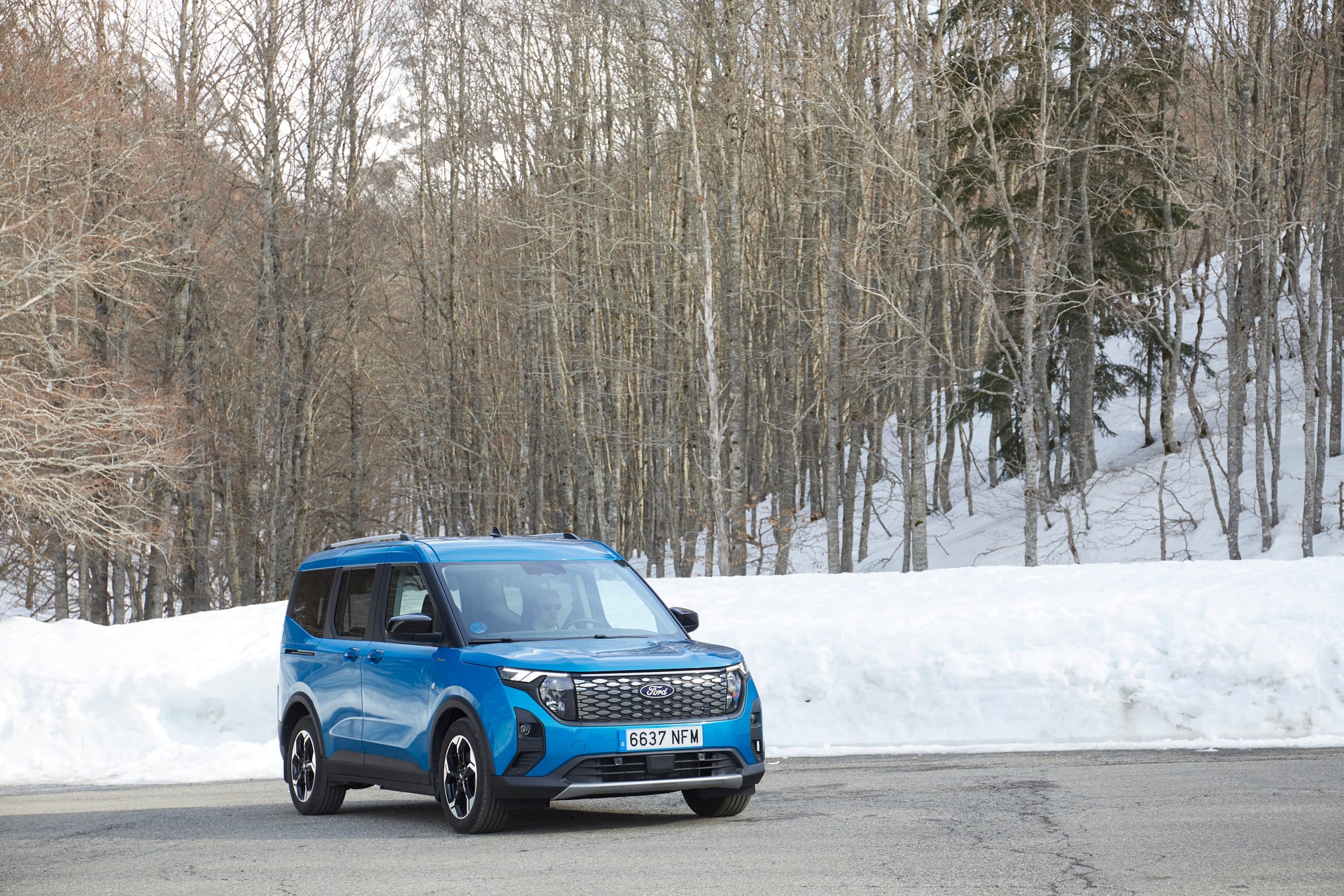
Fitting three child seats side by side in an ordinary car is almost a competitive sport. A compact SUV is nearly always too small, so many families with three young children end up looking at MPVs. Here we compare two options that are almost identical in price but solve the problem in quite different ways: the Volkswagen Touran 1.5 TSI 150 CV and the Ford Tourneo Connect SWB 1.5 EcoBoost Trend. Both sit around the manufacturer’s recommended retail price of €34,300-34,500, with no dealer discounts or one-off campaigns, so the decision is not about budget: it is about how you live day to day with three little ones in the back seat.
Why the width of the rear bench matters more than power
With three Isofix child seats in a row, the real limit is not set by the engine or the horsepower: it is set by the space taken up by the armrests and the anchorages of the centre seat. Neither of these two MPVs solves this by magic, but the layout of the rear seats, the width of the doors and the type of opening change the experience a lot when you are fitting (and removing) a baby in the rain while in a hurry.
Volkswagen Touran 1.5 TSI 150 CV: the MPV designed for long journeys
The Touran has for years been the reference when a family needs to cover real distance: motorway driving, luggage, a high chair dismantled in the boot. Its 1.5 TSI of 150 CV is not trying to be sporty; it is designed to pull with ease when the car is loaded to the limit, something that is especially noticeable when overtaking at cruising speed.
| Model | Power | Top speed | Consumption | Fuel | CO₂ |
|---|---|---|---|---|---|
| Volkswagen Touran 1.5 TSI 150 | 110 kW / 150 CV | ≈210 km/h | ≈6.5 l/100 km | Petrol | ≈150 g/km |
Ford Tourneo Connect SWB 1.5 EcoBoost Trend: the modular and urban alternative
The Tourneo Connect comes from a more utilitarian origin, and that shows in a positive way: a flat floor, wheel arches that do not intrude much, and a sense of urban manoeuvrability that the Touran has not developed to the same extent. Its 1.5 EcoBoost delivers a little less power than the German car, but in town and on short trips that difference is barely noticeable.
| Model | Power | Top speed | Consumption | Fuel | CO₂ |
|---|---|---|---|---|---|
| Ford Tourneo Connect SWB 1.5 EcoBoost Trend | 90 kW / 120 CV | ≈180 km/h | ≈6.5 l/100 km | Petrol | ≈150 g/km |
Rear access: sliding doors versus hinged doors
This is probably the difference that anyone fitting three child seats every morning will notice most. The Tourneo Connect has sliding doors on the second row, standard on most configurations: that means opening them fully without having to calculate the space in the garage or knocking the car next to you in a tight school car park. The Touran, by contrast, keeps conventional hinged doors, which are quicker to open but need more clear space at the side, something that in a narrow garage space becomes an exercise in patience with a baby in your arms.
For anyone who parks daily on the street or in tight communal spaces, the Ford’s sliding door is an objective advantage that is hard to dispute. For anyone who parks in a large garage or at home, the difference largely disappears.
ISOFIX and anchorages: where the three seats actually fit
Both MPVs offer Isofix anchorages on the two outer seats of the second row, the usual standard for this type of body. The centre seat, always the most problematic, is resolved with a three-point seatbelt in both cases: neither the Touran nor the Tourneo Connect has a standard third central Isofix in the versions compared here. What does change is the sense of lateral room: the Touran, being a model designed from the outset as a passenger MPV, offers a rear bench somewhat better suited to the comfort of three adult occupants or bulky child seats, whereas the Tourneo Connect, heir to a commercial platform, prioritises the flat floor and access over the exact width of the centre seat.
Boot space with the three seats installed
With three child seats occupying the entire second row, the boot becomes the real bottleneck: pushchair, nappy bag, weekly shop. The Touran, with a longer body designed from the start for carrying people, offers a more generous and regular load space for tall items such as a baby pushchair. The Tourneo Connect compensates with a lower, flatter load floor that is comfortable for loading heavy items, although its vertical capacity is a little tighter when the boot is filled up to the roof.
Summary comparison table
| Model | Engine | Power | Rear access | Price from | Score (1-10) |
|---|---|---|---|---|---|
| Volkswagen Touran | 1.5 TSI 150 | 150 CV | Hinged doors | ≈€34,500 | 7.8 |
| Ford Tourneo Connect | 1.5 EcoBoost Trend | 120 CV | Sliding doors | ≈€34,300 | 7.6 |
Indicative manufacturer RRP prices, without dealer discounts, one-off campaigns or purchase aids such as the Plan Auto+. Always check the official website for the current price.
Verdict: which MPV to choose depending on your use
If your life with three young children involves long journeys, roads and a boot pushed to its limit, the Touran 1.5 TSI 150 CV gives you more margin: more power for driving loaded, and more regular load capacity. If your daily life is mostly city driving, tight car parks and getting in and out of the car several times a day with child seats in tow, the Tourneo Connect wins thanks to its sliding door, a detail that in everyday use matters more than the 30 CV difference. In terms of price-performance the two are almost level, with less than 1% difference in RRP, so the decision is not driven by the wallet: it is driven by how you park each night. Anyone who wants to explore seven-seat alternatives with a longer wheelbase can also look at the SUVs and MPVs with the longest wheelbase currently on sale in Spain, and anyone torn between an MPV and a large seven-seat SUV will find a direct comparison in Peugeot 5008, Nissan X-Trail and KIA Sorento.
Frequently asked questions
Which MPV fits three child seats, the Touran or the Tourneo Connect?
Both allow three child seats to be fitted in the second row, but the Tourneo Connect makes the daily manoeuvre easier thanks to its sliding doors, while the Touran offers a little more overall width on the rear bench.
Do both models have an Isofix anchorage on the centre seat?
No. The versions compared here have Isofix on the two outer rear seats; the centre seat is secured with a three-point seatbelt in both cases.
Which is cheaper, the Touran or the Tourneo Connect?
The Ford Tourneo Connect starts at a slightly lower indicative price, around €34,300, compared with €34,500 for the Volkswagen Touran. The difference is minimal and should not be the deciding factor.
Which is better for long journeys with children?
The Volkswagen Touran 1.5 TSI 150 CV, thanks to its greater power and a more regular boot for bulky luggage, is the more comfortable option when the main use is road travel and family holidays.
