

Buying a hybrid SUV for less than €26,000 in 2026 is no longer an exercise in resignation. There is real choice, with full hybridisation (not dubious mild hybrids) and equipment that ten years ago you only saw in higher trims. What few buyers look at with the same attention as the price is the warranty: this is where some brands earn long-term customer trust, and others simply meet the legal minimum.
The difference is huge. Some manufacturers reach ten years of coverage if you meet a few simple conditions, while others stay at three years, full stop. In a car you plan to keep for seven or eight years, that is not a minor detail: it is real money at stake for possible breakdowns outside the warranty period.
What "warranty included" means in a hybrid SUV and why it should matter as much as the price
The factory warranty covers material and manufacturing defects, not normal wear and tear. But in a hybrid there is one component that especially worries buyers: the battery. Here each brand plays a different card, and it is worth separating the general vehicle warranty from the specific hybrid battery warranty, which is often longer.
Buying a car with 3 years/100,000 km is not the same as one with 7 years/150,000 km. In practice, if you drive around 15,000 km a year, those 150,000 km from Kia or MG cover you for a full decade. The 100,000 km from Dacia, Renault or Nissan run out in just over six years.
Toyota Yaris Cross Hybrid from €23,900: the Relax warranty as a selling point
Toyota is the most striking case in the segment. The base warranty is 3 years with no mileage limit, but the Relax programme extends it year by year, up to a maximum of 10 years or 160,000 km, provided you carry out servicing at the official Toyota network. It is small print that almost any ordinary driver can meet, and it makes the Yaris Cross the option with the least long-term uncertainty in its group.
| Version | Power | Consumption | Label | Fuel |
|---|---|---|---|---|
| Yaris Cross 1.5 Hybrid 116 | 85 kW / 116 CV | 4.1 l/100 km | ECO | Hybrid |
Kia Stonic Hybrid from €20,995: 7 years of warranty as the brand standard
For years Kia has made 7 years or 150,000 km (whichever comes first) its hallmark, with no servicing conditions tied exclusively to an official dealer. The Stonic Hybrid, with its 48V 1.0 T-GDi mild-hybrid engine, is not the most sophisticated hybrid on this list, but its entry price and those 7 years place it very high in terms of warranty-to-value.
| Version | Power | Consumption | Label | Fuel |
|---|---|---|---|---|
| Stonic 1.0 T-GDi 48V Hybrid | 74 kW / 100 CV | 5.3 l/100 km | ECO | Hybrid |
MG ZS Hybrid+ from €22,990: the long warranty as a commercial weapon of Chinese brands
MG replicates Kia’s formula: 7 years or 150,000 km of general warranty. It is the card Chinese brands use to win over a Spanish buyer who is still wary of long-term reliability. The ZS Hybrid+ adds a hybrid system with 196 CV combined, more powerful than almost all its direct price rivals, and that shows when overtaking on the motorway.
| Version | Power | Consumption | Label | Fuel |
|---|---|---|---|---|
| ZS Hybrid+ | 144 kW / 196 CV | 5.0 l/100 km | ECO | Hybrid |
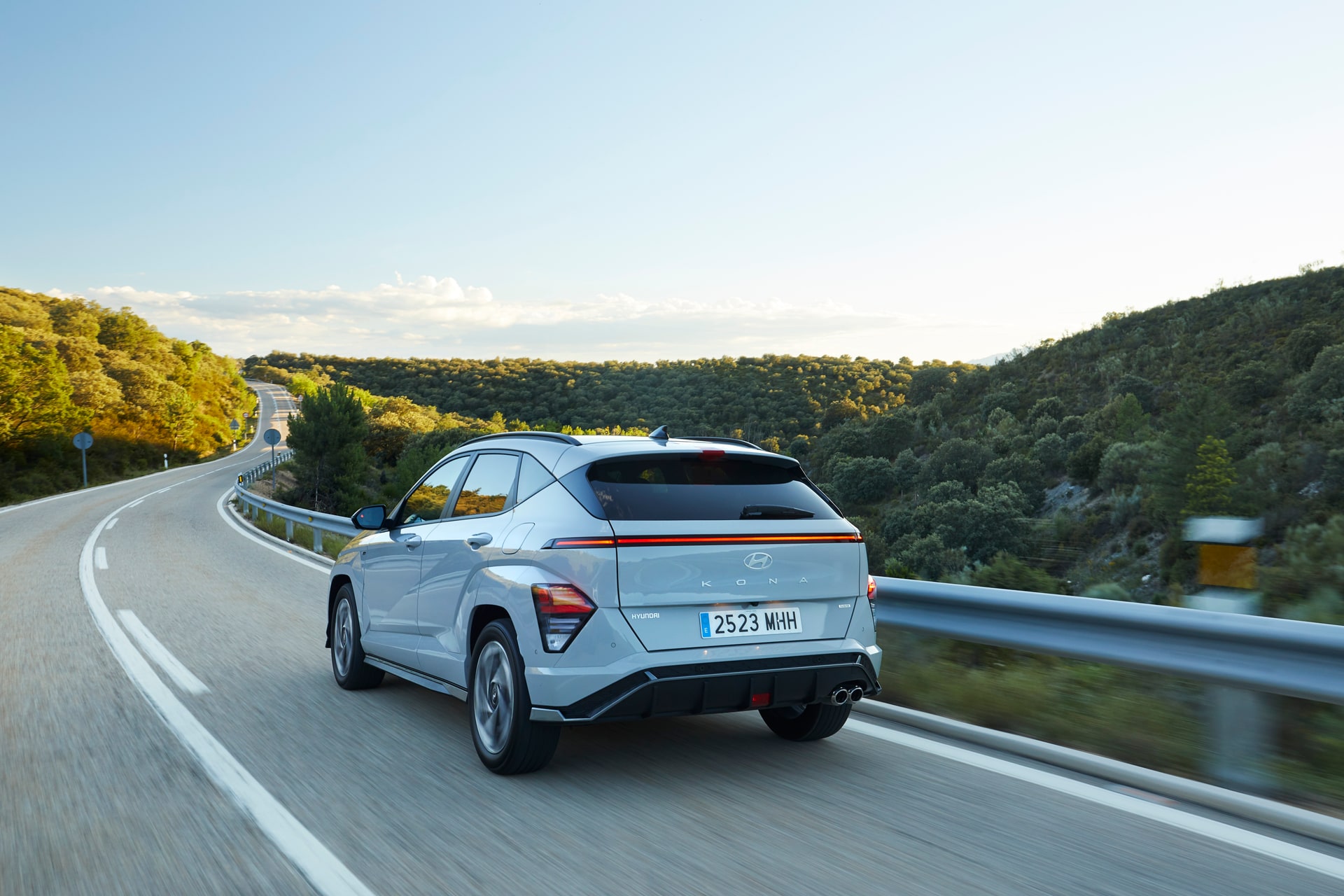
The 5-year standard: Hyundai Kona Hybrid from €26,700
Hyundai offers 5 years with no mileage limit, a reasonable middle ground that for years was the industry reference. The Kona Hybrid slightly exceeds the €26,000 budget in its entry trim, but it deserves a mention because it defines the intermediate step: neither the 3 years of the French and Japanese group, nor the 7-10 years of Kia, MG and Toyota.
| Version | Power | Consumption | Label | Fuel |
|---|---|---|---|---|
| Kona 1.6 GDi Hybrid | 104 kW / 141 CV | 4.4 l/100 km | ECO | Hybrid |
The usual 3 years: Dacia Duster Hybrid, Renault Captur E-Tech and Nissan Juke Hybrid
This is the bulk of the mainstream market: 3 years or 100,000 km, with no small print extending it as standard. That does not mean they are worse cars (the Captur E-Tech, in fact, is convincing on real consumption, as we already saw in its comparison with the Juke Hybrid), but it does mean that from the fourth year onwards, any fault is paid for by you.
| Model | Power | Consumption | Label | Fuel |
|---|---|---|---|---|
| Dacia Duster Hybrid 140 | 103 kW / 140 CV | 4.8 l/100 km | ECO | Hybrid |
| Renault Captur E-Tech full hybrid 145 | 107 kW / 145 CV | 4.3 l/100 km | ECO | Hybrid |
| Nissan Juke Hybrid | 105 kW / 143 CV | 4.8 l/100 km | ECO | Hybrid |
Comparison table: starting price, warranty and battery for the 7 models
| Model | Starting price | General warranty | Hybrid battery warranty | Warranty+price score (1-10) |
|---|---|---|---|---|
| Toyota Yaris Cross Hybrid | €23,900 | 3 years + Relax up to 10 years/160,000 km | Up to 10 years | 9.5 |
| Kia Stonic Hybrid | €20,995 | 7 years/150,000 km | 7 years | 9 |
| MG ZS Hybrid+ | €22,990 | 7 years/150,000 km | 7 years | 8.5 |
| Hyundai Kona Hybrid | €26,700 | 5 years, unlimited mileage | 5 years | 7 |
| Dacia Duster Hybrid 140 | €23,100 | 3 years/100,000 km | 3 years | 6 |
| Renault Captur E-Tech | €25,700 | 3 years/100,000 km | 3 years | 5.5 |
| Nissan Juke Hybrid | €25,400 | 3 years/100,000 km | 3 years | 5.5 |
Verdict: which hybrid SUV to choose based on your priority
If you are looking for maximum after-sales peace of mind and plan to keep the car for more than six years, the Toyota Yaris Cross Hybrid wins without discussion: 10 years of coverage with affordable servicing in the official network is unmatched in this price range.
If you prioritise the lowest entry price without giving up a long warranty, the Kia Stonic Hybrid from €20,995 is the best value-for-money-and-warranty ratio in the group, although its mild-hybrid system is less sophisticated than a full hybrid.
For those who want more power for the money and don’t mind a brand still young in Spain, the MG ZS Hybrid+ offers 196 CV and a 7-year warranty for less than €23,000; the price gap against the Kona Hybrid exceeds 15%, and there the MG clearly comes out ahead on paper and in your wallet. If your priority is the brand with the widest workshop presence and traditional assistance network, the Hyundai Kona Hybrid fulfils the role, although its 5 years fall short compared with the leaders in the ranking.
Frequently asked questions
Which hybrid SUV under €26,000 has the most warranty years in 2026?
The Toyota Yaris Cross Hybrid, with the Relax programme that can extend coverage up to 10 years or 160,000 km if servicing is carried out at the official network.
Do Kia and MG offer the same warranty?
Yes, both brands offer 7 years or 150,000 km (whichever comes first) as the general warranty, including the hybrid battery.
Is it worth paying more for a brand with fewer warranty years?
It depends on your use. If you change cars every 3-4 years, a long warranty matters less; if you plan to keep it for 8 or 10 years, brands such as Toyota, Kia or MG reduce the risk of unexpected costs.
Are there public grants to buy a hybrid SUV in 2026?
The Plan Auto+ remains in force as the framework of purchase aid for electrified vehicles in Spain. The specific amounts and conditions change frequently, so it is advisable to check the official website before completing the purchase.
