

Choosing a PHEV SUV in 2026 is not just a matter of environmental label or WLTP electric range. The real cost of the car, what it ends up costing over 4 years, depends on who pays for it and how it is paid: a self-employed worker who can partially deduct VAT and income tax is in a different position from a company car user who must consider the benefit in kind, or from a private buyer who bears the full retail price and hopes to recover it through residual value. This guide crosses product and taxation with three specific profiles and a named recommendation for each.
From the list of earlier candidates we have ruled out two brands on editorial grounds: BYD and Nissan are excluded from this analysis because, in our view, their current PHEV offerings do not quite hold up against European and Japanese rivals in the specific balance this piece calls for: homologated range, comfort, technology equipment and value for money. This is not a judgement on the manufacturer; it is that, for this crossover of product and taxation, the models that qualify perform better overall.
Why the tax profile matters as much as the technical specification
A PHEV SUV with a CERO label (more than 40 km of homologated WLTP electric range) and one with an ECO label can have very similar technical specifications, but they are not taxed the same way nor do they enjoy the same municipal advantages. For a company, the difference between a car that enters a ZBE (low-emission zone) without restriction and one facing restrictions on the 2027-2028 horizon weighs on residual value. For a self-employed worker operating in Madrid or Barcelona, it does too.
The current aid framework, Plan Auto+, remains a significant boost for PHEVs with high electric range, although the specific amounts should be checked on the official website because they are updated. The self-employed VAT deduction (up to 50% by default, 100% if exclusive business use is proven) and the 20% annual benefit-in-kind taxation on the market value of the vehicle for the company car user are the two tax axes that move the needle.
The three candidates: one per profile
We have chosen three very different PHEV SUVs, each designed to excel in its tax category. The Toyota RAV4 Plug-in as the reference for the self-employed worker who wants to amortise the deduction with proven reliability; the Volvo XC60 Recharge for the company car on lease who must balance benefit in kind and executive use; and the Peugeot 3008 Hybrid as the option for the private buyer who pays out of pocket and needs to keep the retail price down without giving up CERO.
Toyota RAV4 Plug-in Advance Plus — from 54,950 €
In our view the RAV4 Plug-in remains the most rational PHEV in the segment for anyone who will use it intensively. 306 CV combined, electric all-wheel drive at the rear, 75 km WLTP electric range and Toyota reliability as insurance for residual value. For a self-employed worker the combination is clear: a partial VAT/income tax deduction with a car that still holds value after four years.
| Power CV | Power kW | WLTP electric range | WLTP consumption | Label | Fuel |
|---|---|---|---|---|---|
| 306 CV | 225 kW | 75 km | 1.0 l/100 km | CERO | PHEV |
Volvo XC60 Recharge T6 Plus — from 68,100 €
The XC60 T6 Recharge is the reference premium PHEV for company leasing. 350 CV, 78 km WLTP, an interior with integrated Google and a residual value that, in Plus and Ultimate versions, holds up reasonably well at 36-48 months. In company leasing, with a deductible instalment and a user taxed at 20% on market value, the equation is noticeably better than that of an equivalent diesel with the same retail price.
| Power CV | Power kW | WLTP electric range | Label | Fuel |
|---|---|---|---|---|
| 350 CV | 257 kW | 78 km | CERO | PHEV |
Peugeot 3008 Hybrid 195 GT — from 44,390 €
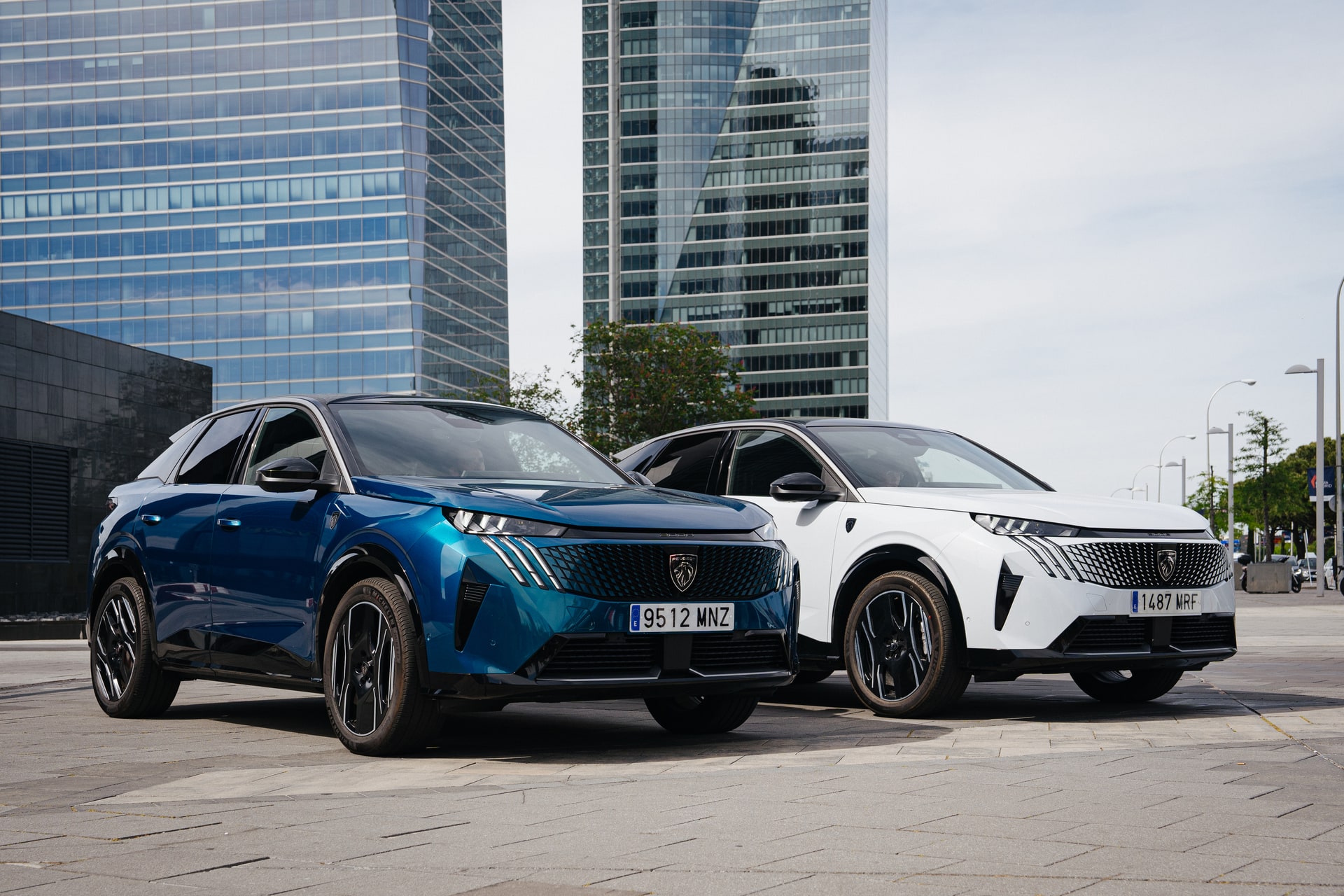
The 3008 Hybrid 195 is the option for the private buyer who does not want to exceed 45,000 € and still gets a CERO label with electric range sufficient for everyday use. Technological interior with the Panoramic i-Cockpit, proven mechanics from the Stellantis group and painless access to ZBEs. It inherits the logic we already discussed when pitting it against the C5 Aircross Plug-in Hybrid.
| Power CV | Power kW | WLTP electric range | Label | Fuel |
|---|---|---|---|---|
| 195 CV | 143 kW | 84 km | CERO | PHEV |
As an alternative reference in the premium segment—useful if the company user prefers a longitudinal engine and traditional finishes—the Mercedes GLC 300 e (from about 72,000 €) plays in the same league as the XC60 Recharge with 313 CV combined and around 130 km of homologated WLTP electric range, a figure that makes it one of the PHEVs with the highest electric range on the market. In corporate leasing, the GLC competes head-to-head with the Volvo.
Comparison table and rating
| Model | Power | WLTP range | Label | Price from | Ideal profile | Score /10 |
|---|---|---|---|---|---|---|
| Toyota RAV4 Plug-in Advance Plus | 306 CV | 75 km | CERO | 54,950 € | Self-employed | 8.7 |
| Volvo XC60 Recharge T6 Plus | 350 CV | 78 km | CERO | 68,100 € | Company / leasing | 8.5 |
| Peugeot 3008 Hybrid 195 GT | 195 CV | 84 km | CERO | 44,390 € | Private buyer | 8.2 |
| Mercedes GLC 300 e | 313 CV | ~130 km | CERO | ~72,000 € | Premium company | 8.6 |
Where each one clearly wins
The RAV4 Plug-in wins on reported reliability and residual value: for a self-employed worker who amortises the car, that is money. The XC60 Recharge wins on brand perception and comfort on business trips, with an interior that feels a step above the Peugeot. The 3008 Hybrid wins on retail price: between it and the XC60 there is a difference of more than 50%, which puts it outside direct comparison on price but perfectly aligned on label and real electric range.
Verdict by tax profile
- If you are self-employed with business activity and mixed use: Toyota RAV4 Plug-in Advance Plus. Partial VAT/income tax deduction, proven reliability and solid residual value. It is the one that gives the fewest scares after 4 years.
- If you are going for company leasing or a company car with executive use: Volvo XC60 Recharge T6 Plus or the Mercedes GLC 300 e if you prefer greater homologated electric range to minimise real consumption on short trips. The GLC is more expensive, but its larger battery pays off in TCO if you charge daily.
- If you are a private buyer paying out of your own pocket: Peugeot 3008 Hybrid 195 GT. CERO label, 84 km WLTP and a restrained retail price. With Plan Auto+ applied, the equation is the most reasonable of the trio.
Frequently asked questions
Can a self-employed worker deduct 100% of the VAT on a PHEV SUV?
Only if they prove exclusive business use, which is difficult with a passenger car. By default, the tax authority accepts 50% and the burden of proof to increase it rests on the taxpayer.
How is a PHEV company car taxed as a benefit in kind?
The general rule is 20% per year on the market value of the vehicle, with an additional reduction (up to 30%) for vehicles with a CERO label. A CERO-label PHEV reduces the user’s tax bill compared with an equivalent diesel.
Does the CERO label change access to ZBEs compared with ECO?
Yes. CERO enters all Spanish ZBEs without time or capacity restrictions; ECO still has access but with increasing restrictions in some cities from 2027-2028 onwards.
Is a PHEV worth it if I won’t plug it in daily?
No. A PHEV that is not regularly plugged in consumes more than a conventional hybrid because of the extra battery weight. If you do not have a wallbox or a parking space with a plug, a full hybrid is the better choice.
