

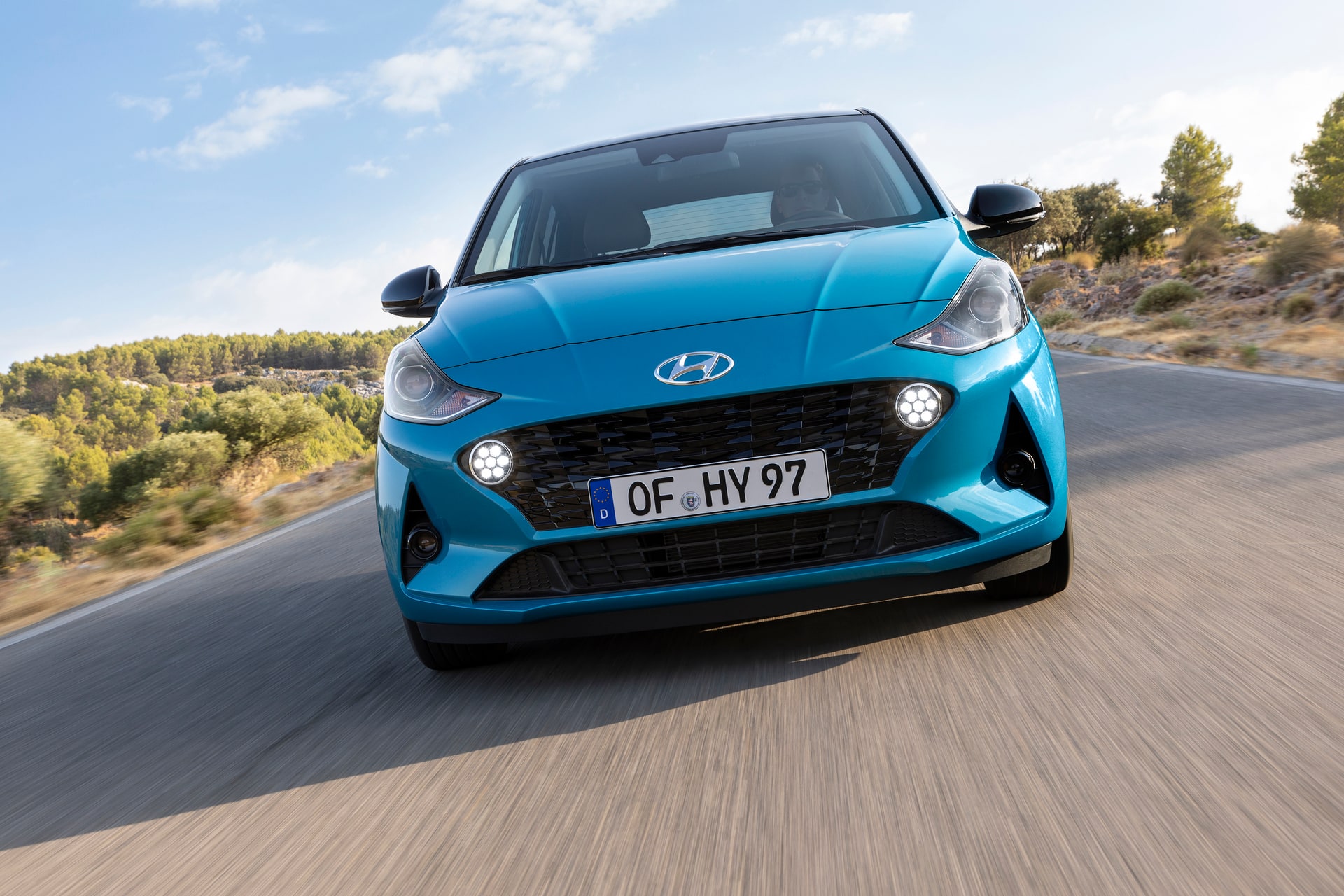
The A-segment is heading towards extinction. Every year another rival throws in the towel — the Volkswagen up!, Ford Ka and SEAT Mii have all gone — and those left are struggling as best they can against rising costs and the SUV avalanche. In this depleted landscape, the Hyundai i10 is still standing, with a clear proposition: a genuine city car, with five homologated seats, a long warranty and a list price that still starts below the psychological €18,000 barrier.
The question is whether that is enough in 2026. We’ll look at it with data and with two rivals hot on its heels: the Kia Picanto (its platform sibling) and the Toyota Aygo X. And, at the end, a mention of the Dacia Sandero, because anyone considering spending €17,800 on an urban car should first ask whether it isn’t worth jumping up a segment.
Hyundai i10 1.0 MPI 63 hp: what you get from €17,800
The i10 we’re analysing here is the 1.0 MPI 63 hp version in Essence trim, five doors, manual gearbox and Start/Stop. It is the entry-level powertrain and, in our view, the one that makes most sense on this car: a 1-litre three-cylinder naturally aspirated engine, no turbo, no mild hybridisation, no complications. It meets Euro 6 without frills and returns homologated consumption of around 5 l/100 km.
The important figures: roughly 50 kW / 60 hp real, 140 km/h top speed and an C efficiency label. Nothing extraordinary on paper, but on paper nobody wins here. What the i10 wins at is real-world city use, where that small engine holds its own with ease while the contained weight and the short steering do the rest.
| Power kW | Power hp | Top speed | Consumption | Emissions | Label | Fuel |
|---|---|---|---|---|---|---|
| ≈50 kW | ≈60 hp | ≈140 km/h | ≈5 l/100 km | ≈110 g/km CO₂ | C | Petrol |
The starting price is around €17,800 RRP. This is an indicative figure — manufacturer’s recommended retail price, without dealer discounts, one-off campaigns or aid such as the Plan Auto+, which you should check on the official website for the current amount.
Kia Picanto: the cousin in different clothes
The Picanto shares its platform, engine and much of its engineering with the i10. That makes sense: they come from the same stable. What changes is the styling approach (more youthful, with nods to the Stonic in the latest update) and some equipment details.
In driving dynamics there are no miracles: they drive similarly, consume similarly and occupy an almost identical niche in the market. The choice between the two comes down to three factors: the warranty (7 years Kia versus 5 years Hyundai — a clear point for the Picanto), the design (subjective) and the dealer network you have nearby.
In prose: the Picanto is objectively better on warranty and, for many, more attractive in styling. We don’t include a closed technical table here because we don’t want to mix figures that haven’t been verified in detail against an equivalent trim to the i10 Essence.
Toyota Aygo X: when the city car wants to look like an SUV
The Aygo X plays a different card. Instead of presenting itself as a “pure and simple” city car, it dresses up as a crossover: more ground clearance, pronounced wheel arches, adventurous styling. It is still an A-segment car in terms of dimensions and interior space — it fools nobody who sits in the back — but visually it competes on different ground.
Also a three-cylinder engine, pure petrol and a philosophy very similar to the i10’s in terms of running costs. Where the Aygo X wins is in image and a certain sense of visual robustness; where it loses, to our taste, is in rear accommodation and a tighter boot due to the design.
We don’t include a technical table for the Aygo X because we don’t want to publish figures without checking them against the exact specification sheet of the comparable trim.
Where each one wins
- Hyundai i10: the best price-equipment-space balance of the trio. Five usable homologated seats (rare in the segment) and a driving position surprisingly adult for what it costs.
- Kia Picanto: 7-year warranty, unbeatable in the segment. And a fresher image than the i10’s, which has been on the market for a few years.
- Toyota Aygo X: crossover styling that many find eye-catching, and the peace of mind of the Toyota network, which usually comes out well in reported reliability.
The elephant in the room: the Dacia Sandero
For a little more than an i10 Essence costs you can drive home a Dacia Sandero, which is a B-segment car — longer, wider, with a bigger boot, better for travelling. If your use is 90% city, the i10 makes perfect sense. If you regularly drive on motorways, the equation changes and the Sandero becomes hard to ignore. We mention it because it would be dishonest not to — something we already covered when discussing city cars with good real-world consumption.
Summary table and score
| Model | Price from | Power | Approx. consumption | Warranty | Score /10 |
|---|---|---|---|---|---|
| Hyundai i10 1.0 MPI 63 Essence | ≈€17,800 | ≈60 hp | ≈5 l/100 km | 5 years | 8.0 |
| Kia Picanto 1.0 entry | Ask your dealer | ≈60-65 hp | ≈5 l/100 km | 7 years | 8.0 |
| Toyota Aygo X 1.0 entry | Ask your dealer | ≈70 hp | ≈5 l/100 km | Up to 10 years with official servicing | 7.5 |
Verdict
- For 100% urban use and maximum purchasing rationality: Hyundai i10 1.0 MPI Essence. It best balances price, real space and equipment. It wins this comparison on its own turf.
- For those who prioritise the peace of mind of the longest warranty: Kia Picanto. Seven years is seven years, and on a car you’ll probably keep for a long time, that counts.
- For those who want to stand out stylistically: Toyota Aygo X. If crossover design catches your eye, no rational counterargument will hold — and the Toyota network backs the decision.
If your use frequently includes motorway driving, reconsider towards a B-segment such as the Sandero before signing. The i10 is a good city car, not a good car for everything.
Frequently asked questions
How much does the Hyundai i10 cost in 2026?
The entry 1.0 MPI 63 hp Essence version starts at approximately €17,800 RRP. The final price depends on dealer discounts, commercial campaigns and whether any aid such as the Plan Auto+ applies.
Is the 60 hp engine of the Hyundai i10 enough?
For urban and suburban use, yes. On flat motorways it also copes, although long hills and overtaking require downshifting. With a top speed of 140 km/h it is not designed for frequent high-speed travel.
What is the difference between the Hyundai i10 and the Kia Picanto?
They share a platform and mechanicals. The main difference lies in the warranty (7 years Kia versus 5 years Hyundai), the exterior design and some equipment nuances depending on trim. Dynamically they are almost interchangeable.
What is the best city car for under €18,000?
In terms of overall balance — space, price, equipment and running costs — the Hyundai i10 1.0 MPI Essence is the most rounded option in the A-segment. If you value the warranty above all else, the Kia Picanto ties with or beats it depending on how you look at it.

1 Comment
Pingback: Toyota Aygo X vs Hyundai i10 vs KIA Picanto: qué urbano gasolina elegir por menos de 18.000€ en 2026 – Comparativa de Coches