

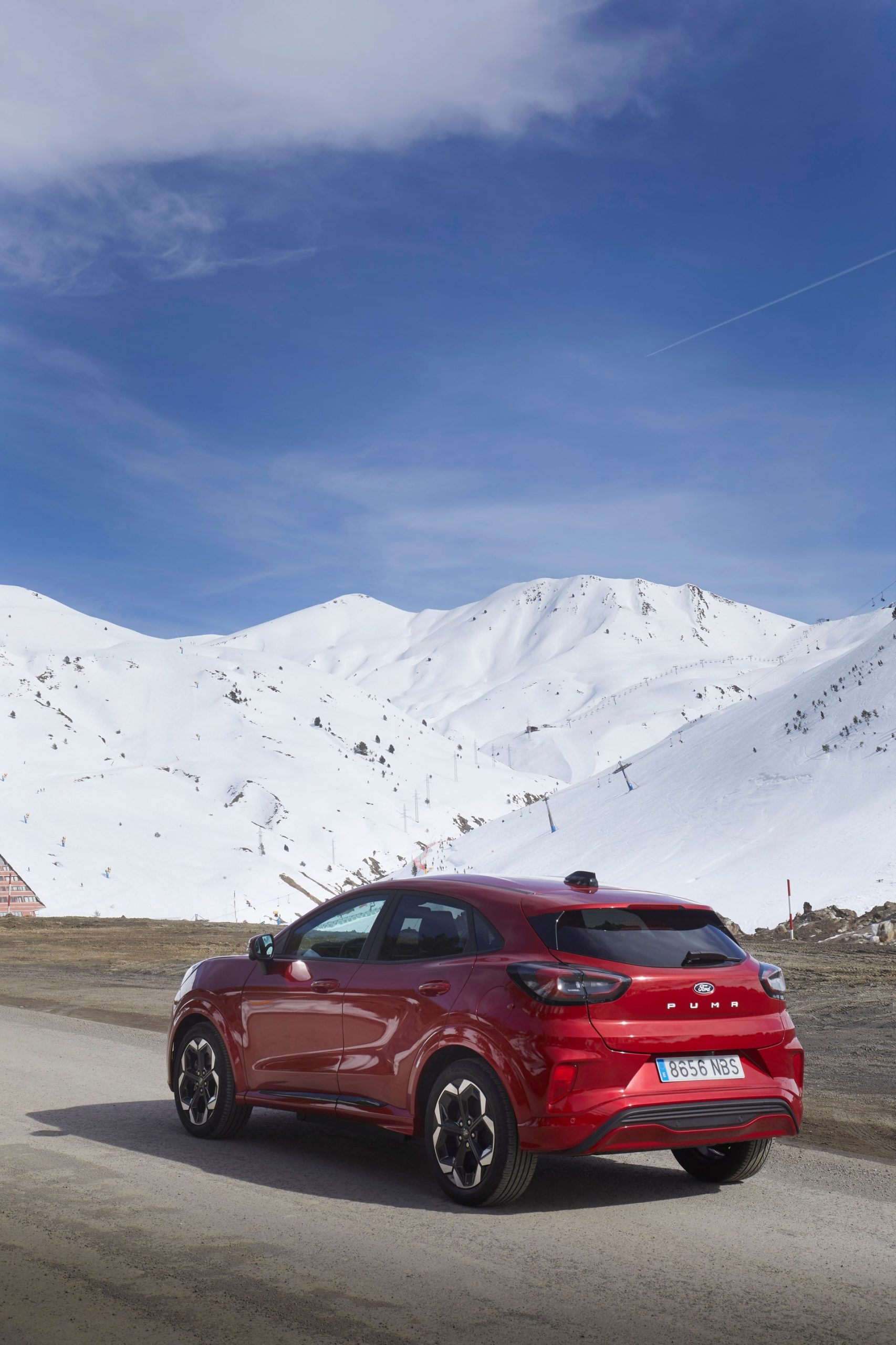
The Ford Puma has spent years as the reference SUV-B in Spain without needing to shout about it. It is not the cheapest, nor the one that includes the most standard equipment, but it is the one that best answers the question that really matters: does it work as the only car for an urban family? This review focuses on the version that sets the tone for the range, the all-electric Ford Puma Gen-E with 170 CV, and on whether the “under 30,000€” argument that so many buyers chase in 2026 holds up or is more of a configurator mirage.
Ford Puma Gen-E: the technical specs to check before anything else
Before talking about impressions, the numbers. The electric version of the Puma uses a motor of roughly 120 kW (170 CV), with a battery of about 53 kWh and an official range close to 380 km. The starting price is around 35,100 € RRP, an indicative manufacturer figure that does not include dealer discounts, occasional campaigns or public aid such as the Plan Auto+.
| Model | Power (kW) | Power (CV) | Top speed | Range | Battery | Fuel | Price from |
|---|---|---|---|---|---|---|---|
| Ford Puma Gen-E | ≈120 kW | ≈170 CV | ≈160 km/h | ≈380 km | ≈53 kWh | Electric | ≈35,100 € |
That 35,100 € figure already reveals the first uncomfortable point of this article: below 30,000€, the electric version does not fit. We will come back to this later, because it is the question that brings most readers here.
Design and interior space: why it still looks like a Puma and not a generic clone
The Puma has not needed to reinvent itself for the electric era. The sharp headlights, the roofline that drops toward the rear and that coupé-SUV stance remain intact on the Gen-E, with the aerodynamic tweaks typical of an electric car: closed grille, specific wheels, a discreet spoiler. Inside, the leap is bigger: a good-sized vertical central screen, a digital instrument cluster and materials that, without being premium, feel a step above the segment average. The rear seats remain the weak point: enough for two adults on short journeys, tight if three travel in the back.
Real-world range: the 380 km on paper versus daily use in the city
The 380 km official figure is a laboratory number, and it should be treated as such. In the city, with regenerative braking used to the full and mild weather, that figure comes fairly close to reality and can even be exceeded on short trips with lots of traffic lights. On the motorway, sustained at 120 km/h, the figure drops noticeably, as it does with any electric car with a moderate battery. For mainly urban and metropolitan-area use, which is the use case this analysis considers, 380 km is more than enough for a week without visiting a charger.
The MegaBox boot: the card no rival in the segment matches
Here the Puma has an objective advantage that is hard to replicate: the MegaBox system, a false floor under the boot that adds extra vertical capacity, designed for boots, sports bags or shopping without things rolling around. It is the kind of detail that is valued day to day, not on the spec sheet, and that no SUV-B on the Spanish market copies exactly.
Urban and road driving
In town, the Puma Gen-E moves with the agility expected of an electric car: instant response, precise steering and a comfortable turning circle for parking in a bay on a narrow street. On the road, the extra weight of the batteries is noticeable in fast bends, with a bit more inertia than the combustion versions, although the low centre of gravity offsets much of that difference. It is not a sports car and does not pretend to be: it is an urban car that copes well on the motorway, which is exactly what its target buyer needs.
Standard equipment and safety
Entry-level trims already include LED headlights, emergency braking assistance and adaptive cruise control, equipment that a few years ago was optional in this segment. For anyone looking for an SUV-B with no surprises in the safety checklist, the Puma delivers without needing to move up a trim.
Is the Ford Puma within reach for under 30,000€ in 2026?
The honest answer: with the all-electric Gen-E, no, at least not at the official RRP without discounts. To get below that barrier you have to look at the mild-hybrid combustion versions in the range, which have noticeably lower entry prices, although I do not have a verified exact figure for this piece. Applying dealer discounts, financing with a minimum-term commitment or the Plan Auto+ where applicable, getting close to 30,000€ with the Gen-E is already more plausible, though not guaranteed under every campaign.
Ford Puma versus its urban SUV-B rivals
In the hybrid field, rivals such as the Renault Captur and the Toyota Yaris Cross compete for the same urban buyer, with different approaches: one focused on combined consumption, the other on mechanical reliability. We have already analysed that ground in detail in our comparison of the Renault Captur E-TECH against the Nissan Juke Hybrid, and it is worth reviewing if the dilemma is hybrid versus electric. The Puma Gen-E plays a different game: that of someone who already has a way to charge at home and wants the extra practicality of the MegaBox.
Is it a good single car? The verdict
Yes, with caveats. For an urban user with a wallbox or nearby charging, moderate daily journeys and the occasional getaway, the Ford Puma Gen-E does more than enough as a single car: sufficient range, a boot that handles everyday life better than any direct rival and agile behaviour in town. For anyone who drives the motorway frequently and needs to get under 30,000€ without conditions, the electric version is not the answer: there you should look at the Puma’s combustion range or straight at another hybrid SUV-B, as we explored in our guide to choosing an urban hybrid SUV-B below 30,000€.
| Model | Range | Boot/practicality | Price from | Score as a single urban car (1-10) |
|---|---|---|---|---|
| Ford Puma Gen-E | ≈380 km | MegaBox, segment reference | ≈35,100 € | 8.3 |
Frequently asked questions
Is the Ford Puma a good single car?
For urban use with regular charging access, yes: its range of around 380 km and the MegaBox boot make it very practical day to day, although on long motorway trips it loses margin against a petrol-tank hybrid.
How much does the Ford Puma cost in 2026?
The all-electric Gen-E starts at an indicative RRP of around 35,100 €, excluding dealer discounts, financing and public aid such as the Plan Auto+, which can bring the final price close to the 30,000€ barrier.
What range does the electric Ford Puma have?
The Gen-E is rated at around 380 km with a battery of roughly 53 kWh, a figure that holds up well in town and drops on the motorway at sustained speeds, as happens with any electric car of this battery size.
Is the Ford Puma the best urban SUV-B option under 30,000€?
With the electric version, it does not fit that budget without discounts. With the combustion versions of the Puma range it gets close to that figure, although for a direct price comparison under 30,000€ it is also worth reviewing hybrid alternatives in the segment.
