

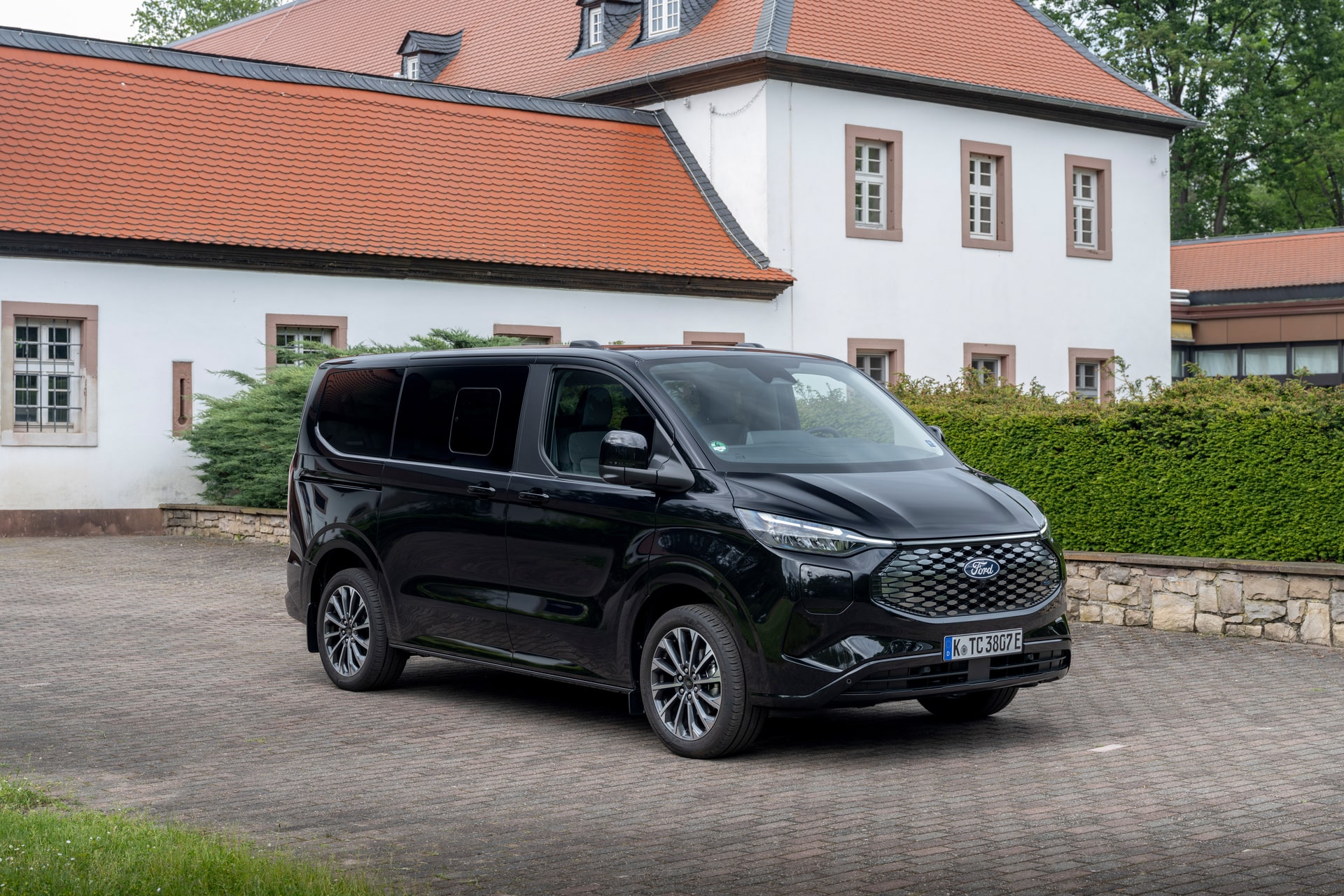
Choosing a 7-to-9-seat car in 2026 is not the same as choosing a family SUV with a symbolic third row. Here we are talking about vehicles designed to carry real people, with luggage, on long journeys and sometimes with a VTC (private hire) licence behind them. The category has shrunk considerably in recent years — goodbye to the classic MPVs — and today the Spanish market revolves around three names: Ford Tourneo Custom, Volkswagen Multivan and Mercedes-Benz Clase V. Three different approaches to the same problem: moving people.
Before getting into the comparison, a warning: all the prices you will read are manufacturer’s recommended retail prices (PVP), without dealer discounts, campaigns or Plan Auto+ aid. Use them as a guide, not as a closed offer.
Why the 7-9 seat segment has emptied out (and what is really still on sale)
The Grand C-MAX, the 7-seat Touran in higher versions, the Galaxy, the Sharan… all discontinued or in residual stock. Three-row mid-size SUVs (Hyundai Santa Fe, KIA Sorento, Peugeot 5008) cover the gap up to 7 seats, but the third row remains tight for adults and there is no 8- or 9-seat option. To genuinely transport 7 adults with luggage, or to register as a VTC, the answer in 2026 lies with passenger vans derived from light commercial vehicles. And there the podium is clear.
Ford Tourneo Custom (from ~48,000 €): the versatile benchmark
In our view, the Tourneo Custom is the most rational option of the trio. It shares its platform with the Transit Custom, offers 8- and 9-seat configurations, short or long wheelbase, and is available with the 2.0 EcoBlue diesel engine and also in a PHEV version with a CERO label — something that makes a difference in low-emission zones such as Madrid or Barcelona. The access points are generous, the electric sliding side door works well and the second row with swivelling individual seats turns the interior into a meeting room if needed.
The drawbacks? The perceived interior quality is below Mercedes, and the base trim is rather spartan. But it costs between 20% and 35% less than an equivalent Clase V, and in a VTC fleet that shows in the bottom line.
Ford has understood what a private transfer operator needs: proven diesel reliability, an extensive after-sales network and a cabin that withstands 300,000 km without drama. For large family use, the same Tourneo Custom works just as well — it is, quite simply, the most car-like car in the category.
Volkswagen Multivan (from ~62,000 €): the generational leap with a CERO label
The current Multivan (T7) no longer shares its chassis with the industrial Transporter. It is built on the MQB platform, the same as a Tiguan or a Passat, and that changes the driving experience: it feels more like a car, less like a van. It offers up to 7 seats (never 9) in a configuration with longitudinal rails, and its ace in the hole is the eHybrid PHEV version with around 50 km of homologated electric range and a CERO label.
For a family that uses the city during the week and travels at weekends, the Multivan eHybrid is probably the most refined option in the segment. For 8- or 9-seat VTC use, it simply won’t do: those configurations do not exist.
If you want more context on how driving changes with a PHEV and its battery under the floor, the Multivan format shares many of the logics we already analysed in family plug-in SUVs.
Mercedes-Benz Clase V (from ~68,000 €): the premium choice for VIP transfers
If your business is executive transfers, the airport-to-5-star-hotel run or the private chauffeur, the Clase V has no real rival. Perceived quality, sound insulation, driving position and the prestige of the star all work in its favour. Available in 7- and 8-seat versions, with well-proven OM654 diesel engines and, more recently, a 100% electric variant (EQV) that widens the menu for those who need a CERO label at the top of the range.
The problem? The price. An equipped Clase V goes above 85,000 € without breaking a sweat, and diesel consumption is high for the category. For a pure large family it is disproportionate; for premium VTC it is almost compulsory.
Comparison table
| Model | Seats | Fuel | DGT Label | Price from | Score |
|---|---|---|---|---|---|
| Ford Tourneo Custom | 8-9 | Diesel / PHEV | C / CERO | ~48,000 € | 9 / 10 |
| Volkswagen Multivan | 7 | Petrol / PHEV | C / CERO | ~62,000 € | 8 / 10 |
| Mercedes-Benz Clase V | 7-8 | Diesel / Electric (EQV) | C / CERO | ~68,000 € | 8 / 10 |
The detailed technical data (power, WLTP consumption) are not included here because they vary widely depending on trim and specific engine; always check the official dealer specification sheet for the version you are interested in.
Where each one wins, without false equivalence
- Ford Tourneo Custom wins on versatility and price-to-capacity ratio. It is the only one offering genuine 9 seats at a contained PVP, and the only one with a CERO label at a reasonable price (PHEV).
- Volkswagen Multivan wins on ride refinement and interior versatility (rails, sliding seats, integrated table). It is the best "car" of the three if you measure it as a saloon.
- Mercedes-Benz Clase V wins on perceived quality, acoustic comfort and status. For VIP transfers there is no argument.
Verdict by use case
- For a large family (6-8 members) on a sensible budget: Ford Tourneo Custom diesel in a mid-level trim. It enters the 50,000 € league well equipped, covers the miles and carries everyone with real luggage.
- For a 9-seat VTC and a profitable fleet: Ford Tourneo Custom, no question. The PVP gap with Mercedes exceeds 30%, and in commercial operation the TCO decides.
- For premium private transfers and VIP airport runs: Mercedes-Benz Clase V. The customer pays for the star and for the silence on board.
- For mixed family use, city and travel, with a restrictive ZBE: Volkswagen Multivan eHybrid. It is the most car-like of the three and the one that best handles everyday urban driving with a CERO label.
- Overall price-performance ratio: Ford Tourneo Custom. It is no coincidence that it dominates the people-transport fleet segment in Spain.
Frequently asked questions
What is the legal difference between 7-, 8- and 9-seat vehicles in Spain?
From 9 seats including the driver, the vehicle falls into category M1 but requires a D1 licence to drive professionally with passengers. Up to 8 seats plus the driver, a B licence is sufficient. For VTC, a specific licence and compliance with the corresponding regional regulations are also required.
Can a 7-seat SUV replace a Tourneo Custom-type van?
For a family of 5 with two young children occasionally in the third row, yes. To genuinely transport 7 adults with luggage on a long trip, no — the third row of a Santa Fe or a Sorento is for emergencies. And none of them offers 8 or 9 seats.
Does a PHEV make sense in a vehicle of this size for VTC use?
It depends on the usage pattern. If 70% of your services are urban with the possibility of overnight charging, yes: the CERO label gives access to ZBE zones and preferential airport stations. If most of your driving is on motorways, diesel is still more efficient in real-world consumption.
Are there pure electric alternatives in the 8-9 seat segment in Spain?
Yes, although limited. The Mercedes EQV offers configurations up to 8 seats with a CERO label. Ford also sells the 100% electric E-Tourneo Custom version. Real-world range on the motorway with passengers is the main constraint — WLTP figures should be taken with a pinch of salt, and you should do the sums based on your specific service.
