

Installing three ISOFIX child seats in the same row is one of those problems that never appears in any commercial brochure. The dealer shows you the boot, the driving modes, the central screen. Nobody tells you whether the ISOFIX anchor points on the rear seat are 48 or 52 centimetres apart, or whether the middle seat will hit the headrests of the outer seats. And that is where many purchases go wrong.
Why the real width of the bench matters more than the segment
The inherited rule—”if I have three kids, I need a large SUV”—is misleading. A 4.60 m compact SUV can have a rear bench that is narrower at shoulder height than an MPV derived from a van of similar length, because the wheel arches eat into interior space. What matters is not the car’s length but three measurements: usable width between the seatbelt anchorages, the separation between the two ISOFIX points of each seat, and access to the middle seat (whether it has its own ISOFIX or uses a seatbelt).
The three measurements that really decide the purchase
Usable width at seat height: ideally above 140 cm for three conventional Group 1/2/3 seats. Below 135 cm, forget it unless you use narrow seats such as the Multimac or Axkid Minikid.
ISOFIX in the middle seat: most cars omit it. If it has it, your options multiply. If not, the middle seat goes with a three-point seatbelt and must be approved for that use.
Side access: sliding doors or rear doors that open very wide (85° or more) make all the difference when you are carrying a baby in your arms and two children holding onto your trousers.
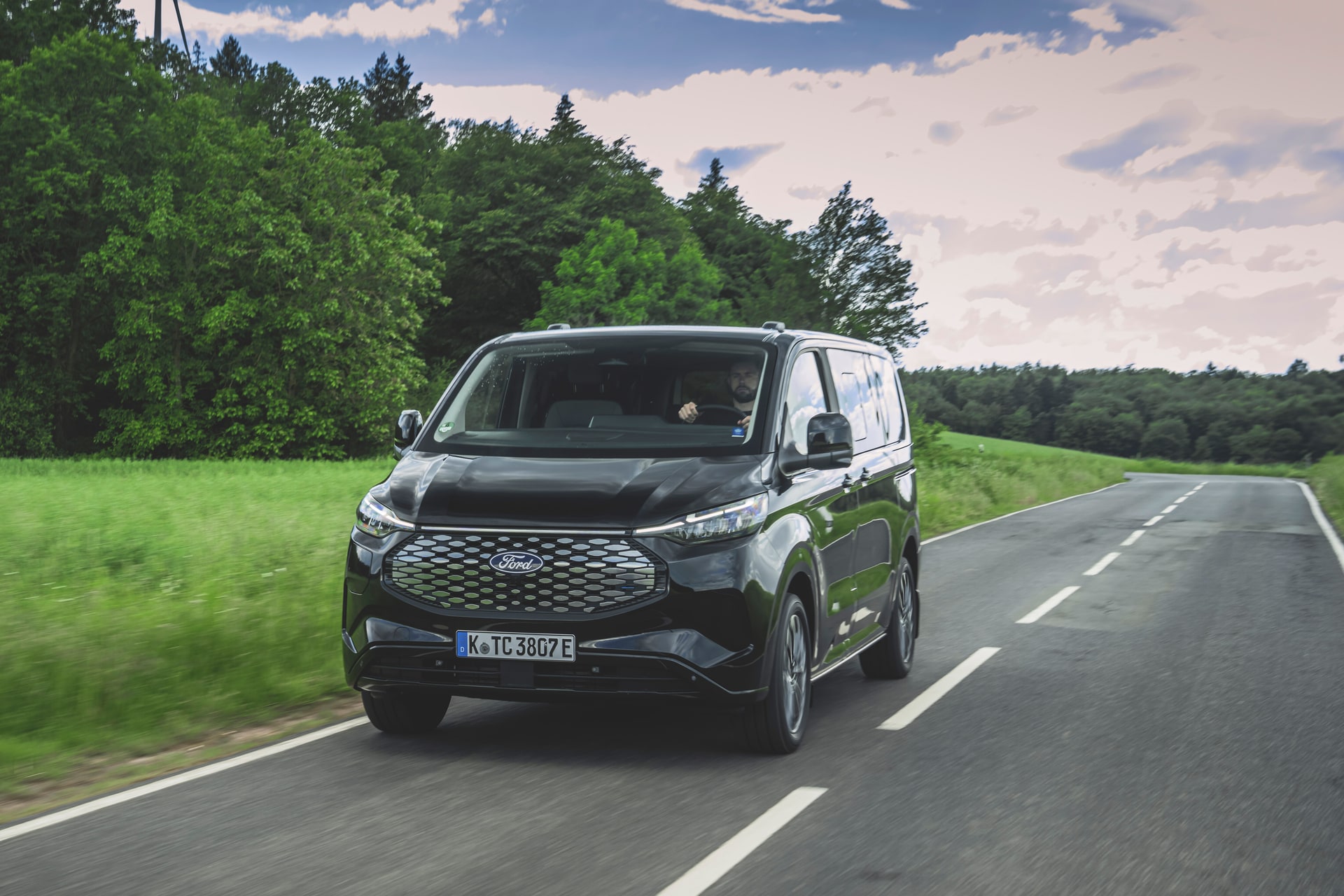
Ford Tourneo Custom — from ~€52,000
In our view, the Tourneo Custom is the benchmark for anyone who installs three seats in the back without compromise. Its second row comfortably exceeds 150 cm of usable width, the seats come as individual captain’s chairs or a bench depending on the configuration, and the rails allow the seats to be moved to create space between rigid seats. Electric sliding doors solve access in narrow car parks—something any parent with two Group 2 seats alongside appreciates every day.
The price is the price: it sits high and is diesel, with a recommended retail price from roughly €52,000. For families with three children of seat age at the same time, it pays off. For families with two children and an occasional cousin, it is more than enough.
There is no detailed technical sheet for the Tourneo Custom in this analysis, so we stick with the concrete fact we can cite: it is a van-derived vehicle with a C label in its combustion versions and an 8–9 seat configuration.
Ford Capri Extended Range Select — from ~€53,200
The Capri is the interesting candidate for families who do not want an MPV but need three reasonable ISOFIX positions. It is an electric crossover with a large battery and a dedicated platform, which means a flat floor in the back—a real plus when the middle seat has a support leg. Its interior width does not reach that of the Tourneo Custom, that is clear, but it exceeds the average for compact SUV-Cs.
The problem appears with bulky i-Size rear-facing seats: two outer seats take up so much room that the middle one is squeezed. With three narrow seats, it fits. With three booster seats and high-back seats for older children, it also fits. In the intermediate range—one rear-facing baby and two Group 1/2 seats—it is questionable whether it is worth it compared with an MPV.
| Power kW | Power CV | Max speed | WLTP range | Battery | Label | Fuel |
|---|---|---|---|---|---|---|
| 210 kW | 286 CV | 180 km/h | 627 km | 84 kWh | Zero | Electric |
Dacia Jogger — rational alternative under €20,000
We cannot talk about large families without mentioning the Jogger. It is long (4.55 m), has three genuine rear seats with two side ISOFIX points and a middle seat that can be used with a seatbelt. It is not the widest car on the market, but the price changes the conversation: for less than half the price of a Tourneo Custom you get 7 seats and access to a third row. For families on a tight budget, the full analysis of the Jogger against its VW group rival remains essential reading.
We do not have a canonical technical sheet for the Jogger in this block, so we mention it only conceptually: a 7-seat MPV with petrol, LPG and hybrid engines, and an ECO label on some versions.
Summary table and score by use case
Score from 1 to 10 considering the parent who installs three ISOFIX seats every day. Recommended manufacturer retail prices, without discounts, campaigns or aid such as the Plan Auto+.
| Model | Bench width | Central ISOFIX | Door access | Price from | Overall score |
|---|---|---|---|---|---|
| Ford Tourneo Custom | Excellent (>150 cm) | Depending on configuration | Sliding | ~€52,000 | 9.2 |
| Ford Capri Extended Range | Adequate | No | Conventional | ~€53,200 | 7.1 |
| Dacia Jogger | Adequate | No (seatbelt) | Conventional | From ~€18,000 | 8.0 |
Verdict
- For three rigid ISOFIX seats every day, without compromise: Ford Tourneo Custom. It is the only one that does not force you to choose seats based on their width.
- For a mid-budget family that wants electric: Ford Capri Extended Range Select, aware that with i-Size rear-facing seats it will be tight.
- Unbeatable price-performance ratio: Dacia Jogger. The retail price gap with the Tourneo Custom exceeds 60%, and for many families that gap decides everything.
If the budget allows and the family has three young children at the same time, the Tourneo Custom wins. If not, the Jogger is the honest answer.
Frequently asked questions
How many ISOFIX points does a family car in Spain come with as standard?
The vast majority fit two ISOFIX points on the outer rear seats. A middle seat with its own ISOFIX is rare and limited to van-derived MPVs, some 7-seat SUVs and certain electric cars with a flat floor.
Can I fit three ISOFIX seats in a conventional 4.5-metre compact SUV?
In most cases, no, not with standard Group 1/2/3 seats. The usable width is usually between 130 and 138 cm, insufficient for three bulky shells. With specific narrow seats it is feasible.
Can the middle seat use a three-point seatbelt instead of ISOFIX?
Yes, as long as the seat is approved for seatbelt installation (most Group 2/3 seats allow it). It is safe if tightened correctly, although ISOFIX reduces the margin for error.
Does a van-derived MPV lose much comfort compared with an SUV?
On motorways you do notice slightly more aerodynamic noise and body roll. In return, the interior space and ease of access with small children are unmatched. For mixed urban and road use with three seats, the trade-off is worth it.

2 Comments
Pingback: Cómo elegir un coche familiar para tres sillas infantiles en 2026 según el ancho real del asiento y el acceso a las plazas traseras – Comparativa de Coches
Pingback: Los 5 monovolúmenes y furgonetas de pasajeros con asiento trasero más ancho para tres sillas infantiles ISOFIX en 2026 – Comparativa de Coches