

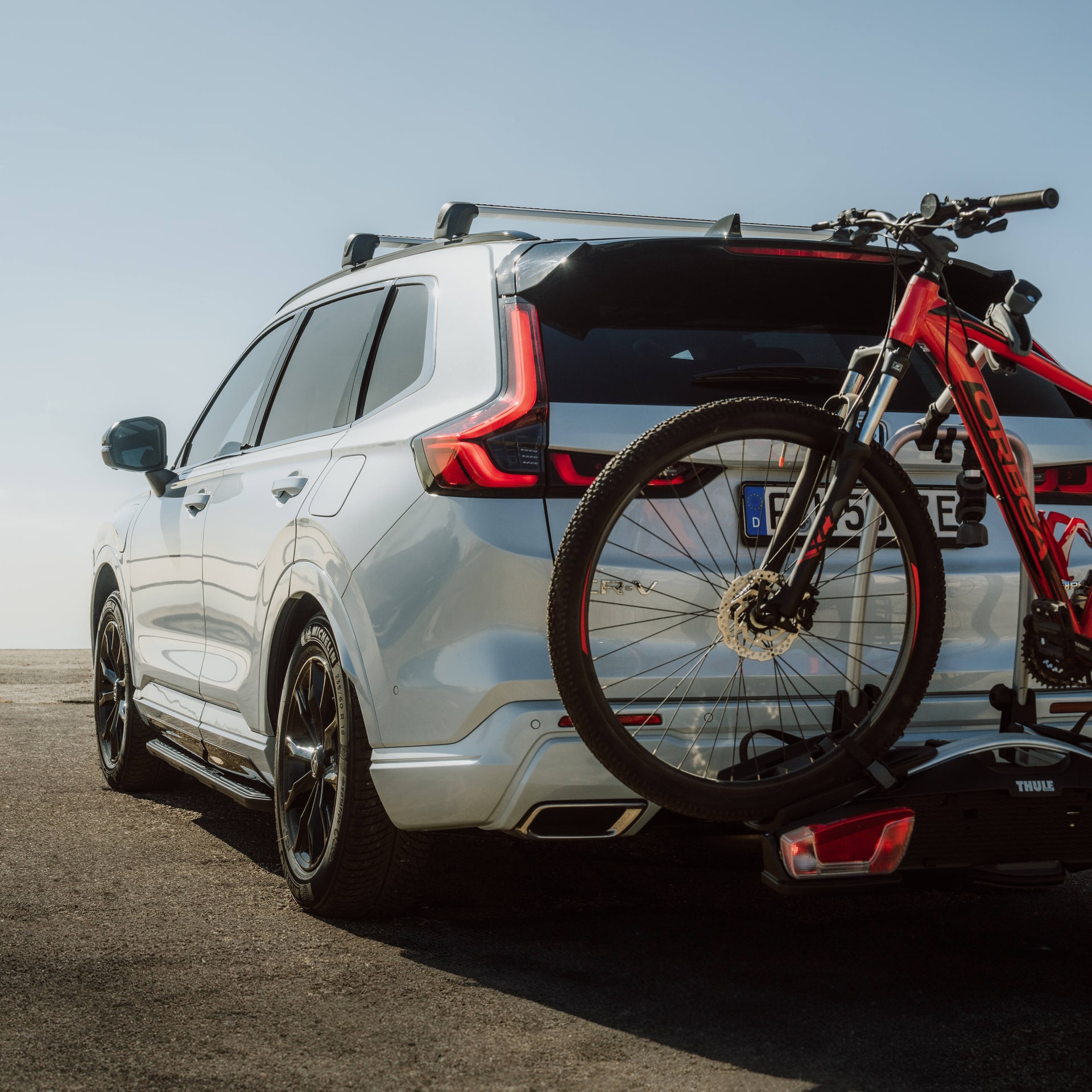
Buying a hybrid SUV by looking only at the WLTP figure is the fastest way to end up disappointed on the first 800-kilometre getaway. The homologation figure is measured under conditions no real trip can reproduce: no air conditioning at full blast, no four passengers, no boot packed up to the parcel shelf. This guide uses a different criterion: how much each model consumes at 120 km/h with the car loaded, and how many suitcases actually fit when the boot is no longer empty as in the catalogue photo.
What “real consumption” on the motorway means compared with the WLTP figure
A full hybrid performs better in the city than on the motorway, the opposite of a diesel. At high, steady speed the battery barely intervenes and the combustion engine does nearly all the work, so the gap between WLTP and real consumption widens considerably: we are talking about 1 to 2 litres more per 100 km on long journeys. That is why a RAV4 that claims 5.7 l/100 km homologated can show 6.8-7.0 l/100 km in real driving on a Madrid-Alicante trip with the boot loaded and the air conditioning on. That margin of error is what really matters to a family doing 20,000 km a year on the motorway.
Loaded boot: usable litres versus theoretical VDA litres
The VDA figure (the litres each manufacturer publishes) is calculated by stacking standardised cubes up to the roof, not by loading real suitcases with irregular shapes. In practice, a 580-litre VDA boot may take three cabin cases and one large one, no more, while another 560-litre boot with a better-used space fits four large suitcases without forcing them. This matters especially in 7-seat SUVs: with the third row unfolded, the usable boot often drops below 200 litres, enough for the weekly shop but not for five holiday suitcases.
Profile 1: family of four, demanding boot — Toyota RAV4 from €39,900 vs Honda CR-V e:HEV from €43,000
The Toyota RAV4 uses the 2.5 hybrid with 2WD or AWD traction and 218-227 hp combined depending on version, with an ECO label and a 580-litre boot that in practice holds the luggage of four people without using the rear parcel shelf. The Honda CR-V e:HEV, with its 184 hp 2.0 i-MMD powertrain, offers 589 litres in front-wheel-drive form, slightly more gross space, but its loading floor is a little higher, which penalises bulky items such as a large hard-shell suitcase stood upright.
| Model | Power | Consumption | Label | Fuel |
|---|---|---|---|---|
| Toyota RAV4 | 160-170 kW / 218-227 hp | 5.7 l/100 km | ECO | Hybrid |
| Honda CR-V e:HEV | 135 kW / 184 hp | 5.8-6.4 l/100 km | ECO | Hybrid |
The RAV4 wins on real motorway range thanks to its larger fuel tank and more efficient hybridisation at sustained speed; the CR-V wins on cabin quietness and suspension feel, which is noticeable on drives of more than three hours in one go.
Profile 2: large family, seventh seat needed — Hyundai Santa Fe from €49,900 vs Kia Sorento from €45,900
If you genuinely need seven seats, not just as an emergency option, the comparison changes. The Hyundai Santa Fe hybrid (1.6 T-GDi + electric motor, 215 hp combined) offers a squarer cabin design that makes access to the third row easier, something we already analysed in depth in our review of the Santa Fe as a family travel car. The Kia Sorento hybrid, mechanically related and with 230 hp combined, outdoes its Korean cousin on boot space with five seats in use (616 litres versus the Santa Fe’s 571) and on warranty: 7 years or 150,000 km versus the Santa Fe’s 5 years with no mileage limit.
| Model | Power | Consumption | Label | Fuel |
|---|---|---|---|---|
| Hyundai Santa Fe Hybrid | 172 kW / 215 hp | 6.2-6.7 l/100 km | ECO | Hybrid |
| Kia Sorento Hybrid | 169 kW / 230 hp | 6.0-6.5 l/100 km | ECO | Hybrid |
With the third row folded both perform similarly on the motorway; with all seven seats occupied and luggage behind, the Sorento holds up slightly better because its real-use boot with 7 seats drops to around 187 litres, compared with the Santa Fe’s usual 130-150 litres in the same configuration.
Profile 3: maximum annual mileage, total cost per km — Nissan X-Trail e-Power from €41,900 vs Renault Austral from €36,900 vs Ford Kuga from €34,900
For those who do a huge amount of motorway driving, the e-Power system of the Nissan X-Trail changes the rules: the petrol engine only generates electricity and never drives the wheels directly, which gives very smooth driving but a motorway consumption that does not improve as much as it promises in the city (around 6.5-7 l/100 km real at 120 km/h). The Renault Austral E-Tech full hybrid, with 200 hp combined, is the most restrained of the three on mixed consumption, although its 500-430 litre boot (depending on seat track position) falls short if you travel with luggage for four people. The Ford Kuga Hybrid, with 190 hp and 581 litres of boot space, is the cheapest entry point and the one that best balances price and space, although its hybrid system is the least sophisticated of the three in braking energy recovery.
| Model | Power | Consumption | Label | Fuel |
|---|---|---|---|---|
| Nissan X-Trail e-Power | 150 kW / 204 hp | 6.1 l/100 km | ECO | Hybrid |
| Renault Austral E-Tech | 130 kW / 200 hp | 4.9-5.3 l/100 km | ECO | Hybrid |
| Ford Kuga Hybrid | 143 kW / 190 hp | 5.4-5.8 l/100 km | ECO | Hybrid |
Summary table: the seven hybrid SUVs compared
| Model | Price from | Boot (5 seats) | Warranty | Long-trip score (1-10) |
|---|---|---|---|---|
| Toyota RAV4 | €39,900 | 580 l | 5 years / 100,000 km | 8.7 |
| Honda CR-V e:HEV | €43,000 | 589 l | 3 years (extendable) | 8.2 |
| Hyundai Santa Fe | €49,900 | 571 l | 5 years unlimited | 8.0 |
| Kia Sorento | €45,900 | 616 l | 7 years / 150,000 km | 8.5 |
| Renault Austral | €36,900 | 500 l | 5 years / 100,000 km | 7.8 |
| Nissan X-Trail e-Power | €41,900 | 575 l | 3 years / 100,000 km | 7.6 |
| Ford Kuga Hybrid | €34,900 | 581 l | 3 years unlimited | 8.1 |
The price gap between the Ford Kuga (€34,900) and the Hyundai Santa Fe (€49,900) exceeds 40%, so they are not direct budget rivals: the Kuga competes with the other 5-seat SUVs, while the Santa Fe and the Sorento play in the 7-real-seat league.
Verdict: which hybrid SUV to choose based on your use
For a family of four with a demanding boot and many motorway kilometres a year, the Toyota RAV4 is the safest choice: the most stable real consumption at steady speed and a maintenance network that offers no surprises. If you need the seventh seat in regular use, the Kia Sorento wins on usable boot space with all three rows occupied and on its 7-year warranty, which for a car that will accumulate mileage quickly weighs more than it seems on paper. And if budget comes first and you accept a slightly tighter boot, the Ford Kuga offers the best price-performance ratio in the group, with a €34,900 entry price and motorway consumption not far from the leader. Anyone who wants to go deeper into deciding between more children or more mileage can also check our guide to family SUVs by number of children and annual mileage.
Frequently asked questions
Which hybrid SUV consumes least on the motorway at 120 km/h in 2026?
Among the models compared, the Renault Austral E-Tech and the Toyota RAV4 best maintain consumption at motorway speed, with real figures around 5-6 l/100 km compared with the 6.5-7 l/100 km of e-Power systems such as the Nissan X-Trail’s.
What boot size do I need to travel with two children and a week’s luggage?
With two children and a week’s luggage, 550-580 litres of real boot space is enough, the range where the Toyota RAV4, the Honda CR-V and the Ford Kuga sit. For families with three or more children, it is best to prioritise 7-seat models with a boot larger than 600 litres in the 5-seat configuration.
Is it worth paying more for a 7-seat SUV if I almost always travel with four people?
Not always. If the third row is used only occasionally, a 5-seat SUV such as the RAV4 or the Kuga provides more usable boot space in everyday life than a Santa Fe or a Sorento with the third row poorly utilised.
Can I benefit from the Plan Auto+ when buying one of these hybrid SUVs?
Non-plug-in hybrids with an ECO label may fall within the Plan Auto+ aid depending on the current call, although the amounts and requirements change with each update of the plan. Always check the official website before closing the purchase to confirm the exact amount applicable to your case.
