

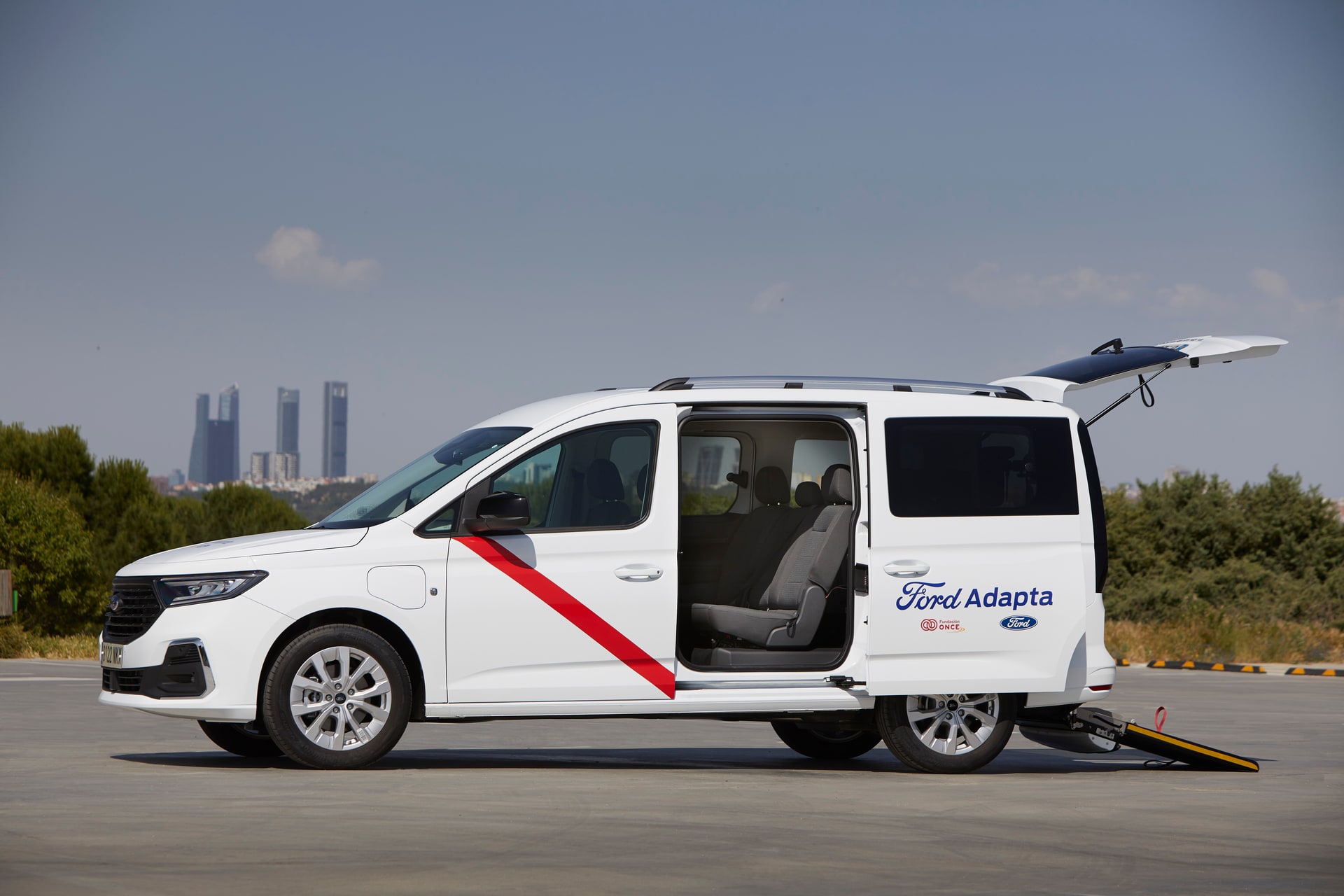
The Ford Tourneo Courier has spent years in no man’s land: it is neither a fashionable SUV, nor a large van, nor does it compete in the traditional compact car space. And yet, when you focus on what really matters in an urban family car — fitting two child seats without a struggle, parking without sweating and loading the shopping trolley without playing Tetris — few cars at its price stand up to the comparison. This review puts the 2026 Tourneo Courier against the benchmark of what a family living in the city but unwilling to give up space expects today.
What the Ford Tourneo Courier is today and where it fits in the range
The Tourneo Courier is the passenger version of the Transit Courier, the smallest van in the Ford line-up. We are talking about a compact MPV measuring 4.34 metres, with five seats and a very clear approach: a tall body, wide doors and a boot that does not measure up the same way as that of a segment B SUV.
Within the Ford family, it sits below the Tourneo Connect (longer, with an optional seven-seat layout) and well below the Ford Tourneo Custom, the large eight- or nine-seat model designed for professional transfers or very large families. The Courier is the entry step: city use, a young family, a medium-sized dog and the occasional weekend trip.
Ford Tourneo Courier 1.0 EcoBoost 125 Trend: specifications and indicative price from 27,000 €
The version we tested is the only petrol option available at present: the Ford Tourneo Courier 1.0 EcoBoost 125 Trend 5p S/S, with a manual gearbox, 130 CV and a DGT C environmental label. The starting price is around 27,000 € as Ford’s recommended retail price, before any dealer discounts, campaigns or aid. It is worth bearing in mind: the prices given here are indicative, not fixed, and you should ask for a real offer before deciding.
| Power | CV | Consumption | CO₂ | Fuel | DGT label |
|---|---|---|---|---|---|
| ≈90 kW | ≈130 CV | ≈6.5 l/100 km | ≈150 g/km | Petrol | C |
The three-cylinder 1.0 EcoBoost is no paragon of refinement — its character shows, especially when cold and at low revs — but it copes more than adequately with the weight of the car. In town it moves with ease, and on motorways it keeps up the pace without feeling strained, provided you do not plan to overtake with four on board and a full boot as if it were a GTI.
Practicality: where it beats the average SUV-B and where it falls short
Here is the real selling point. A segment B SUV such as the Puma, 2008 or Juke measures around 4.2 metres, but with a low roof, a high waistline and a usable boot that, by eye, loses out to the Courier’s by somewhere between 20% and 30%. The Tourneo Courier plays with a different geometry: almost 1.80 m of height and a B-pillar that leaves a frankly generous door opening.
In practice, this means three things. First, fitting a rear-facing child seat without straining your back. Second, letting grandad get in and out of the car without stooping. And third, a boxy boot where the folded pushchair leaves room for the shopping, not the other way round.
What does it lose against a SUV-B? The sense of a “pretty” car, a more agile driving feel and, above all, the perception of interior quality. The Courier’s dashboard is functional, with honest hard plastics and a decent central screen, but nobody will say it looks like a 30,000 € car. In our view, it is a reasonable trade-off if the priority is real space rather than finish.
Real-world consumption and daily use
The 1.0 EcoBoost is homologated at around 6.5 l/100 km. In mixed urban use, with dense traffic and short trips, it is realistic to expect a little above 7 l/100 — the tall body takes its toll on aerodynamics and the car is heavier than it looks. For families living in the city who drive few kilometres a month, the fuel cost is manageable; for anyone covering 25,000 motorway kilometres a year, a hybrid makes more sense today.
The C label allows access without restriction to most ZBE zones for residents, but it does not give free access to Madrid Central or equivalent zones for non-registered vehicles. If you live inside a restrictive ZBE as a non-resident, this figure should weigh in your decision.
Where it shines and where it doesn’t
Points where the Tourneo Courier clearly beats an equivalent SUV-B:
- Usable boot volume and ease of loading (wide tailgate, low loading lip).
- Access to the rear seats: large doors and a high roof, unbeatable for child seats.
Points where it loses out:
- Dynamics and refinement: it does not hide its kinship with the van.
- Perceived quality and status: at the same price, an SUV looks more like a car.
If what you are looking for is a larger vehicle for transporting several adults, the logic leads directly to the Tourneo Custom as an alternative for private transfers, not the Courier.
Summary table and score
| Criterion | Ford Tourneo Courier 1.0 EcoBoost 125 Trend | Score /10 |
|---|---|---|
| Rear seat practicality | High roof, wide doors | 9 |
| Usable boot | Boxy shape, large tailgate | 8.5 |
| Real-world consumption | ≈7 l/100 km in town | 6.5 |
| Perceived quality | Functional, no frills | 6 |
| Dynamics and refinement | Honest, not sporty | 6 |
| Price / equipment | From ≈27,000 € | 7.5 |
| Overall rating | Urban family MPV | 7.3 |
Verdict by use case
- For urban use with one or two child seats: the Tourneo Courier is the rational choice. Nothing at the same price offers this access or this boot.
- For frequent long motorway journeys: it is not its territory. A hybrid SUV-C is better, even if the ticket price is higher.
- For pure price-to-space value: the Courier wins. An equivalent SUV-B at 27,000 € leaves you with half the usable boot.
If your family grows to three child seats or you occasionally need a seventh seat, the natural step up is the Ford Tourneo Connect versus the Volkswagen Caddy, rather than forcing yourself to stay with the Courier.
Frequently asked questions
Is the 2026 Ford Tourneo Courier worth it as a family car for the city alone?
Yes, provided the family has up to four members and the main use is urban and peri-urban. For families of five or more, or for intensive motorway mileage, it falls short of a hybrid SUV-C or a larger MPV.
What engines are available in the Tourneo Courier?
The commercial offer in Spain is concentrated on the 125/130 CV 1.0 EcoBoost petrol with a C label. There is no diesel or hybrid version in the model’s current range.
How much does a Ford Tourneo Courier cost?
The indicative starting price is around 27,000 € as the manufacturer’s recommended retail price for the Trend trim, excluding dealer discounts, one-off campaigns and current public aid such as the Plan Auto+ (whose amount and conditions should be checked on the official website).
Is the Tourneo Courier better than a SUV-B at the same price?
It depends on use. For space, access and usable boot, the Courier wins clearly. For dynamics, refinement and perceived quality, it loses out to a well-equipped SUV-B. For an urban family, the Courier is the rational choice; for anyone seeking image and driving pleasure, the SUV is the better option.
