

A four-star hotel and a corporate transfer company do not buy a 9-seat van the way a family buys an MPV. Here the vehicle is part of the service: it is the first thing the customer sees when stepping off the plane and the last thing before entering the room. That changes the purchasing equation entirely.
This article puts three vans that are actually sold in Spain for this use side by side: Mercedes-Benz Vito Tourer, Volkswagen Multivan and Ford Tourneo Custom. All three cover between 7 and 9 seats depending on configuration, all three are used today in hotel and VTC fleets, and all three start from very different value propositions. There is no technical tie: each wins on different ground, and it is worth knowing which one before signing the leasing agreement.
What a hotel or transfer company really needs from a 7- to 9-seat van
A airport shuttle that covers 300 km a day on the motorway does not have the same needs as a van that picks up a corporate group in central Madrid and enters the low-emission zone four times a day. The first needs range and low cost per kilometre. The second needs a favourable environmental label and urban manoeuvrability. Very few professional buyers weigh the three axes (image, comfort, cost) equally, so before looking at spec sheets it is worth being clear about which one takes priority in the specific case.
Brand image: what each van conveys to the customer who gets in
Mercedes-Benz Vito Tourer: the standard for premium shuttles
The star on the grille is still the quickest mental shortcut for conveying prestige. The Vito Tourer PRO with the 2.0 CDI 116 CV (85 kW) engine is the choice most high-end hotels make for precisely that reason: nobody questions a Mercedes parked at the door. The interior is not luxurious in the sense of a brand’s passenger car, but the upholstery, the centre-console finishes and the quietness at cruising speed sustain that perception.
| Model | Power | Fuel | Consumption | Label | Price from |
|---|---|---|---|---|---|
| Mercedes-Benz Vito Tourer 116 CDI | 85 kW / 116 CV | Diesel | 7.4 l/100 km | C | 43,500 € |
Volkswagen Multivan: elegance without the “van” label
The Multivan (T7 generation) plays a different card: it does not look like a passenger van, it looks like a premium MPV. That distinction matters in corporate transfers where the customer does not want to feel they are being taken “in a van”. The 150 CV (110 kW) TDI version is the one that moves most in professional fleets thanks to its balance between driving feel and consumption.
| Model | Power | Fuel | Consumption | Label | Price from |
|---|---|---|---|---|---|
| Volkswagen Multivan TDI 150 | 110 kW / 150 CV | Diesel | 6.8 l/100 km | C | 48,900 € |
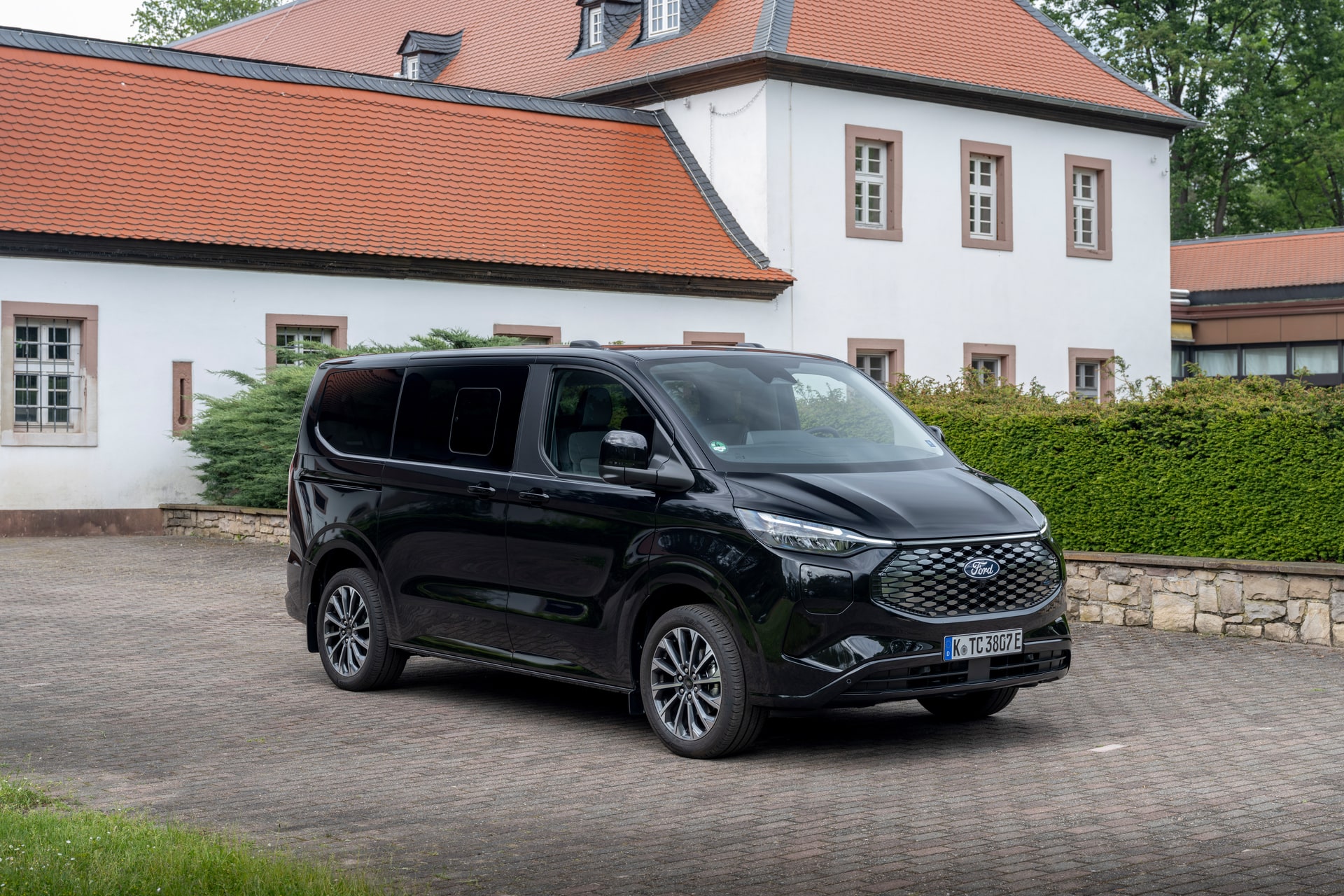
Ford Tourneo Custom: the option that doesn’t give away the budget
The Tourneo Custom in Titanium trim with the 2.0 EcoBlue 136 CV (100 kW) engine does not seek brand epic; it seeks to go unnoticed in a good way: it neither screams low cost nor tries to sell itself as a luxury product. For company transfers without an explicit VIP pretension, it performs perfectly well and nobody notices the price difference with its rivals.
| Model | Power | Fuel | Consumption | Label | Price from |
|---|---|---|---|---|---|
| Ford Tourneo Custom 2.0 EcoBlue 136 | 100 kW / 136 CV | Diesel | 7.0 l/100 km | C | 39,200 € |
Real passenger comfort: seats, space and access
This is where the Multivan pulls ahead. Its individual sliding and swivelling seats allow the rear lounge to be configured as a meeting room, something no rival in this trio offers as standard. The Vito Tourer has better interior height and easier access for passengers with reduced mobility thanks to its flat floor, but its rear seats are less sophisticated than those of the German car-derived models. The Tourneo Custom sits in between: generous space, but the cabin feels more utilitarian, more “well-dressed van” than rolling lounge.
Total 4-year cost of ownership: where money is won and lost
The Tourneo Custom’s entry price is 19% lower than the Multivan’s, a difference that over 4 years and with a fleet of several units shows up in the balance sheet. Maintenance on the Ford also tends to be cheaper at multi-brand workshops, while the Vito Tourer and the Multivan more often rely on the official network, which makes servicing more expensive. That said, the residual value of the Mercedes and the Volkswagen holds up better on resale after 4 years, which offsets part of the initial difference if the company renews its fleet regularly.
Which powertrain suits which type of route
For urban routes with frequent entries into ZBEs (low-emission zones), diesel remains viable with a C label on all three models, but it is advisable to monitor regulatory developments up to 2027. For airport transfers with long motorway stretches, diesel keeps a clear advantage in range and cost per kilometre over electrified alternatives. For anyone combining both uses who wants to hedge against future restrictions, plug-in hybrid versions of the Multivan (eHybrid) already exist, allowing electric driving on urban stretches and using the combustion engine on the road, although at an extra cost that only pays off with heavy daily urban use. Those who want to explore this dilemma further can review how to choose between a petrol/diesel or electric passenger van based on daily kilometres.
Other alternatives to consider
The Stellantis group offers a cheaper route with the Peugeot Traveller and the Citroën SpaceTourer, both in 8-seat configurations and with entry prices below 40,000 €, although their perceived image sits a step below the main trio for a demanding corporate customer. The Opel Zafira Life, a platform sibling of both, adds one more option if the fleet already works with that supplier and seeks maintenance uniformity. For anyone managing several units and prioritising pure cost over image, it is worth reviewing how to choose a 9-seat van for a company based on the total cost of ownership over 5 years.
Comparison table
| Model | Power | Consumption | Label | Price from | Warranty | Image | Comfort | 4-year cost | Overall score |
|---|---|---|---|---|---|---|---|---|---|
| Mercedes-Benz Vito Tourer 116 CDI | 116 CV | 7.4 l/100 km | C | 43,500 € | 2 years, no km limit | 9 | 7 | 6 | 7.5 |
| Volkswagen Multivan TDI 150 | 150 CV | 6.8 l/100 km | C | 48,900 € | 3 years / 100,000 km | 8.5 | 9 | 6.5 | 8 |
| Ford Tourneo Custom 2.0 EcoBlue 136 | 136 CV | 7.0 l/100 km | C | 39,200 € | 3 years, no km limit | 7 | 7 | 8.5 | 7.8 |
Verdict: which van to choose based on your use case
For a 4- to 5-star hotel with a reception shuttle, where image accounts for 70% of the decision: Mercedes-Benz Vito Tourer. The extra cost is repaid in brand perception, which is exactly what is being sold in that service.
For long corporate transfers, with executive customers travelling more than 40 minutes per trip and valuing the ability to work or hold meetings inside the vehicle: Volkswagen Multivan. Its swivelling seats and lounge-style space justify the 12% premium over the Vito and the 19% over the Ford.
For large fleets where cost per kilometre rules and VIP image is not the selling point, but reliable everyday service is: Ford Tourneo Custom. It is, by a wide margin, the option with the best price-to-performance ratio of the trio, and its warranty with no kilometre limit in Spain reduces risk in high-use fleets.
The price gap between the Tourneo Custom and the Multivan exceeds 19%, so if the budget is tight and brand image is not decisive in your customer segment, the Ford makes up the difference without the passenger noticing any real drop in comfort.
Frequently asked questions
Which 7- to 9-seat van conveys the best image for a luxury hotel?
The Mercedes-Benz Vito Tourer remains the reference for its immediate brand recognition, although the Volkswagen Multivan offers superior interior comfort at a somewhat higher price.
Is the Volkswagen Multivan worth it over the Ford Tourneo Custom for corporate transfers?
If journeys exceed 30–40 minutes and the customer values being able to meet or work in the vehicle, yes. For short trips or large fleets, the Tourneo Custom offers a better total cost of ownership.
What environmental label do these vans carry and does it affect their use in ZBEs?
The three diesel versions analysed carry a C label, which allows them to circulate today in most Spanish ZBEs, although it is advisable to check the current municipal regulations before committing a fleet over the long term.
Are there public grants for buying a passenger van for a company?
Yes, within the framework of the Plan Auto+, although amounts and requirements vary and it is advisable to check them directly on the official website before calculating the final cost of the operation.
