

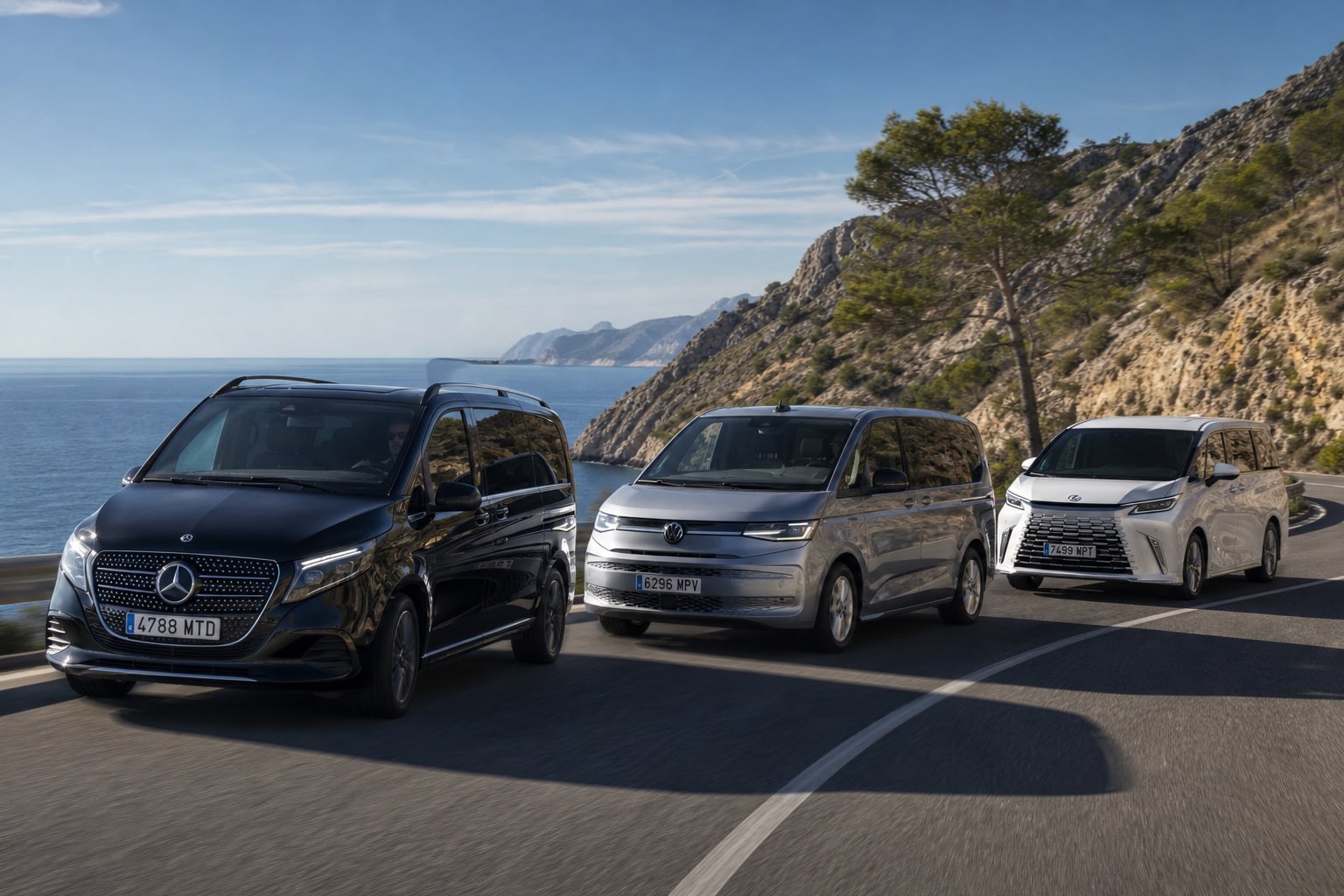
Three cars, three different philosophies for tackling the same problem: moving several people with a level of comfort that a seven-seat SUV cannot offer. The Mercedes-Benz V-Class, the Volkswagen Multivan and the Lexus LM share the segment but not the target market. One aims at the professional chauffeur, another at the self-employed professional who needs daily versatility, and the third plays directly in the VIP transport league. Let’s look at what each one does well and where it falls short.
Mercedes-Benz V 220 d: the balance between size and refinement, from €76,200
The V-Class in its 220 d 163 4p configuration with 9G-Tronic gearbox is the most “all-round” option of the trio. A 160 hp diesel, enough to move with ease without chasing sports-car figures, and a nine-speed automatic gearbox that smooths out any long journey. It is the MPV that Mercedes best understands as a representative tool: an interior with materials worthy of an E-Class, the possibility of configuring up to seven independent seats, and an exterior look that does not give away its origins as an adapted van, something that does happen with other rivals in the segment.
| Power (kW) | Power (CV) | Top speed | Consumption | CO₂ emissions | Fuel |
|---|---|---|---|---|---|
| 120 kW | 160 CV | 190 km/h | 7 l/100 km | 190 g/km | Diesel |
Volkswagen Multivan 2.0 TDI: the most efficient diesel option of the trio, from €57,100
The diesel Volkswagen Multivan, in its 2.0 TDI 150 version with seven-speed DSG gearbox, is the one that best understands intensive daily use. It does not aim to compete with the V-Class on perceived luxury, but its consumption of 6.5 l/100 km is the lowest of the three, and its starting price, roughly €19,000 below the Mercedes, makes it the option with the best value for money for anyone who covers many kilometres each month. We have already discussed its behaviour as a work tool for premium transfers and it became clear there: it keeps up the pace of a self-employed professional without faltering, although the interior finish does not disguise its kinship with VW’s commercial range.
| Power (kW) | Power (CV) | Top speed | Consumption | CO₂ emissions | Fuel |
|---|---|---|---|---|---|
| 110 kW | 150 CV | 190 km/h | 6.5 l/100 km | 170 g/km | Diesel |
Lexus LM 350h: the luxury MPV with no direct rival in Spain, from €131,000
Here the approach changes radically. The Lexus LM 350h, in its six-seat Luxury AWD trim with 2.5 hybrid powertrain, does not compete on price with anyone in this trio: its indicative RRP is around €131,000, more than double that of the V-Class. What it offers in return is a rear-cabin experience closer to a suite than to a car seat, with its combined 250 CV moving with the smoothness characteristic of the Toyota-Lexus hybrid system. It is the only one of the three without a diesel option, and the only one with four-wheel drive as standard. For VIP fleets of five-star hotels or high-level corporate events, it is practically the reference in the Spanish market right now.
| Power (kW) | Power (CV) | Top speed | Consumption | CO₂ emissions | Fuel |
|---|---|---|---|---|---|
| 180 kW | 250 CV | 180 km/h | 7 l/100 km | 160 g/km | Hybrid (petrol/electric) |
Where each one wins, no half measures
The Multivan wins on real-world consumption and on entry price: it is by far the cheapest to get into and the one that uses the least fuel. The V-Class wins on configuration versatility and on the perception of a premium all-round brand, useful when the car is used both for business and for family. The Lexus LM wins on rear-seat comfort and on quiet running thanks to its hybrid powertrain; nothing else in this comparison comes close there. What it does not win is the price battle: with a difference of more than 70% over the V-Class, its buyer is a completely different one.
Summary table and verdict
| Model | Engine | Power | Consumption | Price from | Score |
|---|---|---|---|---|---|
| Mercedes-Benz V-Class 220d | Diesel | 160 CV | 7 l/100 km | €76,200 | 8.0/10 |
| Volkswagen Multivan 2.0 TDI | Diesel | 150 CV | 6.5 l/100 km | €57,100 | 8.3/10 |
| Lexus LM 350h | Hybrid | 250 CV | 7 l/100 km | €131,000 | 8.6/10 (in its niche) |
The prices shown are the manufacturer’s recommended RRP, without dealer discounts or one-off campaigns; it is advisable to check current offers and, where applicable, the Plan Auto+ for financing with advantages.
For urban use and daily transfers for the self-employed or small fleets: Volkswagen Multivan, for consumption and entry price. For companies that need representation without overshooting the budget: Mercedes-Benz V-Class, the most reasonable balance of the trio. For VIP fleets, luxury hotels or clients who do not look at the price but demand the best possible rear seat: Lexus LM, without question, although you must accept that it costs more than double its two rivals compared here.
Frequently asked questions
What is the real price difference between the Mercedes V-Class and the Volkswagen Multivan?
The V-Class 220d starts at around €76,200 compared with the €57,100 of the Multivan 2.0 TDI, a difference of approximately 33% in favour of the German from Wolfsburg. That gap shows in the cabin materials and in brand perception, but not so much in mechanical performance.
Is the Lexus LM’s price premium over the V-Class worth paying?
It depends on use. If the car is for high-end corporate transfers or VIP fleets where the rear-seat passenger experience is the product itself, then yes, it is worth it. For standard mixed family or corporate use, the V-Class covers the needs more than adequately for less than half the price.
Which premium MPV consumes least on the motorway?
The Volkswagen Multivan diesel, with a homologated consumption of 6.5 l/100 km compared with the 7 l/100 km of both the V-Class and the hybrid Lexus LM, which on long motorway journeys loses part of its urban hybrid advantage.
Is the Lexus LM as easily available in Spain as the Mercedes V-Class or the Volkswagen Multivan?
Yes, the Lexus LM is officially sold in Spain, although its volume of units is much smaller, as it is a niche product aimed at luxury fleets and high-net-worth private clients, compared with the much more extensive sales network of Mercedes-Benz and Volkswagen.
