

Buying a passenger van in 2026 is, above all, deciding what kind of mileage you are going to do. It is not the same as a hotel moving guests to the airport at 120 km/h for six hours a day as a school service that stops every 400 metres in a city with a ZBE. The same mechanics that shine on the motorway are penalised in the city, and vice versa. Before looking at prices, look at the map.
Two uses, two different vehicles
The “city with stops” pattern penalises the consumption of any diesel and rewards two things: an environmental label with no restrictions and a short turning radius. The “long-distance motorway” pattern reverses the priorities: acoustic comfort at 120, real-world range between refuelling or recharging stops and stable consumption. An electric van with 330 km WLTP range that drops to a real 230 km on the motorway is no good for making Madrid-Valencia twice a day; a diesel at 7 l/100 km in the city does not fit well in a centre with strict ZBE rules either.
Candidates on the table
Volkswagen Multivan — from €58,900
The Multivan T7 is the all-round reference. There is a eHybrid plug-in hybrid version with a 0 label, which is exactly what you need if you enter and leave ZBE zones all day. On long motorway runs, the weight of the battery is a penalty and the small fuel tank forces you to refuel more often than you would like. Modular interior with individual seats that slide on rails — a success for configuring cargo/passenger space according to the day.
| Power CV | Fuel | Label | WLTP consumption |
|---|---|---|---|
| 218 CV | PHEV | 0 | 1.9 l/100 km |
Mercedes-Benz Vito Tourer — from €52,400
The Vito Tourer with the 2.0 CDI of 163 CV and 9G-Tronic automatic gearbox is, as things stand, the most serious option for anyone doing 40,000 km a year on the motorway. At 120 km/h it runs at 7-7.5 l/100 km in real conditions, the acoustic insulation is a step above that of a Trafic or a Traveller, and the chassis does not tire. The downside: C label. If your operation includes Madrid Centro or Barcelona ZBE during restricted hours, it is a real problem.
| Power CV | Fuel | Label | WLTP consumption |
|---|---|---|---|
| 163 CV | Diesel | C | 7.2 l/100 km |
Ford Tourneo Custom — from €48,500
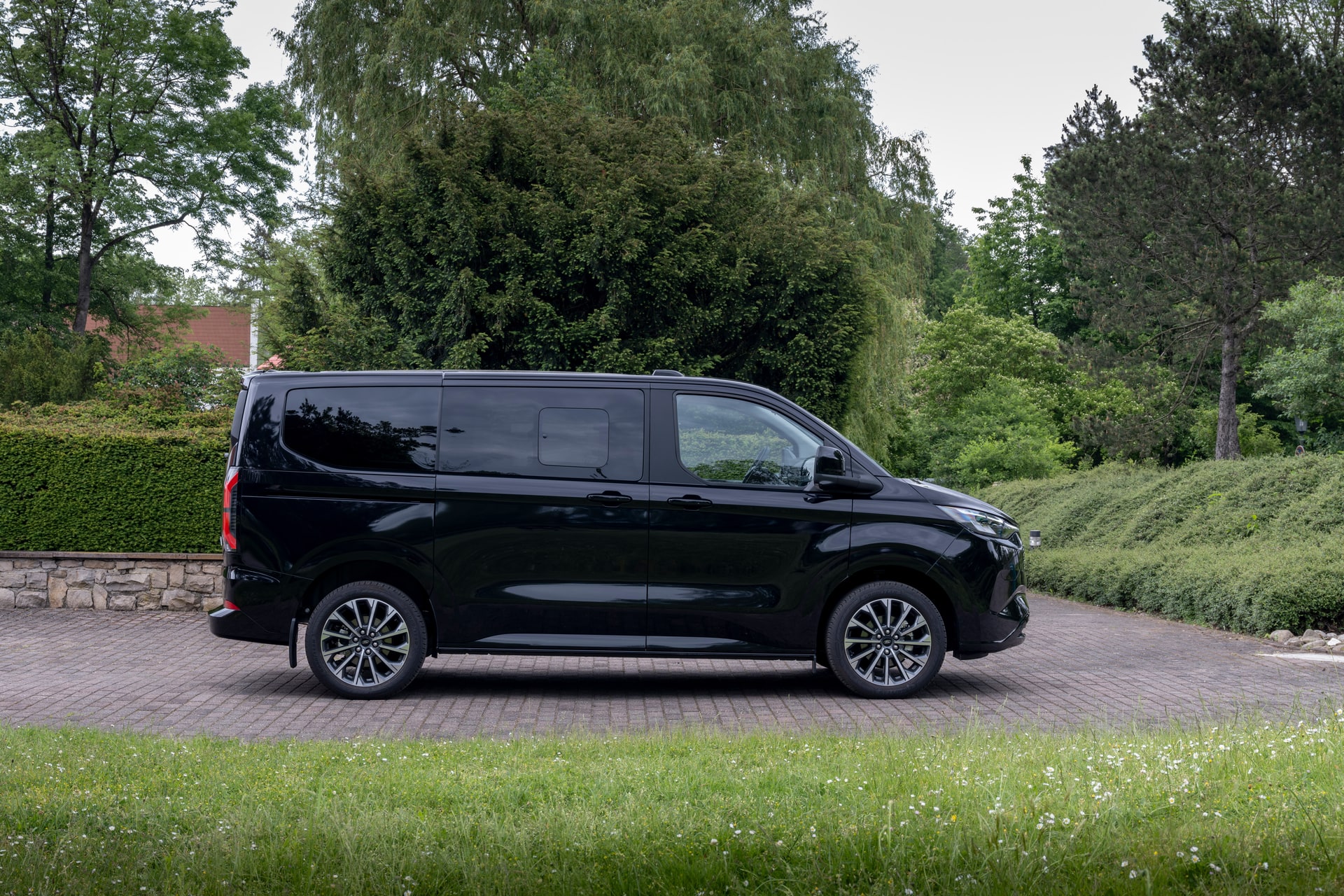
The new Tourneo Custom (second generation) has made a quality leap that places it squarely in the Multivan conversation. There is a 150 CV 2.0 EcoBlue diesel and, most interestingly, a PHEV version with a 0 label and 56 km of homologated electric range. For mixed fleets that combine urban and road use, it is the most rational option on the market. We discussed it in detail in the analysis of the Tourneo Custom as a private transfer vehicle.
| Power CV | Fuel | Label | WLTP consumption |
|---|---|---|---|
| 150 CV | Diesel | C | 7.4 l/100 km |
Peugeot Traveller — from €42,900
The Traveller takes the opposite approach: there is a 100% electric version (e-Traveller) with a 75 kWh battery and around 330 km WLTP. For urban hotel services, nearby airport runs or schools with a fixed base and their own charger, the numbers add up. On long motorway runs, they do not — real range drops and you lose time charging. The BlueHDi 145 diesel Traveller remains an honest option, although the interior feels a step below the Multivan. If you want a direct comparison with its Stellantis siblings, here is the Traveller vs Zafira Life showdown.
| Power CV | Fuel | Label | Range |
|---|---|---|---|
| 136 CV | Electric | 0 | 330 km |
Renault Trafic Passenger — from €39,800
The Trafic Passenger is the reference option for anyone looking at the price per seat without giving up some equipment. 2.0 Blue dCi diesel with several power outputs, C label and a correct, though not remarkable, consumption. It has no electric version adapted for passengers in the current Spanish catalogue — the electric Trafic is sold as a cargo van. For self-employed drivers doing mixed transfers who need to make the investment pay off, this offers the best balance of initial outlay.
| Power CV | Fuel | Label | WLTP consumption |
|---|---|---|---|
| 150 CV | Diesel | C | 7.6 l/100 km |
Diesel, electric or PHEV: what suits each use
Diesel remains unbeatable on pure motorway routes of more than 500 km a day: energy density, refuelling network and purchase price. Electric shines in urban use with a fixed base and short, repetitive routes. The PHEV is the useful compromise: it covers the urban day in electric mode and does not leave you stranded if the service runs long. That said, if you do not charge the PHEV every night, it consumes more than an equivalent diesel — the weight of the battery is paid for on the motorway.
Comparison table
| Model | Powertrain | Label | Price from | Urban use | Motorway use | Overall score |
|---|---|---|---|---|---|---|
| VW Multivan eHybrid | PHEV 218 CV | 0 | €58,900 | 9/10 | 7/10 | 8.5/10 |
| Mercedes Vito Tourer | Diesel 163 CV auto. | C | €52,400 | 5/10 | 9/10 | 8/10 |
| Ford Tourneo Custom | Diesel 150 CV / PHEV | C / 0 | €48,500 | 8/10 | 8/10 | 8/10 |
| Peugeot e-Traveller | Electric 136 CV | 0 | €42,900 | 9/10 | 5/10 | 7.5/10 |
| Renault Trafic Passenger | Diesel 150 CV | C | €39,800 | 6/10 | 7.5/10 | 7/10 |
What to check before signing
Real turning circle (important if you work in historic centres), total height if you have a car park with a barrier at 1.90 m, access to the Plan Auto+ if you choose an electrified model, and real seats with luggage. A van approved for 9 seats with the third row occupied leaves barely any room for a hand luggage bag. For the tax aspect between approvals, review the difference between M1 and N1.
Verdict by use case
- City with constant stops and strict ZBE: Peugeot e-Traveller if you have your own charger. Volkswagen Multivan eHybrid if you cannot depend on third-party charging.
- Professional long-distance motorway use: Mercedes-Benz Vito Tourer with automatic gearbox. No other model maintains comfort and driver fatigue levels over 600 km days.
- 50/50 mixed city-road use: Ford Tourneo Custom. It is the most honest on both terrains, with PHEV available and a reasonable price.
- Price-performance ratio: Renault Trafic Passenger. It enters the market €19,000 below the Multivan eHybrid — a huge difference — and does the job if you do not need a 0 label.
Frequently asked questions
Is an electric passenger van worth it in 2026?
Yes, if your operation is urban, with a fixed base, your own charger and routes under 250 km a day. Outside that profile, diesel or PHEV perform better in terms of real range and useful time.
Which 8-9 seat van uses the least fuel on the motorway?
Among diesels, the 163 CV automatic Mercedes Vito Tourer runs at 7-7.5 l/100 km in real conditions at 120 km/h. The Stellantis models (Traveller, Zafira Life, SpaceTourer) come in around 7.5-8 l/100 km under equivalent conditions.
What DGT label does a new diesel passenger van have?
Most are homologated with a C label (Euro 6d), which allows circulation throughout Spain except for specific ZBE restrictions in Madrid Centro and Barcelona during pollution episodes. To avoid any restriction, you need an ECO (PHEV) or 0 label (electric or PHEV with 40+ km of electric range).
Which van has the best turning circle for urban manoeuvres?
Within the 5-metre length category, the Stellantis models (Traveller, SpaceTourer, Zafira Life) in short version offer one of the tightest turning circles, below 11.5 metres kerb to kerb. The Vito Tourer and the Tourneo Custom in long wheelbase version exceed 12 metres.
