

Buying a hybrid SUV-B for less than €30,000 in 2026 is no longer a matter of finding the most efficient engine. Almost all the rivals in this segment have similar consumption figures in the city. The real difference lies in what the manufacturer fits as standard in the entry-level or mid-range trim, which is the one most buyers actually choose: a 360º camera, lane assist systems that don’t get in the way, a screen with wireless Android Auto, or a boot that doesn’t force you to play Tetris with the shopping bags. We have put five models head to head: Toyota Yaris Cross, Renault Captur E-Tech, Hyundai Kona HEV, Honda HR-V e:HEV and Nissan Juke Hybrid.
What “standard equipment” means when you buy under €30,000
A common trick in manufacturers’ brochures is to advertise a starting price with a trim level that almost nobody buys from a dealership. For this guide we have used the trim that actually includes the features that matter to the urban buyer: GSR2 safety (autonomous emergency braking, lane departure warning, traffic sign recognition), automatic air conditioning, a multimedia screen with wireless connectivity and at least rear parking sensors. If a model only offers them as paid options on the base trim, we say so.
The real criteria: safety, ECO label and connectivity without small print
All five carry the DGT ECO label, so that box alone decides nothing. What does separate them is whether the lane-keeping assistant is useful or a nuisance you have to switch off every time you start the car, and whether the central screen responds smoothly or hesitates like a five-year-old phone. That is where some manufacturers have invested and others have preferred to save.
Toyota Yaris Cross — from €24,950
The cheapest of the five and, paradoxically, the one that spreads standard safety most evenly: every trim includes the complete Toyota Safety Sense package, something not all its rivals can say. Its 320-litre boot is adequate rather than outstanding, and the central screen is a little small compared with the rest.
| Model | Power | WLTP consumption | Label | Fuel |
|---|---|---|---|---|
| Toyota Yaris Cross 1.5 HEV | 85 kW / 116 CV | 4.2 l/100 km | ECO | Hybrid |
Renault Captur E-Tech full hybrid — from €27,900
It is the only one in the group with a variable-capacity boot thanks to its sliding rear bench, which gives between 422 and 536 litres depending on how you configure it. For someone who uses the car in the city during the week and needs room for luggage at weekends, that flexibility matters. The E-Tech system, however, is a little more abrupt in petrol-to-electric transitions than the Toyota’s.
| Model | Power | WLTP consumption | Label | Fuel |
|---|---|---|---|---|
| Renault Captur E-Tech full hybrid 145 | 105 kW / 145 CV | 4.4 l/100 km | ECO | Hybrid |
Hyundai Kona HEV — from €26,950
The balanced choice of the range: a 407-litre boot, by far the largest of the five, and a 5-year warranty with unlimited mileage, which in this segment still stands out against European and Japanese competitors. We analyse it in more detail in our comparison of the Hyundai Kona Hybrid versus the Toyota C-HR and Renault Captur, and the conclusion has not changed: on cargo space, it wins hands down.
| Model | Power | WLTP consumption | Label | Fuel |
|---|---|---|---|---|
| Hyundai Kona 1.6 HEV | 104 kW / 141 CV | 4.4 l/100 km | ECO | Hybrid |
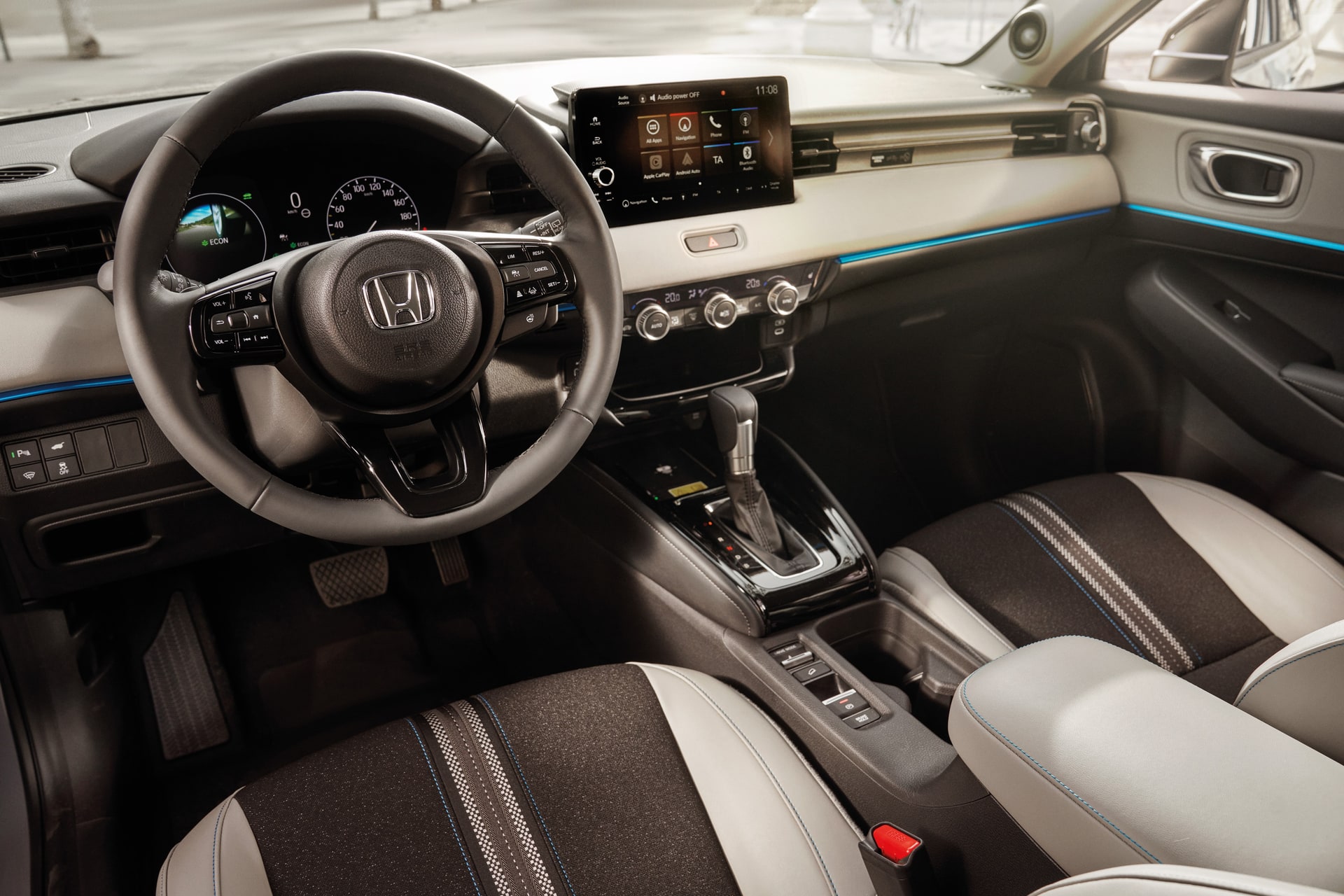
Honda HR-V e:HEV — from €29,950
The most expensive and the one that fits the €30,000 limit least comfortably: it just about makes it. In return it offers the most refined drivetrain in the group, with a power split between electric motor and combustion engine that feels smoother in town than the rest. Its 319-litre boot is among the smallest, and that is where the small print lies.
| Model | Power | WLTP consumption | Label | Fuel |
|---|---|---|---|---|
| Honda HR-V e:HEV | 96 kW / 131 CV | 5.1 l/100 km | ECO | Hybrid |
Nissan Juke Hybrid — from €25,900
The most eye-catching from the outside and the one with the strongest personality inside, with a more sporty driving position than the rest. Its 354-litre boot is modest, and its hybrid system, which has no conventional gearbox, is interesting to drive but less intuitive than the Toyota’s or Hyundai’s during the first week.
| Model | Power | WLTP consumption | Label | Fuel |
|---|---|---|---|---|
| Nissan Juke Hybrid | 105 kW / 143 CV | 4.9 l/100 km | ECO | Hybrid |
Summary table: the five head to head
| Model | Price from | Boot | Warranty | Standard equipment score (1-10) |
|---|---|---|---|---|
| Toyota Yaris Cross | €24,950 | 320 L | Up to 10 years with dealer servicing | 8.5 |
| Renault Captur E-Tech | €27,900 | 422-536 L | 2 years + extendable | 7.5 |
| Hyundai Kona HEV | €26,950 | 407 L | 5 years unlimited | 9 |
| Honda HR-V e:HEV | €29,950 | 319 L | 3 years + extendable | 7 |
| Nissan Juke Hybrid | €25,900 | 354 L | 3 years/100,000 km | 7.5 |
Where each one wins, no sugar-coating
The Toyota Yaris Cross wins on standard safety in its entry trim and on long-term warranty: no one in the segment matches those ten years if you keep up the servicing at an official dealer. The Hyundai Kona HEV wins on boot space and on a warranty that applies from day one, with no maintenance conditions. The Renault Captur E-Tech wins on cargo versatility thanks to its sliding rear bench, something neither Toyota nor Honda offers. The Honda HR-V e:HEV wins on mechanical smoothness, though it pays for it with the tightest boot and a price that eats almost all of the margin under €30,000. The Nissan Juke Hybrid wins on driving character and exterior design, ground where the other four play it safe.
If you want to dig into real-world city consumption before deciding, it is worth reviewing the SUV-B hybrids with the lowest real-world consumption in traffic jams below €30,000, where the differences between these same models show up more clearly in dense traffic than on the WLTP figures.
The verdict: which model to choose depending on your case
For pure city driving on a tight budget, the Toyota Yaris Cross wins on standard safety and total cost of ownership, although its boot means planning big shopping trips more carefully. For those who need real cargo space without leaving the B-segment, the Hyundai Kona HEV is the most rounded option: the largest boot in the group and a warranty without conditions. If versatility for weekend getaways with variable luggage is the priority, the Renault Captur E-Tech justifies its roughly €3,000 premium over the Yaris Cross thanks to the sliding bench. The Honda HR-V e:HEV only makes sense at its price if you value driving smoothness above everything else, and the Nissan Juke Hybrid is the right choice if design weighs in your decision as much as the spec sheet. As a reference for current aid on hybrid and electric car purchases, it is worth checking the up-to-date conditions of the Plan Auto+ on the official website before signing, as they may bring the final price below any of these figures.
Frequently asked questions
Which hybrid SUV-B has the best standard equipment for less than €30,000?
The Hyundai Kona HEV offers the best balance between standard GSR2 safety, boot space and a 5-year warranty without conditions, which is why we place it first in the overall score of this guide.
Which hybrid SUV-B has the largest boot within this budget?
The Renault Captur E-Tech, with a range of 422 to 536 litres thanks to its sliding rear bench, beats the other four models compared.
Is it worth paying more for the Honda HR-V e:HEV over the Toyota Yaris Cross?
Only if you prioritise mechanical smoothness over boot space and price: the HR-V costs €5,000 more and offers 1 litre less cargo capacity.
Do all these hybrid SUV-Bs carry the DGT ECO label?
Yes, all five models (Toyota Yaris Cross, Renault Captur E-Tech, Hyundai Kona HEV, Honda HR-V e:HEV and Nissan Juke Hybrid) carry the ECO label as they are non-plug-in hybrids approved in Spain.
