

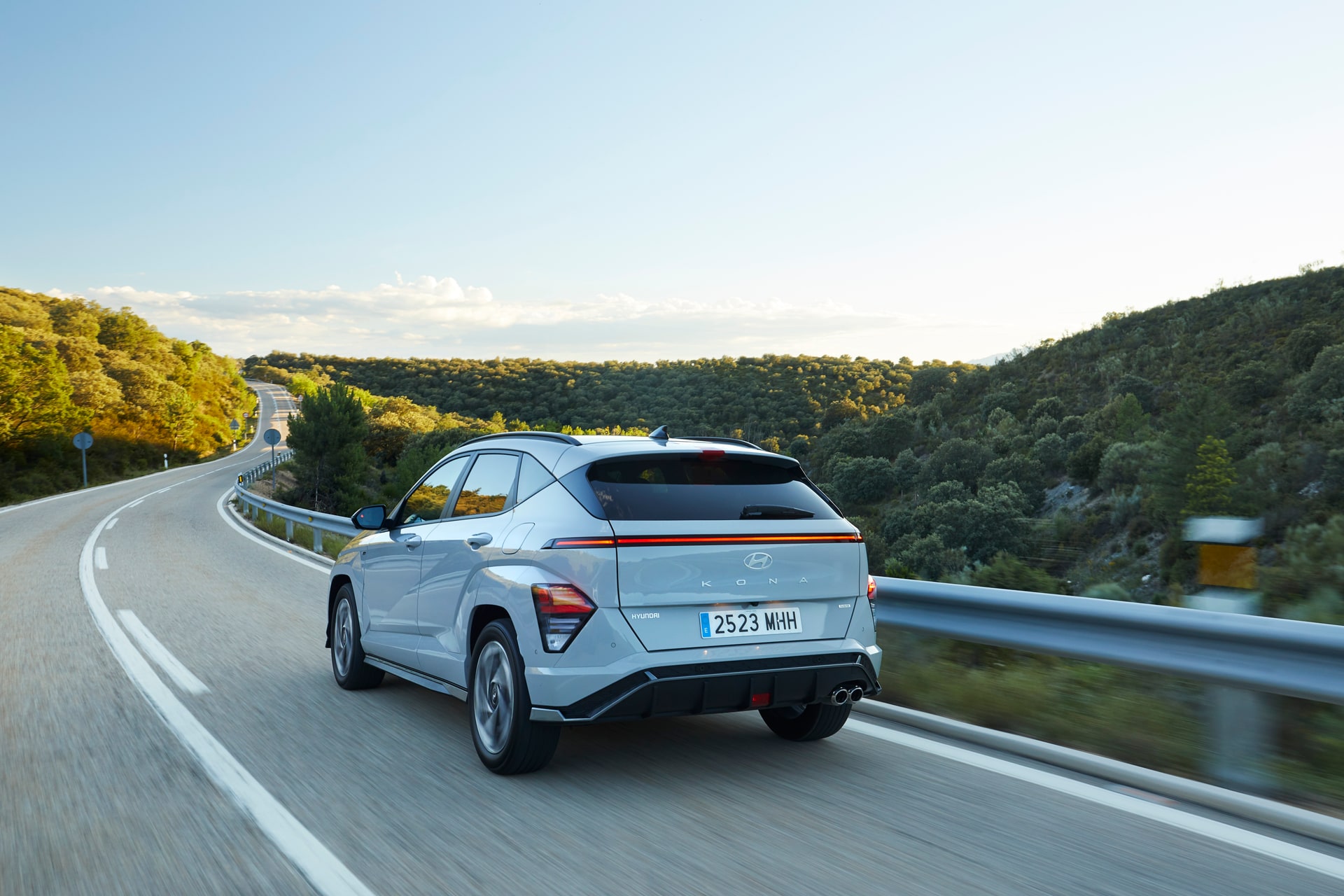
Some comparisons feature two rivals that are so similar you have to dig hard to find differences. This is not one of them. The Omoda 5 SHS and the Hyundai Kona Hybrid share a segment and full hybrid powertrain, but they arrive at that overlap by completely different routes: one goes for more power and a lower entry price, the other for efficiency and a brand presence in Spain that has been established for a decade. The question is not which one is “better” in the abstract. It is which one suits you.
Technical data: Omoda 5 SHS
The Omoda 5 SHS pairs a 1.5 TGDI engine with an electric motor for a combined output of around 220 CV, a figure that is unusual in this segment: most of its rivals sit between 130 and 160 CV.
| Powertrain | Power | Torque | 0-100 km/h | Top speed | Consumption | CO₂ | Price from |
|---|---|---|---|---|---|---|---|
| 1.5 TGDI hybrid | 110 kW / 220 CV | 220 Nm | ≈8 s | ≈180 km/h | ≈5.5 l/100 km | ≈120 g/km | €29,400 RRP |
Technical data: Hyundai Kona Hybrid
The Kona Hybrid, with its naturally aspirated 1.6 GDi supported by an electric motor, gives up muscle in exchange for considerably lower consumption and a smoother response in town.
| Powertrain | Power | Torque | 0-100 km/h | Top speed | Consumption | CO₂ | Price from |
|---|---|---|---|---|---|---|---|
| 1.6 GDi hybrid | 90 kW / 130 CV | 270 Nm | ≈12 s | ≈160 km/h | ≈4.5 l/100 km | ≈100 g/km | €33,500 RRP |
Prices are indicative manufacturer RRPs, excluding dealer discounts, occasional campaigns and incentives such as the Plan Auto+, which you should check on the official website for the current amount.
Design and dimensions: which one takes up less parking space?
The Omoda 5 SHS measures 4,450 mm long, 100 mm more than the Kona Hybrid (4,350 mm). It does not seem much on paper, but in a community car park or a city parking space it is noticeable. The Kona compensates with less weight, 1,490 kg versus the Omoda’s 1,620 kg, which helps both manoeuvrability and the consumption figures we will see later.
Performance and driving behaviour
Here is the first difference that leaves no room for nuance: the Omoda has almost 90 CV more than the Kona. On overtaking and on motorways with gradients it is very noticeable. The Omoda’s 0-100 time is around 8 seconds, compared with 12 for the Kona. That said, power is not always synonymous with enjoyment: the Omoda delivers that strength with a punch that impresses on paper but, in everyday city driving, translates into a slightly abrupt throttle response at low speeds. The Kona, with its 270 Nm well distributed despite its 130 CV, is more docile in urban traffic, which is where a SUV-C actually spends most of its working life.
Real consumption: the Kona’s 4.5 l/100 km versus the Omoda’s 5.5
A litre difference per 100 km is no minor detail if the car covers 20,000 km a year. The Kona Hybrid stays around 4.5 l/100 km, while the Omoda rises to 5.5. Over a year, with petrol at roughly €1.65 per litre, that difference could mean more than €300 of extra fuel for the Omoda. It is the price of carrying more horsepower under the bonnet.
Standard equipment and technology
The Kona Hybrid benefits from the safety and connectivity package that Hyundai has refined generation after generation, something we already analysed in detail when reviewing what the entry-level trim of a hybrid SUV includes as standard. The Omoda 5 SHS, being a newcomer to the Spanish market, plays the card of offering more equipment in its entry trim to make up for its shorter brand track record: bigger screens and more driver assistance systems from the base level. It is a common strategy among brands entering the market to win share, and it works if the buyer prioritises “more for less” over the reassurance of a well-established after-sales network.
Boot and everyday space
Neither of the available data sheets specifies the exact boot capacity in litres, so we will not invent a figure here. What can be stated from the body dimensions is that the Omoda, being longer, usually translates that extra centimetre into a little more luggage space, although in practice the difference is modest.
Price and versions: RRP from €29,400 versus €33,500
The price gap between the two exceeds 15%: the Omoda starts at €29,400 and the Kona at €33,500, roughly €4,100 apart in RRP. This is the variable that weighs most in this comparison, and it is worth keeping firmly in mind before being swayed solely by the power figure.
Summary comparison table
| Model | Power | Consumption | Price from | Score |
|---|---|---|---|---|
| Omoda 5 SHS | 220 CV | 5.5 l/100 km | €29,400 | 7.5/10 |
| Hyundai Kona Hybrid | 130 CV | 4.5 l/100 km | €33,500 | 7.8/10 |
Verdict: which hybrid SUV-C to choose based on your needs
For urban use with short journeys and a focus on consumption: the Kona Hybrid. Its 4.5 l/100 km and lower weight make it more pleasant in everyday city driving, and the brand offers an after-sales reassurance that the Omoda still has to earn in Spain.
For those seeking more power and prioritising the entry price: the Omoda 5 SHS. With almost 90 CV more and an RRP €4,100 lower, it is the logical choice if budget is the deciding factor and you do not mind paying a bit more for fuel in return.
In terms of price-performance ratio, the Omoda wins on equipment volume and power per euro invested, but the Kona offsets that €4,100 difference with lower consumption and a brand backing that, in the long term, weighs on resale value. If your horizon is keeping the car for five years or more, the Kona recovers that initial difference better. If what you want is to enter the SUV-C segment with the most horsepower for the least outlay, the Omoda is the most rational purchase today.
Frequently asked questions
Is the Omoda 5 SHS already on sale in Spain?
Yes, it is on sale and available at Omoda dealerships across the country, with an indicative RRP from €29,400.
What environmental label do the Omoda 5 SHS and the Hyundai Kona Hybrid carry?
As full hybrids, both qualify for the DGT’s ECO label, although you should confirm the exact certification of each trim before purchase.
Can I apply the Plan Auto+ to the purchase of either of these two models?
It depends on the scheme’s requirements in force at the time of purchase. Check the official Plan Auto+ website for the current amount and conditions, as they can vary by autonomous community.
Which one consumes less in the city, the Omoda 5 SHS or the Kona Hybrid?
The Kona Hybrid, with a homologated consumption of around 4.5 l/100 km compared with the Omoda 5 SHS’s 5.5 l/100 km, is more efficient in typical urban use.
