

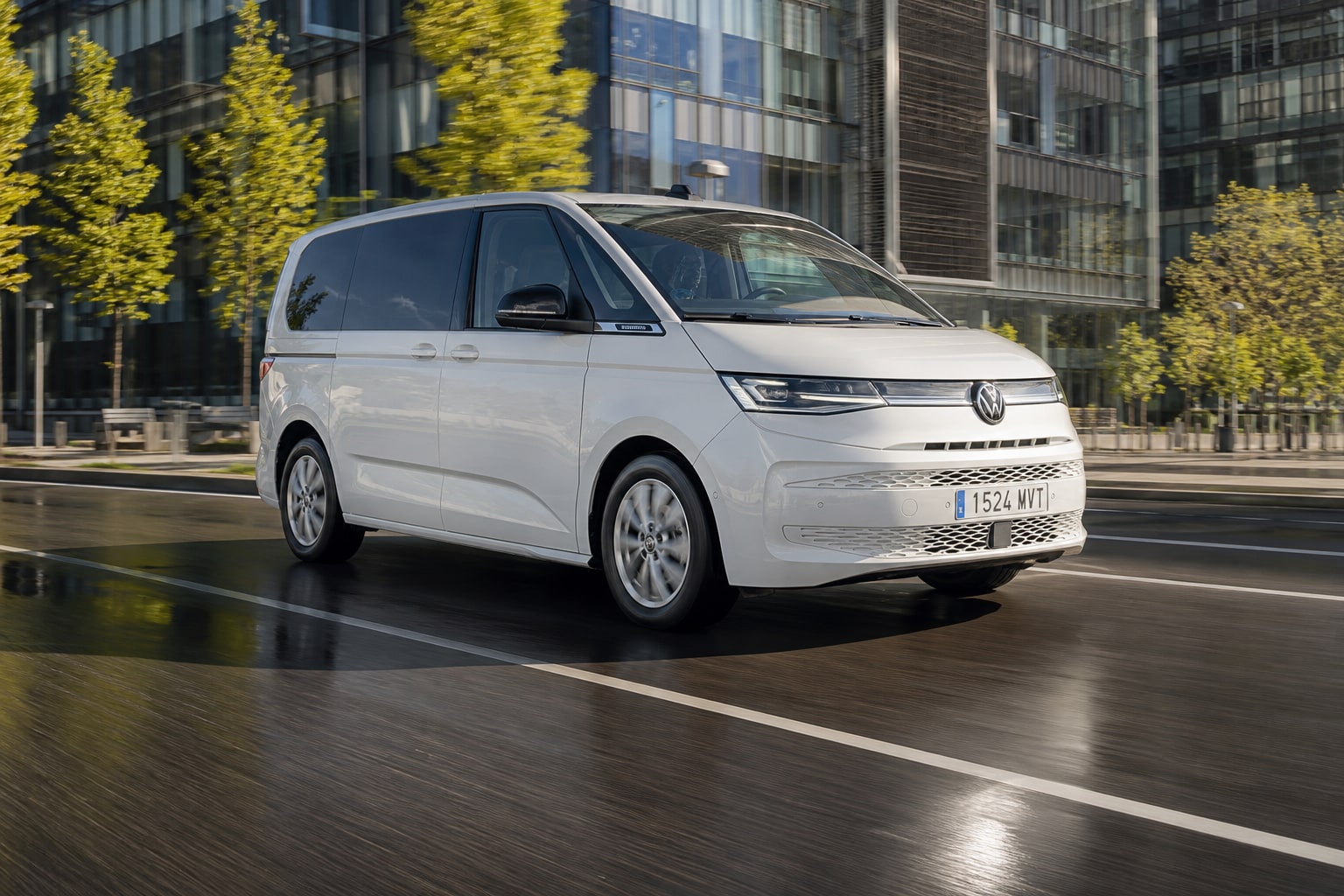
Setting up a premium chauffeur service in 2026 is not decided by the badge on the steering wheel, it is decided by the bottom line. A self-employed VIP transfer driver needs a vehicle that does three things well: the client in the back seat should have no complaints, fuel consumption should not eat into the margin, and maintenance should not stop your schedule for a week every month. The Volkswagen Multivan in its 2.0 TDI 150 CV version with DSG7 gearbox has been appearing for months on the shortlists of this type of buyer. Let us see whether it holds up to scrutiny.
A note before we begin: all prices quoted are manufacturer’s recommended RRP, without dealer discounts, one-off campaigns or aid such as the Plan Auto+. Take them as a reference, not as a closed offer.
Volkswagen Multivan 2.0 TDI 150 DSG7 — from ≈57,100 €
The current Multivan (T7) is no longer the dressed-up Transporter of old. It shares the MQB platform with the group’s passenger cars, and that shows at the wheel and, above all, when you carry a client in the back. It rides flat, filters bumps better than the previous generation, and the cabin has a perceived quality that plays in a different league from any van derived from a commercial model.
The version of interest to the transfer self-employed driver is this one: 2.0 TDI with 150 CV, seven-speed DSG gearbox, diesel. It is not the most powerful in the range, but it balances the accounts. The homologated consumption is around 6.5 l/100 km and, although real-world motorway use will run a little above that with four passengers and luggage, it remains a reasonable figure for a vehicle of this size. The top speed sits at around 190 km/h — irrelevant for the intended use, but indicative that the engine does not run short when overtaking with the car loaded.
| Power kW | Power CV | Top speed | Consumption | Fuel |
|---|---|---|---|---|
| ≈110 kW | ≈150 CV | ≈190 km/h | ≈6.5 l/100 km | Diesel |
VIP habitability: where it shines and where it falls short
The Multivan’s second row is the selling point. The individual seats run on longitudinal rails, rotate 180º and can be removed one by one — useful if one day you need to free up space for bulky luggage from a client flying to Ibiza with three hard-shell suitcases. The sliding central table is a detail that corporate clients value more than one might think: it allows working with a laptop between the airport and the hotel without resting it on your knees.
That said, access to the third row with the two individual seats fitted requires some choreography. An older client with reduced mobility will appreciate the electric sliding door — standard on higher trims — more than the interior layout itself. And the boot with all seven seats occupied is honest but not enormous: enough for hand luggage for everyone, tight if everyone checks in.
Operating cost: the figure that matters
A 150 CV diesel with DSG, well maintained, should come in at fuel costs of between 9 and 11 € per 100 km at current diesel prices. The official maintenance interval and the VW Comerciales network — which is where this car belongs, not a passenger-car dealership — help you plan stops without surprises. The environmental label is C, which allows operation in most Spanish ZBEs, although with growing restrictions in Madrid Central and equivalent areas of Barcelona. That is probably the biggest strategic weak point of choosing diesel today for a five-year business.
Mercedes-Benz V-Class — the direct rival to reckon with
You cannot talk about the Multivan as a VIP tool without putting the V-Class alongside it. It is the car the client expects to see when booking a premium transfer — the three-pointed star weighs on the perception of the service, whether we like it or not. Mechanically it has plenty to spare (the 220 d and 300 d have been well tuned for years), the interior of the Avantgarde or Exclusive trim feels a step above the Multivan in fine materials, and soundproofing at 120 km/h is noticeably better.
Where does it lose out? In entry price — it starts clearly above the Multivan, with differences exceeding 15% when you compare equivalent versions — and in a drive that still feels more “van” than the VW. The Multivan feels more like a car; the V-Class, more like a recognisable professional tool. For a specific analysis of interiors between the two, we already covered the direct face-off between the Multivan and the V-Class in another article.
We do not include a technical table for the V-Class because the range is broad and the specific figures for the comparable version should be verified in the official configurator before closing any deal.
Where each one wins, no half measures
The Multivan wins on:
- Driving dynamics and driver comfort on long working days.
- Entry price for a self-employed driver starting out or renewing a fleet.
The V-Class wins on:
- Brand perception by the end client (the logo sells the transfer).
- Refinement of materials in higher trims and acoustic insulation.
Summary table and score
| Model | Version | Price from | VIP comfort | Operating cost | Brand image | Overall score |
|---|---|---|---|---|---|---|
| Volkswagen Multivan | 2.0 TDI 150 DSG7 | ≈57,100 € | 8/10 | 8/10 | 7/10 | 8/10 |
| Mercedes-Benz V-Class | Equivalent diesel | Significantly higher | 9/10 | 7/10 | 9/10 | 8.5/10 |
Verdict by use case
- Self-employed driver starting a premium service on a tight budget who wants healthy margins from day one: Volkswagen Multivan 2.0 TDI 150 DSG7. The price gap with the V-Class — over 15% on comparable versions — translates into monthly instalments and a realistic amortisation.
- Established chauffeur whose client portfolio is luxury hotels, weddings and corporate accounts that expect a Mercedes: V-Class. Here the logo is part of the product you sell.
- Best price-performance ratio and mixed use (airport + events + intercity transfers): Multivan, no question. It is the car that best balances what you pay, what you consume and what the passenger perceives.
One final consideration: if your work is concentrated in central Madrid or Barcelona and you expect to grow in the coming years, it is worth also looking at the plug-in hybrid range of the Multivan itself before signing for the diesel. The C label conditions routes, and that is also a cost.
Frequently asked questions
Does the Volkswagen Multivan 2.0 TDI 150 CV have enough power for transfers loaded with seven passengers and luggage?
Yes. The 2.0 TDI with 150 CV and DSG7 moves the whole with solvency on the motorway and on ramps, although it is not a car with brilliant recoveries at full load. For transfer use — where smoothness is sought, not performance — it is the most reasonable balance in the range.
What real consumption can be expected in mixed professional use?
The homologated figure is around 6.5 l/100 km. In real use by a transfer self-employed driver, with variable load and a mix of motorway and urban driving, it is reasonable to expect between 7 and 8 l/100 km depending on driving style and the percentage of kilometres in the city.
Is it worth paying the difference up to a Mercedes-Benz V-Class?
It depends on your client portfolio. If you invoice companies and hotels that value the star on the front, the extra investment is recovered in service perception. If your business is more across the board (private clients, weddings, one-off transfers), the Multivan leaves you more margin at the end of the month.
What environmental label does the diesel Multivan have, and does it affect work in ZBEs?
It carries a C label. It allows circulation in most low-emission zones in Spain, but with growing restrictions in central Madrid and Barcelona. If a large part of your operation is in those areas, it is also worth studying the plug-in hybrid variant before deciding.

1 Comment
Pingback: Mercedes-Benz Clase V vs Volkswagen Multivan vs Lexus LM: tres monovolúmenes premium de pasajeros frente a frente – Comparativa de Coches