

Every week, a question arrives in the magazine’s inbox: “We have three children, should I get a 7-seat SUV or a minivan?” The short answer is uncomfortable for current fashion. The long answer is the one worth reading.
For a decade, marketing has been pushing the 7-seat SUV as the universal family solution. And for many families with two children it works reasonably well. But when the third child arrives — and especially when all three are still in car seats or booster seats — the problem changes in nature. It is no longer a question of seats. It is a question of interior geometry.
What technically defines a minivan
A minivan, strictly speaking, is a vehicle designed around the cabin. Tall roof, flat or nearly flat floor, vertical sides, forward-positioned A-pillars. The engine and wheel arches take up only what is strictly necessary so the rest becomes usable cargo space. The silhouette looks like a bar of soap because it is optimised to carry people, not to look sporty.
The SUV, however many rows it has, follows the opposite logic: a tall body mounted on a platform that prioritises the look of a “capable” car, with a long bonnet, a sloping rear window and generous wheel arches. Seven seats, yes, but squeezed in wherever they fit.
Track width at the rear wheels: the figure nobody tells you about
Here is the most honest criterion for a family with three young children: how wide the bench is between the rear wheel arches. Three ISOFIX-approved child seats need, in practice, around 140-150 cm of usable width to be installed without overlapping or leaving the anchor points inaccessible.
Most mid-size C/D-segment 7-seat SUVs offer second-row benches of 130-140 cm of usable width between wheel arches. Technically, three seat belts fit. In real life, fitting three ISOFIX seats with accessible buckles, and children who don’t bump their heads at every bend, is a different story. A proper minivan — and even more so one derived from a van — works within 150-160 cm. It sounds like a small difference. It isn’t.
Third-row access: sliding door vs hinged door
The 7-seat SUV requires folding and tilting the second-row seatback to get to the back. With a child seat installed in the second row, that movement becomes an awkward exercise — and sometimes impossible without uninstalling the seat. The minivan’s sliding door eliminates the problem at its root: fixed second row, direct access to the third row through the side opening.
Add the supermarket car park factor. A sliding door doesn’t dent the car next to you. A large SUV’s hinged door, with a small child swinging it open at will, can.
Boot space with all 7 seats in use: the real test
This is the other figure the brochure hides. A typical 7-seat SUV on the market — Kodiaq, Sorento, Santa Fe, Tayron — offers between 170 and 230 litres with the third row deployed. For a weekend with three children, that’s a bread bag. A large minivan provides between 500 and 1,000 litres in the 7-seat configuration, depending on the model.
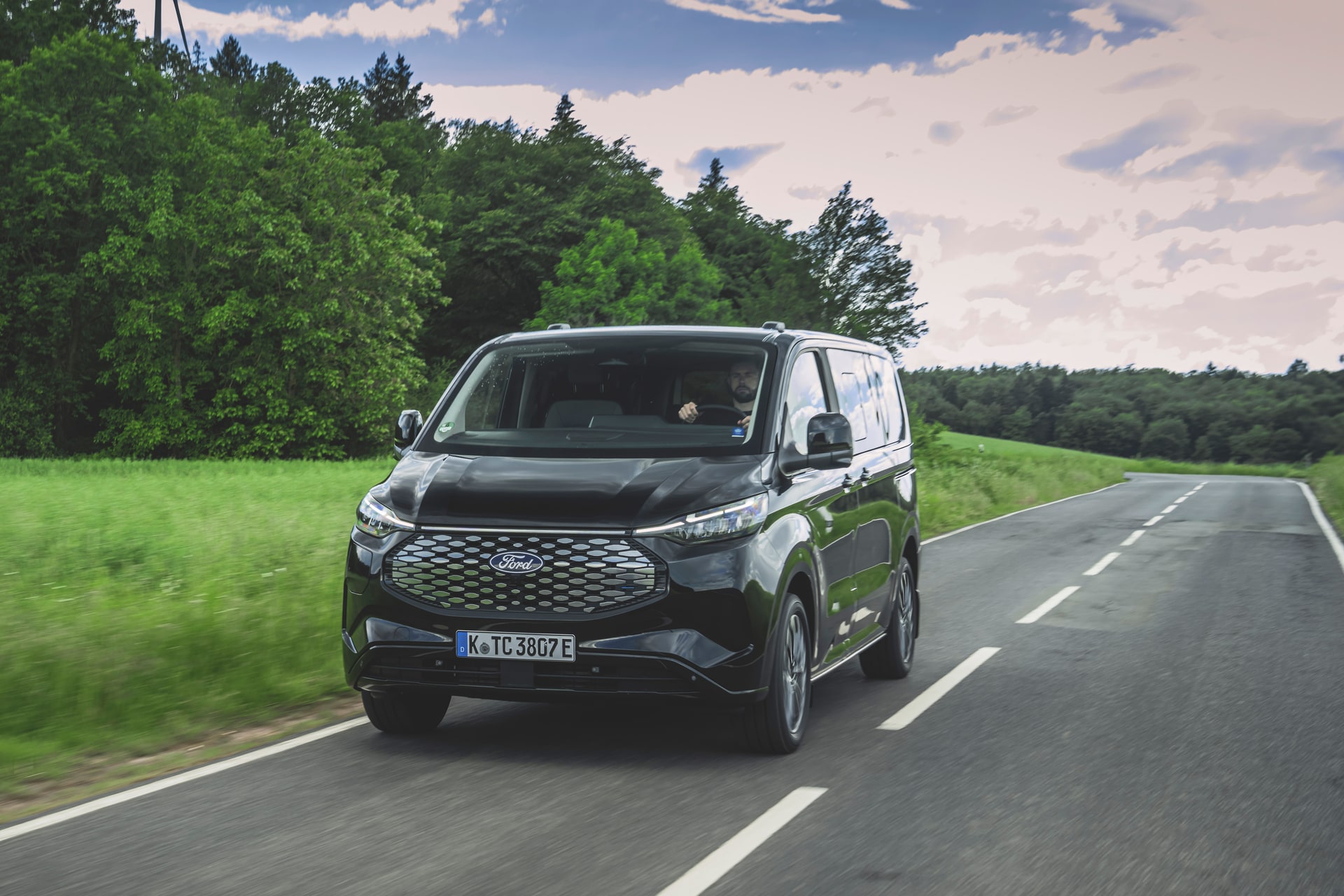
Ford Tourneo Custom: the segment’s representative example (from ~€55,000)
In the Spanish market, the Ford Tourneo Custom is probably the clearest benchmark for a large minivan available today, with up to 8-9 seats, electric sliding doors in higher trims and a flat floor that makes reconfiguring the seats fairly easy. It is not a cheap car and does not pretend to be one: its 2.0 EcoBlue diesel engine and its size place it in a league of its own within the “family” category. But for a family of five with real luggage, it is one of the few solutions that doesn’t force you to give anything up.
The Tourneo Custom does not appear in the technical data table of this article, so we do not quote firm power or consumption figures here — you can consult the dedicated Tourneo Custom review, where we go into detail.
Where the 7-seat SUV objectively wins
Not everything favours the minivan. There are two areas where a well-built family SUV wins without argument:
- Driving and road presence. A lower centre of gravity than a van, more direct steering, greater sense of composure at 120 km/h. A large minivan drives well, but you can tell it is tall.
- Image and resale value. Whether you like it or not, SUVs sell better second-hand. A large minivan’s depreciation is usually harsher in the short term.
Where the minivan objectively wins
- Real cubic metres per euro spent. No SUV at the same price comes close to the useful volume of a proper minivan.
- Family ergonomics. Access, sliding doors, a third row habitable for adults and not just for children up to 1.40 m.
Comparison table: 7-seat SUV vs minivan for a family with 3 children
| Criterion | Typical 7-seat SUV | Tourneo Custom-type minivan |
|---|---|---|
| Usable 2nd-row bench width | 130-140 cm | 150-160 cm |
| 3 ISOFIX seats in 2nd row | Tight / problematic | No problem |
| 3rd-row access | Folding the 2nd row | Side sliding door |
| Boot with 7 seats | 170-230 L | 500-1,000 L |
| 3rd row for adults | Up to 1.70 m with a squeeze | Habitable without drama |
| Loading height | Moderate | High (raised roof) |
| Dynamic driving | Superior | Correct, not sporty |
| Starting price (reference) | ~€40,000-55,000 | ~€55,000 (Tourneo Custom) |
Prices are the manufacturer’s recommended RRP, for reference only, excluding dealer discounts, one-off promotions and purchase aid such as the Plan Auto+.
Verdict by use case
- Family with three young children (all three in a car seat or booster) and mixed city-and-trip use: large minivan, such as the Ford Tourneo Custom. It is the only category that simultaneously solves the three seats in the second row, third-row access and boot space with everyone on board. If the budget doesn’t stretch that far, a 7-seat compact minivan (Tourneo Connect, Caddy or Rifter) is the reasonable step down.
- Family with three children where the eldest is already out of a car seat: here the 7-seat SUV comes back into the equation. A 135 cm bench stops being a problem when there are only two seats to fit. A Sorento, Santa Fe or Kodiaq wins on driving and residual value.
- Pure price-to-functionality ratio: no SUV matches a minivan for useful litres per euro. If the only criterion is “cubic metres for what I pay”, the minivan wins clearly.
Fashion says SUV. The numbers say minivan. Choosing with judgement means knowing which category your family falls into today — and which one it will fall into in three years’ time.
Frequently asked questions
How many centimetres does a bench need to take three ISOFIX seats?
In practice, between 140 and 150 cm of usable width between wheel arches, depending on the width of the seats. Below 135 cm, fitting three seats with accessible anchor points becomes problematic.
Is a 7-seat SUV suitable for a family with three young children?
Technically yes, in the sense that there are seven seat belts. Functionally, it depends on the model: most C/D SUVs have a second row that is tight for three seats and minimal boot space with all seven in use. If all three children are in car seats, a minivan handles day-to-day life better.
Why do sliding doors make such a difference for families?
They provide access to the second and third rows without needing space from the car next to you, they don’t swing shut on a slope, and they give direct access to the third row without folding the second. With young children and seats already installed, it is the difference between getting in in five seconds or five minutes.
Can a large minivan be used as an everyday car?
Yes, with two caveats: parking in the city requires getting used to its size and turning circle, and fuel consumption on the motorway is higher than an equivalent SUV’s. In return, it is the only format that doesn’t force you to give up space when the trip is loaded.
