

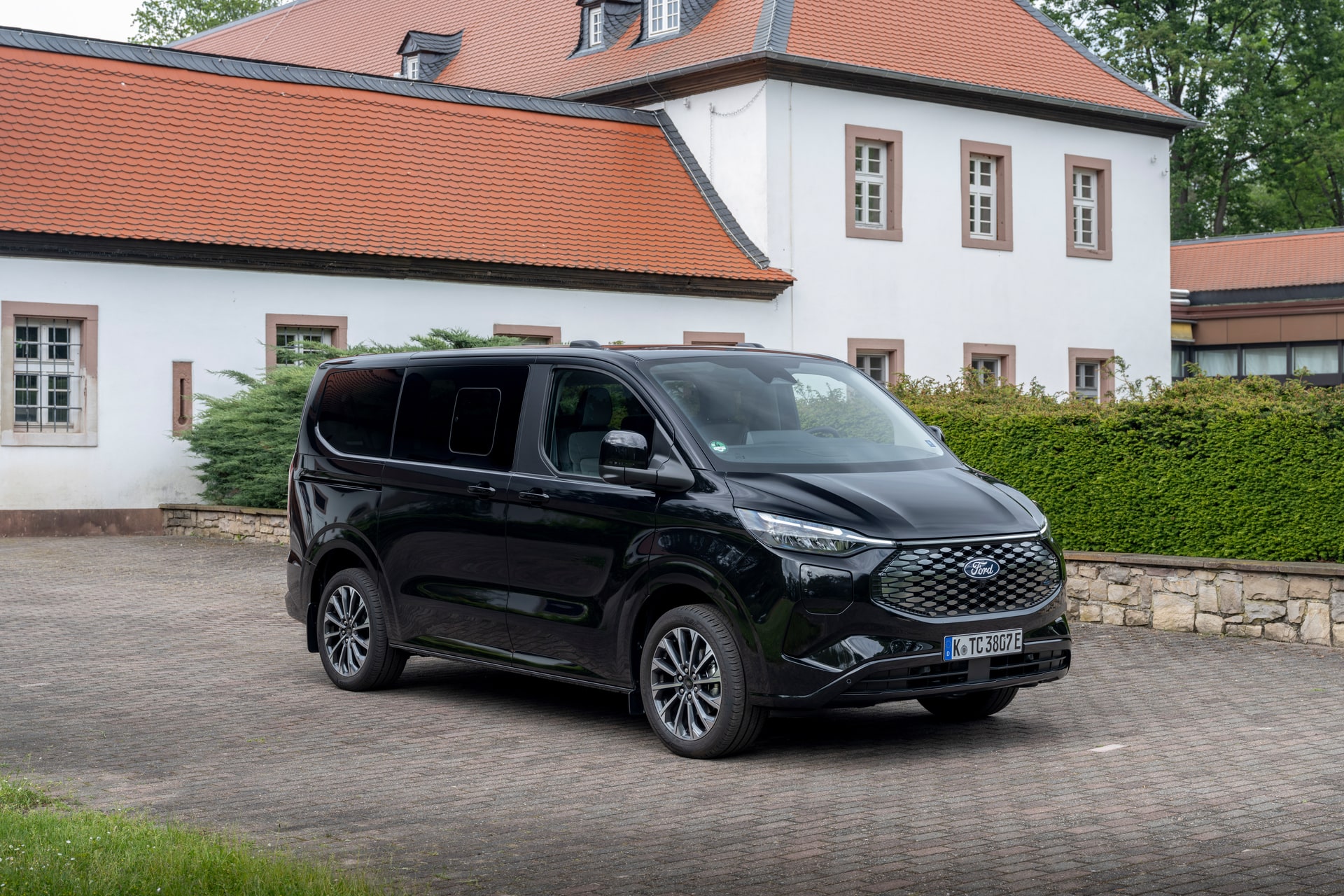
There is a common confusion at the dealership: the customer walks in asking for "a big car for seven" and walks out with a third-row SUV that, in practice, is only good for carrying two small children in the very back on short journeys. For real-world transport of adult passengers, the category you need is a different one. We are talking about the van-derived MPV, a different animal from the family SUV even if the spec sheets agree on the number of seats.
Let’s clear it up with two current archetypes in Spain: the Ford Tourneo Custom as the van-derived MPV and the Hyundai Santa Fe as the 7-seat SUV. They don’t compete with each other — and that is exactly the point.
What a van-derived MPV is
It is a vehicle that starts life as a commercial van (bodywork, platform, doors, high roof) and is adapted to carry people: side windows, homologated second and third rows of seats, acoustic insulation, rear climate control, upholstery, and seat belts and airbags for every seat. The base remains the same as that of the cargo vehicle.
This is where its typical traits come from:
- Interior height that lets you move around standing up or only slightly stooped.
- Sliding side doors, almost always two.
- Flat roof and a pure two-box body.
- Modularity for 7, 8 or 9 seats with individual removable seats or seats on rails.
- A usable boot even with all rows occupied.
The Ford Tourneo Custom is, today, the most quotable example of the segment in Spain alongside the Volkswagen Multivan and the Mercedes-Benz V-Class. It is derived from the Transit Custom van and is offered in configurations of up to 8-9 genuine seats.
What a 7-seat SUV is
It is a passenger car with a tall body and optional four-wheel drive, to which a third row is added above the rear axle. The platform is that of a passenger car or a large SUV, not a van. It prioritises looks, driving dynamics and comfort in the first two rows. The third row, in almost every case, is an emergency one: for children, short journeys or adults without luggage.
The Hyundai Santa Fe is a good example. A mid-size SUV with a third row designed for occasional use, not for a 1.80 m adult to travel four hours without complaining.
The differences that matter when choosing
| Dimension | Van-derived MPV | 7-seat SUV |
|---|---|---|
| Real seats for adults | 7-9 | 5 + 2 occasional |
| Access to 3rd row | Sliding door, standing up | Folding the 2nd row, stooping |
| Boot with all seats in use | Useful (300-700 L) | Minimal (150-250 L) |
| Interior height | 1.30-1.40 m | Head brushing the roof in the 3rd row |
| Road dynamics | Van-like: tall, with body roll | Like a tall passenger car |
| Consumption | Higher, due to frontal area and weight | Lower, especially in hybrids |
| Image | Professional, shuttle-style | Family-oriented, SUV-style |
The point that tends to be overlooked is the boot when the car is full. A 7-seat SUV with all seven seats occupied barely carries backpacks. A van-derived MPV, with all eight seats occupied, still swallows cabin-size suitcases.
Ford Tourneo Custom — from ~52,000 €
The Tourneo Custom is the practical benchmark. Up to 8-9 seats depending on configuration, electric sliding doors available, individual swivelling seats in the second row (in the version with a central table) and a decent boot even when full. Engines: 2.0 EcoBlue diesel with 136 and 170 CV, 8-speed automatic gearbox and a PHEV variant. C or ECO label depending on the powertrain.
For VIP transfers, airport runs or a genuinely large family, this is the car. For popping to the supermarket alone, it isn’t.
We don’t have a finalised spec sheet for the Tourneo Custom in this article’s data block, so we don’t give a table of official figures — it is worth checking the exact version and engine in the configurator, because the price range depending on trim and wheelbase is wide.
Hyundai Santa Fe — 7-seat mid-size SUV segment
The Santa Fe plays in a different league. A family SUV with an occasional third row, a raised-passenger-car platform, hybrid engines (HEV and PHEV) and an ECO or 0 label. It is more comfortable than the Tourneo on a trip with two adults, consumes less and has a better "family car" image. But if someone sits in the very back for four hours, they will remember it.
We don’t have a finalised official spec sheet here either; the exact power and consumption figures should be verified in the configurator by version.
If you want to go deeper into this mid-size SUV comparison, the Santa Fe vs Sorento showdown gives you the detail.
Summary table and score by use case
Score from 1 to 10 according to suitability for carrying adult passengers with luggage:
| Model | Category | Real adult seats | Boot with everything full | Long-trip comfort 7-8 pax | Price from | Passenger transport score |
|---|---|---|---|---|---|---|
| Ford Tourneo Custom | Van-derived MPV | 8-9 | Useful | High | ~52,000 € | 9/10 |
| Hyundai Santa Fe | Mid-size SUV, 7 seats | 5 + 2 occasional | Minimal | Medium-low in 3rd row | ~48,000 € | 6/10 |
Indicative prices, manufacturer’s recommended retail price without dealer discounts, campaigns or incentives such as the Plan Auto+. Always confirm the exact figure for the version in the configurator.
Verdict by use case
- Professional passenger transport, VTC, airport transfers or a family of 6+ members: Ford Tourneo Custom. No contest — a 7-seat SUV is not a substitute.
- Family of 5 with grandparents who occasionally ride along at weekends: Hyundai Santa Fe. More comfortable day to day, better consumption, a third row sufficient for occasional use.
- Value for money if what matters is real seats: Tourneo Custom, even though it is somewhat more expensive to start with. The cost per usable seat is lower.
The costly mistake is buying an SUV when what you need is a passenger van. The reverse also happens, but less often: nobody buys a Tourneo thinking it is a city car.
FAQ
What exactly is a van-derived MPV?
A vehicle whose body and platform come from a commercial van (such as the Ford Transit Custom, VW Transporter or Mercedes Vito) and which is adapted to carry people with windows, homologated seats, rear climate control and passenger-car finishes. It retains the height, sliding doors and modularity of the base van.
How many adults really fit in a 7-seat SUV?
Five comfortably and two in the third row for short journeys. For a long trip with luggage, a 7-seat SUV does not carry seven adults with dignity — the third row is an emergency one and the boot is almost entirely lost.
Does the Ford Tourneo Custom have an ECO label?
It depends on the powertrain: the plug-in hybrid versions carry the 0 label, and the 2.0 EcoBlue diesels carry the C label. It is worth confirming the specific version in the configurator.
What should I buy if I need to move 7 adults with suitcases once a month?
A van-derived MPV such as the Ford Tourneo Custom, Volkswagen Multivan or Mercedes V-Class. No 7-seat SUV solves that use case without sacrificing luggage space or third-row comfort.

3 Comments
Pingback: Qué es realmente un monovolumen frente a un SUV de 7 plazas y por qué sigue teniendo sentido para familias con tres niños – Comparativa de Coches
Pingback: Los 5 monovolúmenes y coches de 7 plazas con mejor maletero real con todas las filas desplegadas en 2026 – Comparativa de Coches
Pingback: Qué es realmente la homologación M1 vs N1 en una furgoneta de pasajeros y cómo afecta a impuestos y uso profesional – Comparativa de Coches