

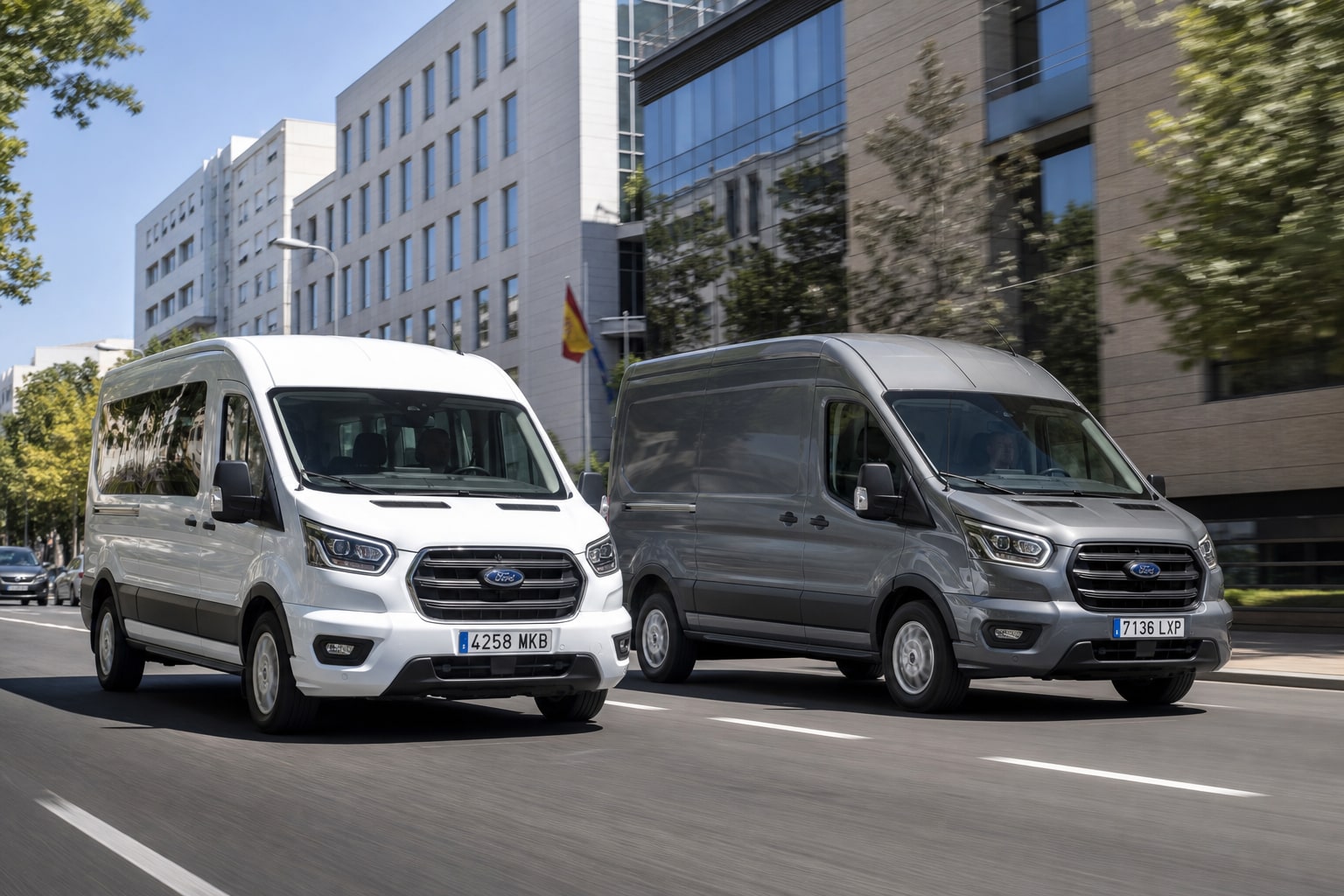
The question sounds technical, almost bureaucratic, but it decides thousands of euros when buying a van. If you are a self-employed transport operator, a fleet manager or a private buyer with a mix of family and professional needs, the M1 or N1 box on the technical data sheet changes the registration tax, the VAT deduction, the DGT label you will carry on your windscreen and even the ITV inspection you will have to pass. Let’s clear it up with real names, figures and models from the Spanish market.
What M1 and N1 really mean for a van
Regulation (EU) 2018/858 classifies motor vehicles into categories according to their intended use. M1 is a vehicle designed for the carriage of passengers with up to 8 seats in addition to the driver. N1 is a vehicle designed for the carriage of goods with a maximum authorised mass of 3,500 kg or less.
Where things get tangled is with passenger vans. A Multivan, a Vito Tourer or a Tourneo Custom can be homologated as M1 (a passenger car with 8 seats for carrying people) or as N1 (a commercial derivative, with fewer seats or a mixed configuration), depending on the version, body, panelling and seats. The same chassis, two different tax realities.
How the category is decided: it is not optional, it is technical
The category is set by the manufacturer in the European type-approval. It depends on physical and documentary criteria: number of standard seats, floor area for cargo versus passengers, presence of a bulkhead, rear windows, ISOFIX anchorage points, interior finish. If the model leaves the factory with 8 seats, carpet and rear climate control, it is M1. If it leaves with 2 seats, a panelled load area and a rubber floor, it is N1. There are intermediate variants (crew van, convertible mixed-use) that also end up as N1 when the cargo function predominates.
The tax impact: IEDMT, VAT and Circulation Tax
This is the crux. The Special Tax on Certain Means of Transport (IEDMT), known as the registration tax, is levied on M1 passenger cars according to CO₂ emissions (from 0% to 14.75%). N1 vehicles used for economic activities are, in practice, exempt from IEDMT as long as they are assigned to the business activity (art. 66 of Law 38/1992). On a €55,000 van with average emissions, that can mean a difference of €4,000-7,000 upfront.
VAT (21%) is paid in both cases, but a self-employed person or company can deduct 100% of the VAT on an N1 used exclusively for the business activity (and 50% if there is mixed use, by presumption). On an M1 the deduction is far more restricted unless exclusive professional use can be proven, something the tax authorities scrutinise closely.
The Circulation Tax (IVTM) also changes: M1 vehicles are taxed by fiscal horsepower like passenger cars; N1 vehicles are taxed like lorries by payload, and it usually works out cheaper.
DGT label and access to Low Emission Zones
There is no distinction by category here: the environmental label depends on the powertrain and emissions, not on whether it is M1 or N1. A diesel Vito Tourer Euro 6d-TEMP carries the C label regardless of the box. What does change is how each municipal ZBE reads it: Madrid and Barcelona apply restrictions by label, but some ordinances introduce nuances for professional N1 vehicles (loading/unloading hours, specific delivery permits) that the equivalent M1 does not get.
Real examples: the same van, two different lives
Volkswagen Multivan — from €62,000
The current Multivan is sold in Spain almost always as M1: it is a 7-seat MPV aimed at families and VIP use. It is not designed as a commercial van. If you buy it as a self-employed person for private transfers, you will pay IEDMT according to emissions and the VAT deduction will be whatever the tax authorities accept case by case.
| Power CV | WLTP consumption | Label | Fuel |
|---|---|---|---|
| 150-218 CV | 6.6-7.8 l/100 km | C / ECO (eHybrid) | Petrol / Diesel / PHEV |
Mercedes-Benz Vito Tourer — from €48,000
The Vito is the textbook case: Mercedes sells it as Vito panel van (N1), Vito Mixto (N1) and Vito Tourer (can be homologated as M1 or N1) depending on seat configuration and finish. The 8-seat Tourer Select with upholstered trim and windows usually comes as M1; the Tourer Base with 9 seats and a more austere configuration tends to come out as N1. For a VTC or transfer company, the N1 version saves thousands of euros at registration.
| Power CV | WLTP consumption | Label | Fuel |
|---|---|---|---|
| 136-237 CV | 6.8-8.1 l/100 km | C / 0 (eVito) | Diesel / Electric |
Ford Tourneo Custom — from €52,000
The Tourneo Custom is the passenger version of the Transit Custom. It is homologated as M1 in Titanium/Active/Sport trims with 8-9 seats and MPV treatment. The Transit Custom Kombi (N1), with the same seats but mixed-use van homologation, is the one many professional fleets choose to take advantage of the tax savings, even knowing the equipment is more basic. We look at it in more detail in the review of the Tourneo Custom as a transfer vehicle.
| Power CV | WLTP consumption | Label | Fuel |
|---|---|---|---|
| 136-170 CV | 7.2-8.0 l/100 km | C / 0 (E-Tourneo) | Diesel / PHEV / Electric |
Changing a van from N1 to M1 (or vice versa) at the ITV
Yes, it can be done. But it is not trivial. The category modification is processed at an authorised ITV station and requires a technical project signed by a competent engineer, endorsed if applicable, and a manufacturer’s certificate confirming the vehicle supports that homologated configuration. In practice, going from N1 to M1 means adding homologated seats, seat belts, anchorage points, side windows if it does not have them, and passing a specific inspection.
The important point: it does not exempt you from retroactive IEDMT. If you bought the van exempt as a professional N1 and convert it to M1 before 4 years have passed, the tax authorities will claim the IEDMT with interest. The change makes sense once the vehicle has passed the assignment period or when its real use stops being professional.
Summary table and scores by profile
| Model | Usual homologation | Price from | Tax advantage for the self-employed | Professional use score | Family use score |
|---|---|---|---|---|---|
| Volkswagen Multivan | M1 | €62,000 | Low | 6/10 | 9/10 |
| Mercedes-Benz Vito Tourer | M1 or N1 | €48,000 | High (as N1) | 9/10 | 7/10 |
| Ford Tourneo Custom | M1 (Kombi: N1) | €52,000 | Medium-High | 8/10 | 8/10 |
Verdict: what to choose depending on your case
For VTC, professional transfers and fleets: the Mercedes-Benz Vito Tourer in N1 configuration. It makes the most of the IEDMT exemption and the VAT deduction, with an upfront saving that can be around €6,000-8,000 compared with its M1 equivalent. The price difference with the Multivan exceeds 15%, and in professional use the Vito justifies that gap.
For a large family or purely private use: the Volkswagen Multivan M1. You will pay more tax upfront, but you will have a vehicle designed as an MPV, with a finish and comfort that no N1 matches. Forget about the tax savings: they will not be allowed.
For mixed use, self-employed plus family: the Ford Tourneo Custom in the Kombi N1 version if you prioritise taxation, or Titanium M1 if you prioritise comfort. It is the one that straddles both worlds best, and the price margin against the Multivan (15% less) makes it the pragmatic choice of the trio.
Frequently asked questions
Can I register an 8-seat van as N1 if I am self-employed?
Only if the manufacturer homologates it from the factory as N1 in that configuration. You cannot decide the category yourself: it is fixed in the European certificate of conformity (CoC). What you can do is choose the commercial version of the model that comes homologated as N1 (for example: Transit Custom Kombi instead of Tourneo Custom).
Can an N1 legally carry passengers?
Yes, as long as it has homologated seats with seat belts and the ITV records those seats. An N1 with 5 or 6 homologated seats can carry people without any problem. What it cannot do is be used as a VTC if the licence requires the M1 category, something that varies by autonomous region.
Is the DGT label different for M1 or N1?
No. The environmental label depends on the Euro emissions standard and the fuel type, not on the homologation category. A diesel Euro 6 M1 and a diesel Euro 6 N1 both carry the C label.
How often does an M1 van go through the ITV compared with an N1?
An M1 has its first ITV at 4 years, then every 2 years until 10, and annually after that. An N1 has its first ITV at 2 years, then every 2 years until 6, and annually after that. The N1 has a more demanding inspection schedule because of its status as a professional vehicle.

1 Comment
Pingback: Mercedes-Benz EQV vs Volkswagen ID. Buzz: qué furgoneta eléctrica de pasajeros rinde mejor en autonomía real para flota – Comparativa de Coches