

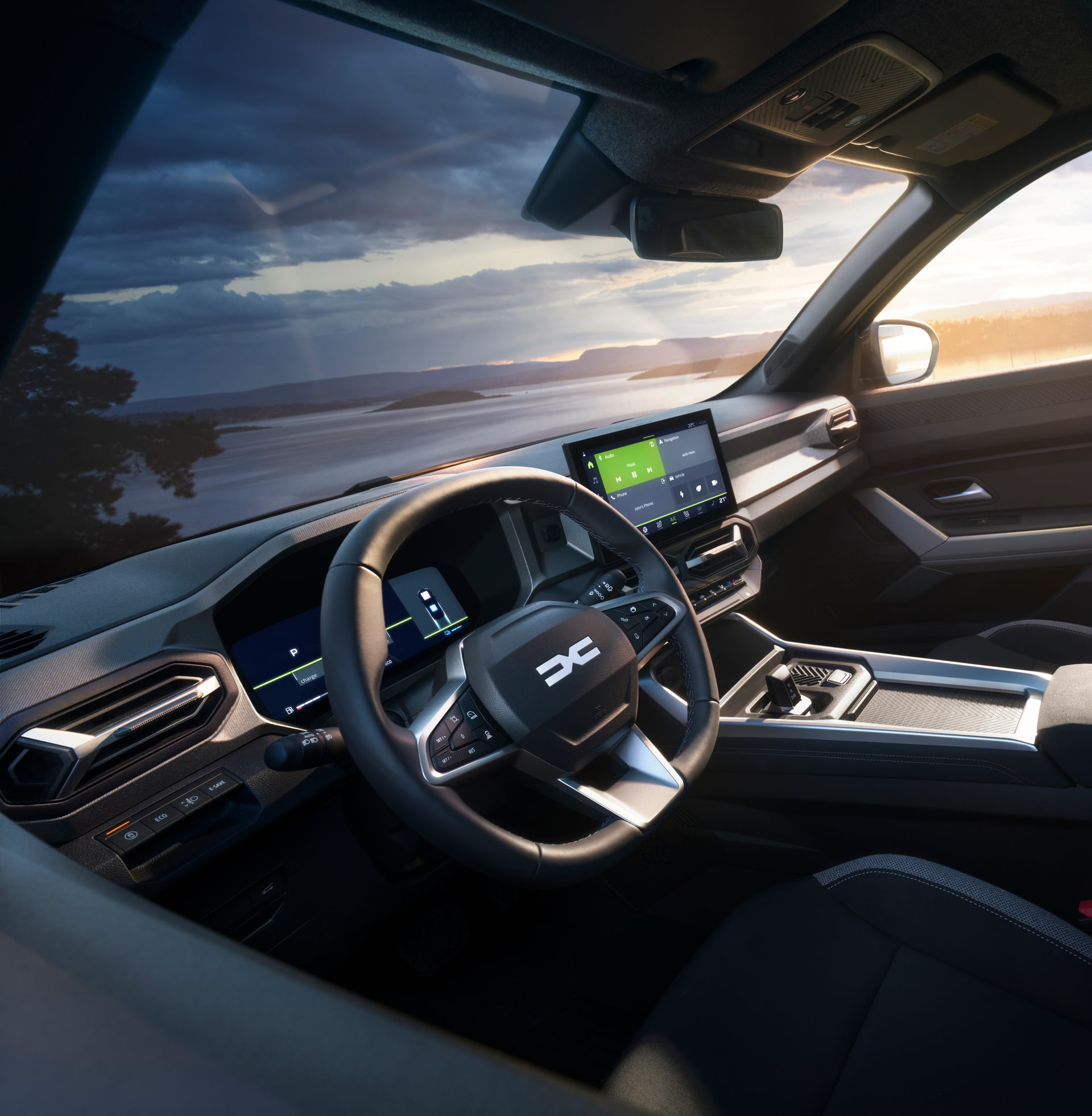
Rarely does a brand redefine a segment with such a clear proposition. The Dacia Bigster arrives at Spanish dealerships with an uncomfortable promise for the competition: offering a 4.57-metre family SUV at the price other brands charge for a well-equipped B-SUV. The question is not whether it is cheap — that is clear from the price list. The question is whether a car like this can cover all of a family’s needs as its only vehicle, without forcing the buyer into compromises that spoil everyday life.
What is the Dacia Bigster and why does it matter in 2026
The Bigster is Dacia’s step into the C-SUV segment, one rung above the Duster. It shares the CMF-B platform with much of the Renault Group, which explains how it can offer so much space without pushing the price up. In our view, its strategic importance is simple: it is the only full-size family SUV that stays close to €25,000 RRP in Spain. In a market where the segment average hovers around €35,000–40,000, we are talking about 25–30% less for a car that, on paper, meets the same usage requirements.
Dacia Bigster Hybrid-G 1.2 TCe 140 48V Essential — from approximately €25,000
The version we tested is the Hybrid-G 1.2 TCe 140 48V in Essential trim. It is the most interesting powertrain in the range: petrol and LPG bi-fuel (the “G” in Hybrid-G), with 48-volt mild hybridisation and a combined output of around 140 CV. The combination is no accident. Dacia knows its customers look closely at the cost per kilometre, and LPG remains the cheapest fuel per litre available in the Spanish market.
| Power | Fuel | Consumption | Top speed | CO₂ emissions | Label |
|---|---|---|---|---|---|
| ≈100 kW / ≈140 CV | Petrol + LPG (48V mild hybrid) | ≈5.5 l/100 km | ≈180 km/h | ≈130 g/km | ECO |
What the Bigster offers as a family car
Let us start with what really matters in a family SUV: space. The boot exceeds 650 litres in the five-seat configuration, a figure that places it directly in the league of the Peugeot 5008 and Skoda Kodiaq — with the caveat that the Bigster is strictly five-seat in this version. The rear seats have plenty of knee room for adults, access with child seats is comfortable, and the high roofline helps it not feel claustrophobic even with five on board.
The DGT ECO label is no minor detail. For anyone living in Madrid or Barcelona, unrestricted access to low-emission zones is what separates a viable car from one that stays in the garage. And the combined range of the LPG tank plus the petrol tank easily reaches around 1,000 real kilometres, making the Bigster an honest long-distance travel car.
Where the price starts to show
We must be honest. Essential is the entry trim, and it shows. The dashboard plastics are hard, the comfort equipment is basic (manual air conditioning, 17″ wheels, a smaller central screen) and the ADAS systems meet the regulatory minimum without any extras. In my view, it is worth stepping up to the Expression trim if the budget allows — the jump in perceived quality is noticeable and does not disrupt the price-to-product equation.
Motorway soundproofing is not its strong point either. At 120 km/h the 1.2 TCe engine is audible, and on long climbs with the car loaded it is asked for more than it gladly gives. It is not a slow car, but it is not a fast one either.
Does it work as a family’s only car?
Here lies the crux of the matter. And the answer depends on what we understand by “family”.
Family of four with two children, mixed city-and-trips use, 15,000–20,000 km/year: yes, it works. The Bigster covers 95% of cases without breaking a sweat. The boot swallows a week’s luggage, the ECO label sorts out daily urban driving, LPG tangibly lowers the cost per kilometre (we are talking about €6–7 per 100 km versus €9–10 for an equivalent petrol car), and the purchase price leaves room to finance or even pay cash for a new car where previously only a used one fit.
Family with three children or a genuine need for seven seats: no, and here the Bigster does not compete. The version we tested is five-seat. For three child seats or frequent passengers, you should look towards the Dacia Jogger or alternatives with a third row.
Family with mostly motorway use, 30,000+ km/year: the Bigster does the job but does not shine. A self-charging hybrid such as a Toyota or Honda will be more efficient in that scenario, though also more expensive upfront. Here the sums need a calculator: how many years it takes to recover the €8,000–10,000 RRP difference through fuel savings.
Points where the Bigster is objectively above the segment average
- Price per litre of boot space: no 4.57 m C-SUV comes close to the ≈€25,000 starting price.
- Cost per kilometre with LPG: the cheapest alternative fuel on the Spanish market, sustained over time, tips the balance in its favour against pure petrol hybrids.
Points where the Bigster falls short
- Perceived interior quality — one step below rivals such as the Jaecoo 7 or the MG HS in plastics and feel.
- Motorway refinement: engine and aerodynamic noise audible from 110 km/h.
Summary table: rating the Bigster as a family’s only car
| Criterion | Score (1–10) | Comment |
|---|---|---|
| Price-to-space ratio | 10 | Unbeatable in its segment |
| Cost per kilometre (LPG) | 9 | Cheapest fuel on the market |
| Interior space and boot | 9 | D-SUV level for B-SUV price |
| Standard equipment (Essential) | 6 | Basic; better to step up to Expression |
| Motorway refinement | 6 | Clear engine noise at high speed |
| Perceived interior quality | 6 | Hard plastics, functional design |
| Versatility (7 seats) | N/A | Only 5 seats in this version |
| Weighted average as a car as the only vehicle | 8 | For families of four, an excellent choice |
Notice: the prices mentioned are the manufacturer’s recommended RRP, without considering dealer discounts, one-off campaigns, financing promotions or public aid such as Plan Auto+. Always check the actual dealer offer before deciding.
Verdict
For a family of four with mixed urban-and-road use and medium-distance trips: the Bigster Hybrid-G 1.2 TCe 140 48V is, today, the most defensible rational purchase in the C-SUV segment in Spain. Full stop.
For those who prioritise refinement, perceived quality and comfort on long journeys: there are better options for €10,000–15,000 more — a Toyota RAV4 Hybrid or a Honda CR-V Hybrid offer a different level, but it is hard to justify if the budget is what matters.
For families of five or more with child seats: the five-seat Bigster falls short. Better to look at the Dacia Jogger or straight to an MPV with a genuine third row.
Absolute price-performance ratio of the 2026 market: without question, the Bigster. There is no other car of this size and capacity for this money.
Frequently asked questions
Does the Dacia Bigster Hybrid-G 1.2 TCe 140 48V have an ECO label?
Yes. The petrol/LPG bi-fuel version with 48-volt mild hybridisation obtains the DGT ECO label, allowing unrestricted access to the ZBE zones of Madrid, Barcelona and other Spanish cities.
How much does it really cost to fill a Bigster with LPG versus petrol?
With the current LPG price in Spain (around €0.90–1.00 per litre versus €1.55–1.65 for 95 petrol), the cost per 100 km at roughly 5.5 l/100 comes to €5–6, about half that of an equivalent petrol car. The saving becomes noticeable from around 15,000 km per year.
Is there a seven-seat version of the Dacia Bigster?
The version analysed in this review, the Hybrid-G 1.2 TCe 140 48V Essential, is strictly five-seat. For families who need seven genuine seats, Dacia offers the Jogger as an alternative within its range.
Does the Bigster compare well against a self-charging hybrid such as a Toyota or Honda?
It depends on mileage and usage profile. In urban and interurban use with medium-distance trips, the LPG Bigster wins on purchase cost and fuel cost. In mostly motorway use and over 25,000 km per year, a pure hybrid can recover its price premium within 4–5 years through lower real consumption.
