

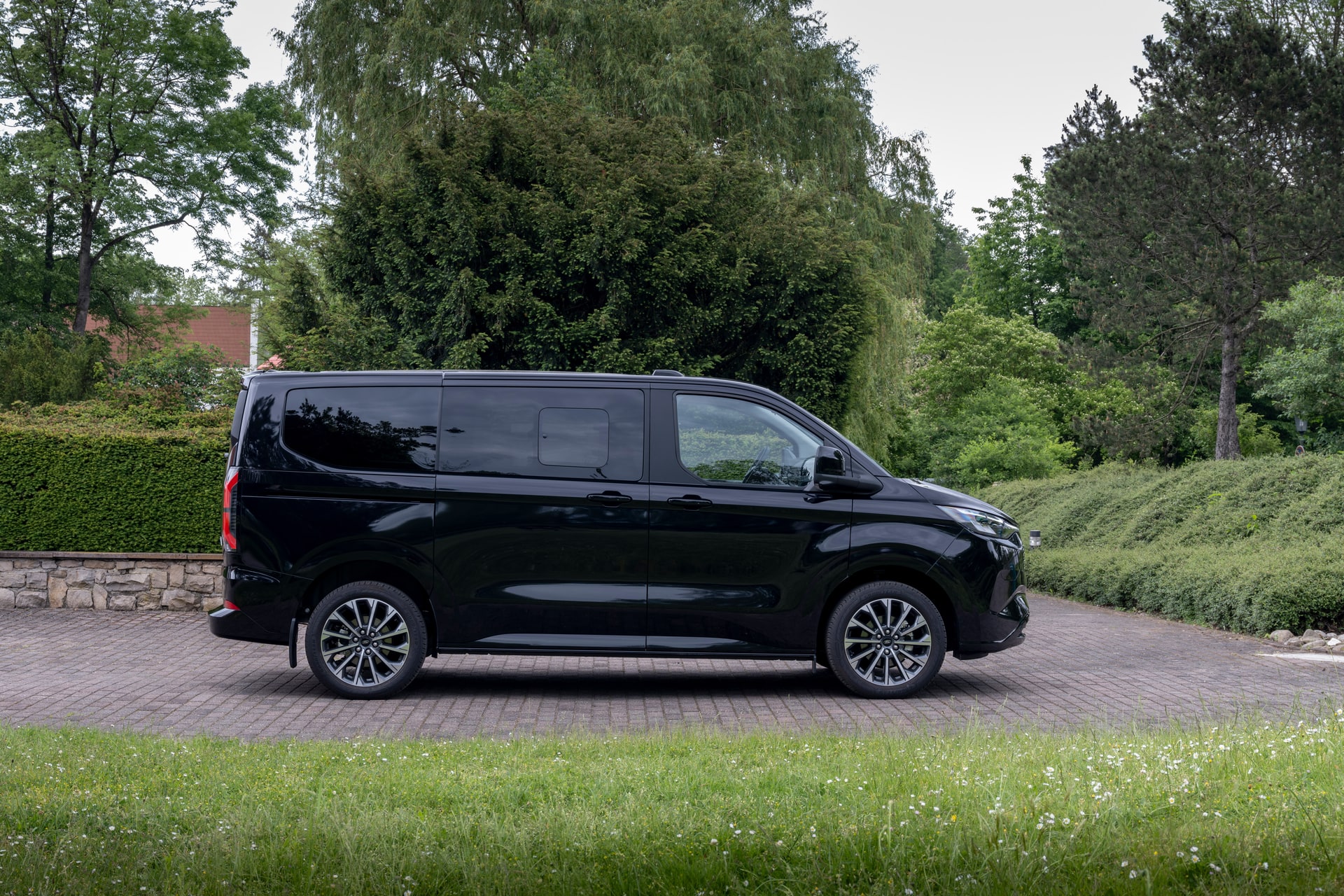
The large 8 and 9 seat people carrier segment has become a rather curious niche: half large family, half work tool for private hire drivers, airport transfers and four and five star hotels. And there, at the crossroads of these uses, the Ford Tourneo Custom has earned a place that deserves a close look before signing a five-year lease.
Let’s see how far the Tourneo Custom goes as a private transfer vehicle in 2026, and in which scenarios it makes more sense than its two obvious rivals: the Volkswagen Caravelle and the Mercedes-Benz Vito Tourer. Advance warning: the prices shown are manufacturer’s recommended retail prices (RRP), without dealer offers, one-off campaigns or public aid such as the Plan Auto+.
What a private transfer vehicle really needs in 2026
Before getting into technical specifications, it is worth sorting out the use case. A private hire operator or a hotel buying a passenger van is not looking for the same thing as a large family. It needs:
- Real seats that are comfortable (not just on paper) for 7-8 adults with luggage.
- A usable boot with all seats occupied, because an airport transfer with eight passengers and zero luggage does not exist.
- Restrained consumption on motorways, which is where real mileage is eaten up.
- Predictable maintenance costs and a service network able to attend to the vehicle without leaving it off the road for a week.
- A presentable image: a customer paying 180 € for an airport transfer does not want to climb into a recycled delivery van.
With this in mind, the analysis changes quite a bit compared with a conventional review.
Ford Tourneo Custom 2.0 EcoBlue 140 CV — from ≈55,300 €
The Tourneo Custom in Trend trim with the 140 CV 2.0 EcoBlue is, in our view, the most sensible configuration for professional use. It is not the most powerful in the range, but it best balances purchase cost, consumption and drivetrain reliability. For long passenger transfers we cover this in depth in this direct comparison with the Multivan.
| Power kW | Power CV | Consumption | Fuel |
|---|---|---|---|
| ≈100 kW | ≈140 CV | ≈7.5 l/100 km | Diesel |
What it does well, and better than the direct competition:
- Interior space usage. The new generation has gained usable width, and the second and third rows allow adults of 1.85 m to travel without their knee touching the front seatback. In the 8-seat configuration there is boot space for 8 cabin trolleys. With nine seats you have to draw lots for the luggage.
- Ride comfort. Better-resolved suspension than the previous generation, and acoustic insulation that no longer gives away its commercial origin. A VIP customer gets out fresh after 300 km.
- Running cost. 7.5 l/100 km homologated and around 8-8.5 l/100 km real-world on motorways with an average load. For a fleet doing 60,000 km a year, this is the figure that matters.
Where it falls short: the driving position still has a van-like quality (very horizontal steering wheel), and the SYNC 4 infotainment works well but the quality of the plastics in the centre tunnel is not up to the price asked. Nor is it a car you enjoy driving; it is a tool.
Volkswagen Caravelle — from ≈58,000 € indicative
For the Caravelle T6.1 with the 150 CV 2.0 TDI we will not give definitive consumption or homologation figures, because they are not among our verified data sheets for this article. What we can discuss is positioning: it is the classic rival of the Tourneo Custom in the professional channel, with a Volkswagen Commercial Vehicles network very well established in Spain and a residual value historically stronger than the Ford’s.
Where it objectively beats the Tourneo:
- Residual value at 4 years. Any renting deal reflects this in the monthly fee.
- Brand perception among end customers at premium hotels.
Where it loses out:
- Higher entry RRP for similar performance.
- More limited range of versions since the transition towards the Multivan as the group’s passenger reference.
If your operation lives off 48-month renting and residual value weighs heavily in the accounts, the Caravelle remains defensible. If you buy outright and amortise over 6-7 years, it loses ground to the Ford.
Mercedes-Benz Vito Tourer — from ≈52,000 € indicative
The Vito Tourer, in its 9-seat configuration with the 116 CDI, is the historic benchmark of the Spanish premium transfer market. We do not give definitive technical figures because they do not appear in our verified data sheets for this model, but its commercial profile is clear.
Where it beats the Tourneo:
- Brand image in front of the end customer: the star still sells transfers.
- Rear-wheel drive available, which in winter and with a full load changes the way the vehicle settles on the road.
Where it loses out:
- Third-row headroom somewhat tighter than in the Ford.
- Official maintenance cost noticeably higher, a fact any fleet manager will confirm.
Summary table and score as a transfer tool
Score designed for the article’s use case (private hire and transfers), not for family use.
| Model | Price from | Seats | Fuel | Passenger comfort | Operating cost | Customer image | Overall score |
|---|---|---|---|---|---|---|---|
| Ford Tourneo Custom 2.0 EcoBlue 140 CV | ≈55,300 € | 8-9 | Diesel | 8.5 | 9 | 7.5 | 8.5 |
| Volkswagen Caravelle 2.0 TDI | ≈58,000 € | 8-9 | Diesel | 8 | 7.5 | 8.5 | 8 |
| Mercedes-Benz Vito Tourer 116 CDI | ≈52,000 € | 8-9 | Diesel | 7.5 | 7 | 9 | 7.8 |
The RRP difference between the cheapest Vito and the most expensive Caravelle is around 11-12%, below the 15% threshold that would force a rethink of the comparison. Even so, it is worth remembering that these figures are indicative and exclude fleet discounts, which in this segment are the norm rather than the exception.
Verdict: who each one suits
- For a private hire or transfer operator with its own fleet and long amortisation: Ford Tourneo Custom 2.0 EcoBlue 140 CV. Real consumption and maintenance cost make it the most rational option. It is our main recommendation.
- For a company financing through 48-month renting: Volkswagen Caravelle. Residual value works in its favour and the monthly fee ends up being competitive despite the higher RRP.
- For a five-star hotel where image weighs more than cost per kilometre: Mercedes-Benz Vito Tourer. The star remains a commercial argument, even if you pay for it in maintenance.
If you have doubts about the right bodystyle for your use case, this guide to choosing a passenger van for private hire complements what we have seen here well.
Frequently asked questions
Does the Ford Tourneo Custom 2.0 EcoBlue 140 CV have enough power to carry 8 passengers and luggage?
Yes. The 140 CV and the torque of the 2.0 EcoBlue move the vehicle without drama on motorways at legal speeds. On a long hill with a full load you will notice it working, but it is not short for regular transfer use. If you will be doing a lot of loaded mountain driving, the higher-power version of the same engine is the logical choice.
What real consumption can be expected on the motorway with the diesel Tourneo Custom?
Against the homologated ≈7.5 l/100 km, real consumption on the motorway at 110-120 km/h with an average load is around 8-8.5 l/100 km. In the city and in dense traffic it can rise above 9.
Is the Tourneo Custom better in the 8- or 9-seat configuration for private hire?
It depends on the average luggage per passenger. For airport transfers with a large suitcase per person, the 8-seat configuration leaves usable boot space. The 9-seat configuration forces you to sacrifice cargo space or fit a roof box, which adds height and consumption.
How much does a new Ford Tourneo Custom cost in 2026?
The Trend trim with the 140 CV 2.0 EcoBlue starts at around 55,300 € RRP. These are indicative prices without dealer discounts, fleet campaigns or public aid such as the Plan Auto+, which in professional purchasing usually reduce the final invoice significantly.

7 Comments
Pingback: Ford Tourneo Courier review: hasta dónde llega el monovolumen compacto como coche familiar urbano en 2026 – Comparativa de Coches
Pingback: Ford Tourneo Courier review: hasta dónde llega el monovolumen compacto como coche familiar urbano en 2026 – Comparativa de Coches
Pingback: Los 5 furgonetas de 8-9 plazas con mejor relación equipamiento-precio para autónomos del transporte de pasajeros en 2026 – Comparativa de Coches
Pingback: Qué es realmente un monovolumen derivado de furgoneta y en qué se diferencia de un SUV de 7 plazas para transportar pasajeros – Comparativa de Coches
Pingback: Cómo elegir una furgoneta de 9 plazas para empresa en 2026 según coste total de propiedad a 5 años – Comparativa de Coches
Pingback: Ford Tourneo Custom vs Mercedes-Benz Vito Tourer: qué monovolumen de 8 plazas convence más como vehículo de empresa para traslados por carretera – Comparativa de Coches
Pingback: Cómo elegir una furgoneta de pasajeros en 2026 según si haces ciudad con paradas o kilómetros de autovía – Comparativa de Coches