

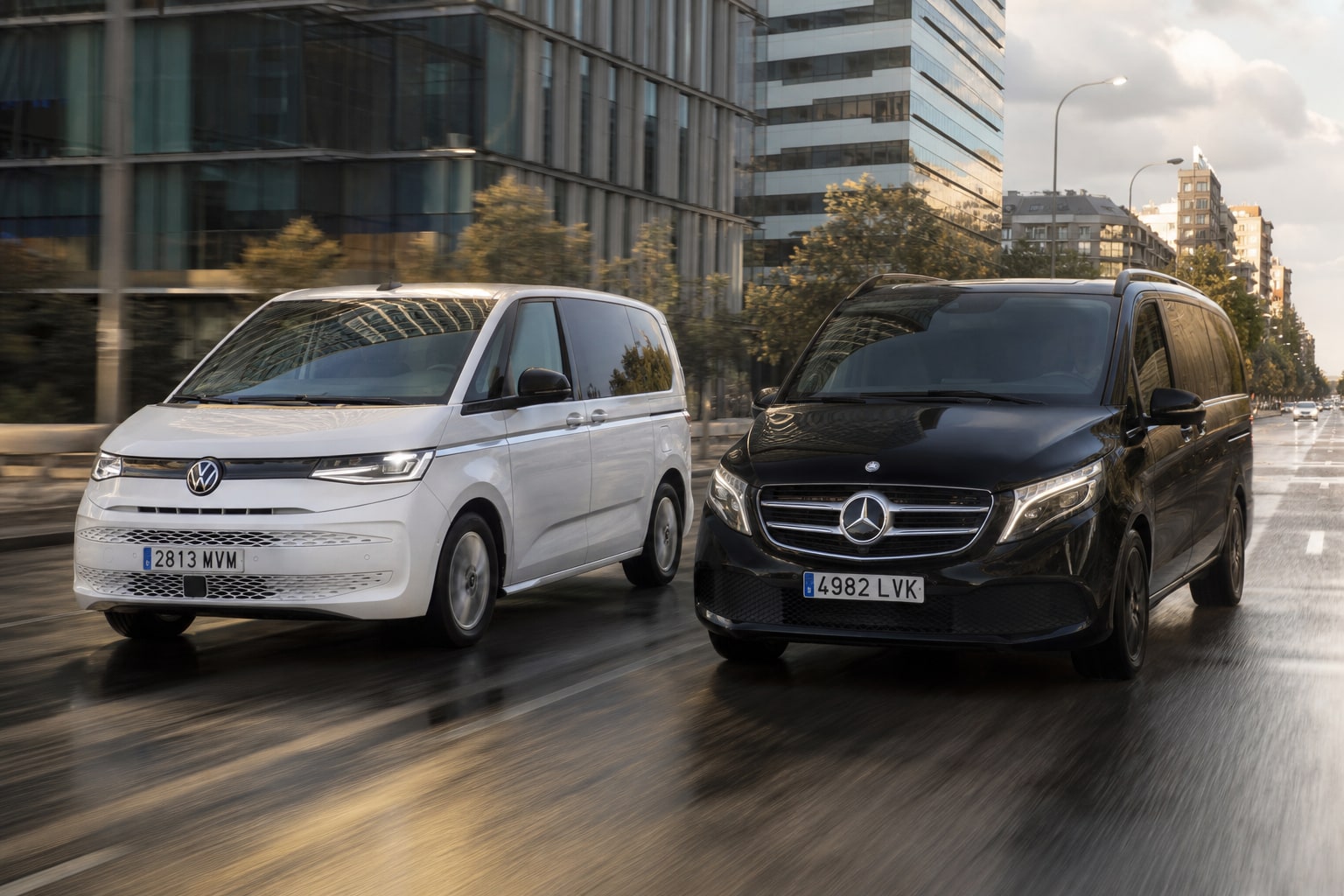
The market for large people carriers in Spain has narrowed to two serious names when we talk about executive transfers with 7 seats: the Volkswagen Multivan and the Mercedes-Benz V-Class. Both are diesel, both exceed five metres in length, and both are sold to premium private hire fleets, hotels and families who make many airport runs. But the approach could not be more different, and neither is the price gap.
If your business depends on the customer stepping out of the car feeling they have travelled well, the interior finish stops being a luxury. It is stock.
Why this comparison makes sense in 2026
On paper, both models share the same mission: seven seats, electric sliding doors, a van format converted into a lounge. But they play different games. The Multivan is built on the MQB platform, the same one used by the group’s passenger cars, while the V-Class remains a converted van, with rear-wheel drive and an architecture inherited from the Vito. That shapes the character of each more than it might seem.
Volkswagen Multivan 2.0 TDI 150 CV DSG7 (from ≈57,100 €)
The current Multivan (T7) breaks with the tradition of the T6.1: it feels more like a car and less like a van. The dashboard is practically that of a stretched Golf 8, for better and for worse. There is a 10-inch central screen, a digital instrument cluster, and a compact gear selector on the column. The upper plastics are soft, the ergonomics are those any modern VW driver will know, and the seating position feels familiar from the first kilometre.
The big asset is modularity. The rear seats are individual, they slide on longitudinal rails and they swivel. You can configure a meeting room with a central table and four passengers facing each other. For executive transfers with a laptop open, this is gold.
| Power | Power CV | Top speed | Consumption | Fuel | Label |
|---|---|---|---|---|---|
| ≈110 kW | ≈150 CV | ≈190 km/h | ≈6.5 l/100 km | Diesel | C |
Mercedes-Benz V-Class Compacto 220 d 163 CV 9G-Tronic (from ≈76,200 €)
The V-Class plays in a different league of perception. The MBUX dual-screen dashboard, wood or brushed aluminium trim depending on the finish, and the distinctive illuminated ring around the air vents create an atmosphere the Multivan, frankly, does not reach. The feel of the soft plastics, the quality of the leather in the Avantgarde or Exclusive trims, the optional quilted seats… everything points to the rear passenger, not the driver.
And there lies the key to its proposition: the V-Class was designed with the person in the back in mind. The individual rear seats can be configured with an integrated folding table, generous reclining backrests and clearly superior acoustic insulation to the Multivan on motorways. For high-end private hire or transfers from 5-star hotels, it is the gold standard in Spain.
That said, you have to pay for it. It costs 33% more than the Multivan at entry RRP, which in absolute terms is around 19,000 € of difference. That is no small change.
| Power | Power CV | Top speed | Consumption | Fuel | Label |
|---|---|---|---|---|---|
| ≈120 kW | ≈160 CV | ≈190 km/h | ≈7 l/100 km | Diesel | C |
Head to head: what each one wins
Where the Multivan is objectively better:
- Cabin modularity. The longitudinal rails with swivelling seats and a movable table have no rival in the V-Class, which is more rigid in its configuration.
- Driving dynamics and consumption. The MQB base shows: it handles bends better, parks more naturally, and the 2.0 TDI 150 CV uses half a litre less than the Mercedes in real mixed use.
Where the V-Class is objectively better:
- Perceived interior quality. Materials, night-time ambience, acoustics, the feel of the controls. The rear passenger notices the difference within two minutes. It is a full step above.
- Brand image for VIP use. The three-pointed star opens doors that the VW badge simply does not open in the high-end executive transfer segment.
Something similar we saw when analysing the Tourneo Custom against the Multivan itself in terms of long-distance comfort: the platform matters, but the interior atmosphere weighs more than the spec sheets suggest.
Summary table with scoring
Score from 1 to 10 focused on VIP use / executive transfers.
| Model | Interior finish | Modularity | Passenger comfort | Consumption | Value for money | VIP image | Overall score |
|---|---|---|---|---|---|---|---|
| VW Multivan 2.0 TDI 150 DSG7 | 7.5 | 9.5 | 7.5 | 8 | 8.5 | 7 | 8.0 |
| Mercedes-Benz V-Class 220 d 163 9G-T | 9 | 7.5 | 9 | 7 | 6.5 | 9.5 | 8.1 |
Verdict by use case
- For pure VIP transfers (hotels, premium airport runs, high-end weddings): Mercedes-Benz V-Class 220 d. The passenger pays to sit in a Mercedes, not a Volkswagen. The difference in RRP is recovered through the rate you can charge.
- For flexible private hire, mixed professional-family use or corporate transfers where the client works on board: Volkswagen Multivan 2.0 TDI 150. Modularity and the lower entry cost more than compensate for the finish gap.
- Best value for money: Multivan, no question. It is around 19,000 € less at entry RRP, a difference that far exceeds 15% and should be kept in mind before signing.
A reminder: both prices are manufacturer RRPs, without dealer discounts, one-off campaigns or aid such as the Plan Auto+. In professional fleets the real figure usually drops considerably.
Frequently asked questions
Which has better motorway soundproofing for transfers of more than 300 km?
The Mercedes-Benz V-Class, by a fair margin. Its van architecture derived from the Vito allows more acoustic insulation in the roof and sliding doors. The Multivan is quiet for what it is, but the V-Class filters road noise better at 120 km/h.
Does the Multivan have a long-wheelbase version like the V-Class?
Yes, Volkswagen sells the Multivan in a long-body version with greater boot capacity while keeping the 7 seats. Mercedes offers the V-Class in three lengths (Compacto, Largo and Extralargo), which gives more configuration room for VIP use with bulky luggage.
Is the V-Class premium worth it if the use is mostly family-oriented?
In our opinion, no. For a large family with children, the Multivan’s modularity and better dynamics outweigh the finish extra. The V-Class only makes sense when the passenger is a customer paying to ride in the back.
Are there hybrid or electric versions of either one?
Volkswagen also offers the Multivan as an eHybrid (PHEV). Mercedes-Benz has presented the electric evolution of the V family, but this comparison focuses on the entry diesel variants, which remain the reference for intensive professional use in Spain.

3 Comments
Pingback: Los 5 furgonetas de 8-9 plazas con mejor relación equipamiento-precio para autónomos del transporte de pasajeros en 2026 – Comparativa de Coches
Pingback: Mercedes-Benz Vito Tourer vs Volkswagen Transporter T7 Kombi: qué furgoneta de pasajeros rinde mejor como vehículo de flota – Comparativa de Coches
Pingback: Volkswagen Multivan review: hasta dónde llega como herramienta de trabajo para autónomo de traslados premium en 2026 – Comparativa de Coches