

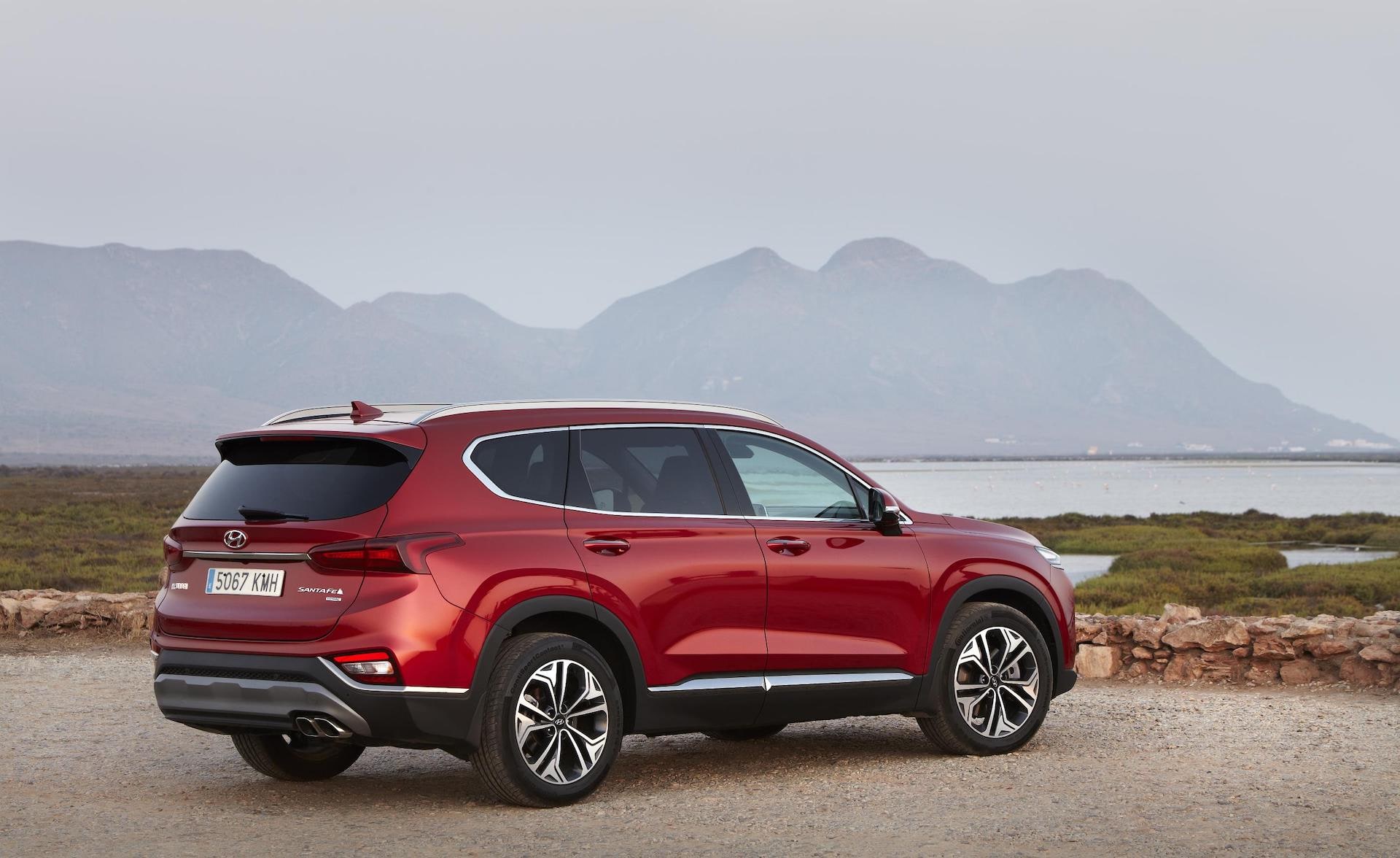
Buying a family hybrid SUV with three child seats is not a catalogue problem, it is a geometry problem. Manufacturers publish litres and centimetres, and then you arrive at the dealership with three ISOFIX seats and discover that two of them touch at the shoulder, or that the boot loses 80 usable litres to the parcel shelf. This guide is about how to measure what really matters, and which models on sale in Spain hold up best under the test.
The real problem: why the brochure is not enough
The VDA boot figure is measured with rigid blocks up to the parcel shelf. It is useful for comparison, but it hides two things: the space under the floor (where a folded pushchair does or does not fit) and the height up to the roof (key if you travel with the boot packed to the top one week a year). Then there is the width between wheel arches, which defines whether three seats can fit side by side. A 4.65 m SUV can have 1,430 mm between arches while another of the same length only manages 1,340 mm. Those 90 mm decide the purchase.
Methodology: how we measure at the dealership
Four measurements, tape measure in hand:
- Width between wheel arches at the height of the second-row backrest, in mm. This is where the seats touch.
- Boot depth with the second row in its rearmost position, in cm.
- Loading height (sill) and interior height up to the parcel shelf, to fit pushchairs.
- Three real ISOFIX test (two Group 1 plus one Group 2/3, the typical case of a family with three children aged 2 to 9).
With that, the marketing stays in the car park.
Toyota RAV4 Hybrid Advance Plus — from €42,900
The RAV4 is the benchmark of the hybrid C-segment, and in family configuration it remains a logical choice. With 580 VDA litres and 1,560 mm of interior width in the second row, it accepts three narrow seats (compact i-Size type) without drama, although with bulky reinforced five-point seats things get tight. The boot is very regular, with straight shapes, and the space under the floor is welcome for the pushchair. The best part? Real city consumption of 5.0-5.5 l/100 km that no unplugged PHEV comes close to. The worst? The second row does not slide, so you cannot borrow centimetres from the boot when you need them.
| Power hp | WLTP consumption | Label | Fuel |
|---|---|---|---|
| 218 hp | 5.8 l/100 km | ECO | Hybrid |
Hyundai Santa Fe Hybrid Tecno — from €48,900
Here we change category: it is a mid-size SUV, 4.83 m long, with up to 7 seats. With the third row folded it offers 628 litres and a width between wheel arches that approaches 1,610 mm, the best of this trio for placing three seats side by side without parents having to contort themselves to buckle the middle one. The squared-off boot shape is a blessing: twin pushchairs fit without folding. As a full hybrid it performs well in mixed use (6.5-7.0 l/100 km real), although on motorways at 120 km/h consumption climbs more than the brochure suggests. For those wanting a more detailed look at the brand’s family approach, the Santa Fe versus Sorento on design and space breaks down the finer differences.
| Power hp | WLTP consumption | Label | Fuel |
|---|---|---|---|
| 215 hp | 6.3 l/100 km | ECO | Hybrid |
Kia Sorento Hybrid Drive — from €49,500
The Santa Fe’s cousin shares platform and mechanics, but tunes other things. Same usable interior width (approximately 1,610 mm), same capacity with 5 seats in use (604 litres), and a third row more usable for children than the RAV4’s, which simply does not have one. What sets the Sorento apart is the second row sliding 190 mm: you can prioritise legroom or boot space depending on the journey. For families with three seats and a large dog, that changes the summer logistics. A 7-year warranty, which remains a strong argument.
| Power hp | WLTP consumption | Label | Fuel |
|---|---|---|---|
| 215 hp | 6.2 l/100 km | ECO | Hybrid |
Comparison table with scoring
| Model | VDA boot | 2nd row width | Length | 3 ISOFIX seats | Price from | Warranty | Score |
|---|---|---|---|---|---|---|---|
| Toyota RAV4 Hybrid | 580 l | ~1,560 mm | 4.60 m | Tight | €42,900 | 3 years + 15 Relax | 7.8/10 |
| Hyundai Santa Fe Hybrid | 628 l (5 seats) | ~1,610 mm | 4.83 m | Comfortable | €48,900 | 5 years | 8.6/10 |
| Kia Sorento Hybrid | 604 l (5 seats) | ~1,610 mm | 4.81 m | Comfortable | €49,500 | 7 years | 8.8/10 |
Where each one wins, no half measures
- RAV4: wins on urban real consumption and on total 5-year cost of ownership. Loses on space and second-row versatility.
- Santa Fe: wins on interior design (a more refined dashboard) and on boot interior height. Loses slightly on warranty against the Kia.
- Sorento: wins on the sliding second row and the 7-year warranty. Loses on perceived brand image against the Hyundai, which with its new design has moved ahead.
Verdict by use case
- Family with three young children (bulky Group 0+/1 seats) and a tight budget: Toyota RAV4 Hybrid Advance Plus. It meets the need, uses little fuel, and the Toyota network carries weight. You have to accept that the seats are tight for width.
- Family of three children where real use is long summer journeys and city life the rest of the year: Kia Sorento Hybrid Drive. The sliding second row, the squared boot and the 7-year warranty justify the extra €6,600 over the RAV4 (a 15% difference, which does weigh in the verdict).
- Family that values design, perceived quality and premium space without moving up to the German D-segment: Hyundai Santa Fe Hybrid Tecno. It is the most coherent single car for a family of five with everyday luggage.
If you are also comparing motorway versus city consumption, the analysis on real consumption and comfort on long journeys complements well what falls outside this guide, which focuses on space.
Frequently asked questions
Do three ISOFIX seats fit side by side in a C-SUV like the RAV4?
It depends on the seat model. With three narrow i-Size seats (such as the Cybex Solution or Joie i-Spin) it is feasible in the RAV4. With wide five-point seats such as Britax or Axkid, you definitely need a mid-size SUV such as the Santa Fe or the Sorento, with 1,600 mm or more between wheel arches.
Does a 7-seat hybrid SUV lose much boot space with the third row up?
Yes, drastically. The Sorento drops from 604 to 175 litres, and the Santa Fe from 628 to around 130 litres. Using the third row as a permanent setup with luggage is not realistic: it suits short trips or journeys with minimal luggage.
Is it worth paying more for a plug-in hybrid (PHEV) instead of a full hybrid for a large family?
Only if you have a home wallbox and drive less than 40 km a day. In real family use with frequent long trips, an unplugged PHEV consumes more than a full hybrid because of the extra battery weight. For the profile in this guide, the full hybrid makes more sense.
Do the Plan Auto+ aids apply to these full hybrid SUVs?
Plan Auto+ is aimed mainly at electrified vehicles (mainly battery electric and PHEV). Full hybrids such as the three in this comparison do not usually fall within the bulk of direct aid. For the current amounts and requirements, check the official website before signing.

3 Comments
Pingback: Skoda Kodiaq vs Volkswagen Tayron: qué SUV familiar híbrido del grupo VW ofrece más maletero real por su precio – Comparativa de Coches
Pingback: Cómo elegir un SUV familiar de 7 plazas híbrido en 2026 según el maletero disponible con la tercera fila en uso – Comparativa de Coches
Pingback: Cómo elegir un SUV híbrido urbano en 2026 según el consumo real en atasco – Comparativa de Coches