

Buying a 9-seater van for your business based on the sticker price is, basically, shooting yourself in the foot. A fleet manager who signs an order for five units today looking only at the list price is ignoring between 55% and 65% of the real money that vehicle will cost over the next five years. And in practice, that is the figure that ends up on the profit and loss account.
This guide is about exactly that: how to choose a 9-seater M1 passenger van based on total cost of ownership (TCO) over 5 years and 150,000 km, with a replicable framework and a reasoned ranking by use case.
What TCO is and why list price misleads in fleet buying
TCO adds up everything the vehicle costs you from the moment you register it until you scrap or sell it. For a 9-seater van used for passenger transport, the relevant items are:
- Depreciation (typically 40-55% of TCO).
- Fuel or energy (15-25%).
- Maintenance and repairs (8-12%).
- Fleet insurance (6-10%).
- Taxes, MOT and financing.
- Downtime in the workshop — the invisible item that almost nobody accounts for and that, in private-hire or airport-transfer fleets, weighs more than fuel.
Looking only at the “from” price is convenient, but a 4,000 EUR difference in list price between two rivals can be reversed if one of them depreciates 8% less over three years. On paper it looks small; across a fleet of ten units, it is 30,000 EUR in real money.
M1 vs N1 homologation: the decision that changes the TCO before you even start
Here there is a technical fork that many buyers overlook. 9-seater vans can be registered as M1 (passenger car) or as N1 (light commercial) depending on the version. The choice affects registration tax, deductible VAT, access to Low Emission Zones, the possibility of using the HOV lane and even insurance.
For passenger transport for commercial purposes (private hire, hotel transfers, shuttles), the usual and correct homologation is M1 combi. For mixed use with a predominance of cargo, N1 combi. Confusing the two leads to tax and MOT problems. Talk to the manufacturer before signing: versions such as the Caravelle, the Vito Tourer, the V-Class, the Tourneo Custom in Titanium Kombi trim or the Traffic Passenger are designed for M1; other variants of the same model are N1.
DGT label and Low Emission Zones: the filter that eliminates candidates
Madrid, Barcelona and the Low Emission Zones being rolled out in cities of more than 50,000 inhabitants set a boundary that can no longer be ignored. An ECO diesel (mild hybrid) has free rein; a standard C diesel starts to face time restrictions in some areas; a diesel with no label simply cannot enter. And there is a nuance here: almost all large 9-seater vans sold in 2026 already come with a Euro 6e diesel carrying the C label, and the electric variants (e-Vito Tourer, e-Traveller, e-Vivaro Combi, Proace Verso Electric, e-Tourneo Custom) carry the 0 label.
If your fleet operates within the Madrid Central low emission zone or the Barcelona perimeter, the 0 label stops being a luxury and becomes a quantifiable operational asset.
Diesel vs electric: when the balance tips
The million-dollar question. A 2.0 diesel with 150-170 CV consumes between 7.5 and 9 l/100 km in real-world use with 9 seats occupied and luggage. A comparable electric van, on urban and short intercity transfers, can bring energy costs below half if charged at a private base on an overnight tariff. But its real-world range with 9 passengers and suitcases rarely exceeds 220-250 km, and the purchase premium typically falls between 12,000 and 18,000 EUR compared with the diesel.
Rule of thumb: below 40,000 km/year and on urban or short intercity routes with your own charging base, the electric wins over 5 years. Above that, with long intercity routes or without your own infrastructure, the diesel remains unbeatable.
The three benchmarks of the Spanish market in 2026
Of the nine brands with a real 9-seater M1 offering in Spain, three concentrate most fleet orders: Volkswagen, Mercedes and Ford. We compare them using the most representative diesel version of each, which is the one that drives the bulk of the professional market.
Volkswagen Caravelle 2.0 TDI 150 CV DSG — from 58,000 EUR
The historic benchmark of the segment. The current Caravelle (T7 generation in the Multivan; Caravelle on the Transporter T6.1 Facelift base still available in 2026) offers the finest balance between passenger comfort, finish and residual value. Its 3-year depreciation is among the lowest in the segment — between 7 and 10 points better than an equivalent Trafic — which offsets a good part of its higher list price.
| Power | Fuel | WLTP consumption | DGT label |
|---|---|---|---|
| 110 kW / 150 CV | Diesel | 7.4 l/100 km | C |
Mercedes-Benz Vito Tourer 116 CDI Pro — from 54,500 EUR
The option with the best brand image for executive transfers without jumping to the budget of a V-Class. The Pro trim already includes rear air conditioning, MBUX and a driver assistance package. The Mercedes workshop network is dense and the mechanical reliability of the OM654 engine is proven. Where it falls short: the interior finish is a step below what you would expect from a Mercedes, and this is especially noticeable next to a Caravelle.
| Power | Fuel | WLTP consumption | DGT label |
|---|---|---|---|
| 120 kW / 163 CV | Diesel | 7.6 l/100 km | C |
Ford Tourneo Custom 2.0 EcoBlue 150 CV Titanium — from 51,200 EUR
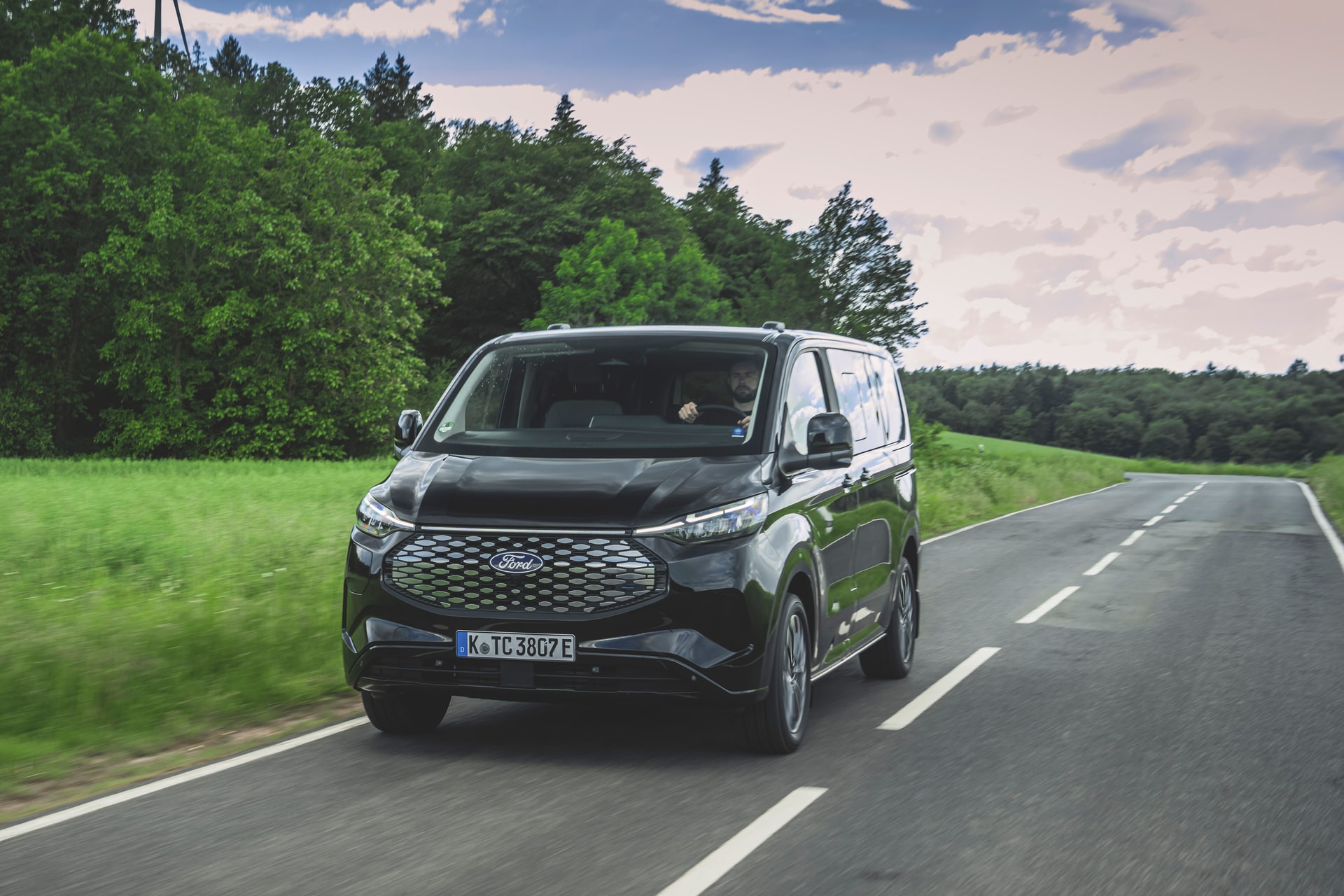
The current generation, launched in 2024, has made a huge leap in perceived quality and technology. A 13″ SYNC 4 screen, rear seats with a reconfigurable rail system and flat rear access thanks to a re-engineered suspension. For private hire and airport transfers it is, in our view, the most rational option of the trio in terms of equipment for the price. We already analysed it in depth in the Ford Tourneo Custom versus the Multivan.
| Power | Fuel | WLTP consumption | DGT label |
|---|---|---|---|
| 110 kW / 150 CV | Diesel | 7.2 l/100 km | C |
The Stellantis and Renault/Nissan alternatives
The Peugeot Traveller, Opel Vivaro Combi and Toyota Proace Verso share the EMP2 platform and engines. Lower entry price (from 42,000-46,000 EUR), but lower residual value and a tighter cabin in the third row. The Toyota adds a Relax warranty of up to 10 years that is very valuable for fleets.
Peugeot Traveller BlueHDi 180 EAT8 Business — from 46,800 EUR
| Power | Fuel | WLTP consumption | DGT label |
|---|---|---|---|
| 130 kW / 177 CV | Diesel | 6.8 l/100 km | C |
Opel Vivaro Combi 2.0 Diesel 145 CV — from 43,500 EUR
| Power | Fuel | WLTP consumption | DGT label |
|---|---|---|---|
| 106 kW / 145 CV | Diesel | 6.9 l/100 km | C |
Toyota Proace Verso 2.0D 180 CV Family — from 48,900 EUR
| Power | Fuel | WLTP consumption | DGT label |
|---|---|---|---|
| 130 kW / 177 CV | Diesel | 6.8 l/100 km | C |
Renault Trafic Passenger dCi 170 EDC — from 44,200 EUR
The cheapest of the French-Japanese trio alongside the Vivaro. The SpaceClass trim raises the finish, but depreciation is the worst in the comparison. Useful when the expected life cycle stretches to 7-8 years and resale value stops mattering.
| Power | Fuel | WLTP consumption | DGT label |
|---|---|---|---|
| 125 kW / 170 CV | Diesel | 7.1 l/100 km | C |
Leasing or buying: what suits the company
For fleets of fewer than 20 units with a 4-5 year rotation, fixed-fee leasing neutralises the residual value risk and simplifies accounting. For operators with their own workshop and long cycles (7+ years), buying still wins. There is a middle ground — fleets of 20-50 units — where leasing with a buy-back commitment or operating leasing with buyback are, in practice, the most widely used.
Summary table and TCO score
Weighted score from 1 to 10 considering estimated 3-year depreciation, WLTP consumption, workshop network, manufacturer warranty, equipment of the compared trim and expected residual value.
| Model | Price from | Power | Consumption | Warranty | 5-year TCO |
|---|---|---|---|---|---|
| VW Caravelle 2.0 TDI 150 | 58,000 EUR | 150 CV | 7.4 l | 2 years | 9 |
| Mercedes Vito Tourer 116 CDI | 54,500 EUR | 163 CV | 7.6 l | 2 years | 8 |
| Ford Tourneo Custom 150 | 51,200 EUR | 150 CV | 7.2 l | 2 years | 8.5 |
| Peugeot Traveller 180 | 46,800 EUR | 177 CV | 6.8 l | 2 years | 7.5 |
| Opel Vivaro Combi 145 | 43,500 EUR | 145 CV | 6.9 l | 2 years | 7 |
| Toyota Proace Verso 180 | 48,900 EUR | 177 CV | 6.8 l | Up to 10 years | 8.5 |
| Renault Trafic Passenger 170 | 44,200 EUR | 170 CV | 7.1 l | 2 years | 7 |
Verdict by use case
- Urban and short intercity fleet with a charging base (hotel shuttles, metropolitan airport transfers): an electric e-Vito Tourer or e-Tourneo Custom wins over 5 years. The purchase premium is recovered through energy and maintenance.
- Executive transfers and premium private hire with brand image: Volkswagen Caravelle 2.0 TDI 150 DSG. Better residual value, better customer perception, lower resale penalty. It costs more up front — more than 15% over the Vivaro — but it gives it back.
- High-mileage intercity private hire with reliability and warranty as the priority: Toyota Proace Verso 2.0D 180 Family. The Relax warranty of up to 10 years changes the TCO calculation when the cycle exceeds 200,000 km.
- Value for money and mid-sized fleet: Ford Tourneo Custom 2.0 EcoBlue 150 Titanium. The best equipment per euro in the comparison, renewed interior and modest consumption.
- Fleet with a tight budget and a long cycle: Opel Vivaro Combi 145 or Renault Trafic Passenger 170. Low entry price, wide network, and they accept long amortisation periods without drama.
FAQ
Is it better to buy a 9-seater van as M1 or N1 for a private-hire company?
For passenger transport with a private-hire licence, the correct homologation is M1. N1 is designed for predominantly cargo use and can cause problems at the MOT and with tax deduction if the real use is passenger transport.
How much does a 9-seater van depreciate in 3 years?
It depends on the model. A Volkswagen Caravelle or a Mercedes Vito Tourer retain between 55% and 60% of their value at 3 years / 100,000 km. An equivalent Vivaro, Traveller or Trafic sits between 45% and 52%. The difference explains why list price is not a reliable indicator of real cost.
Is a 9-seater electric van worthwhile for a fleet in 2026?
Only if use is predominantly urban or short intercity (under 200 km/day), there is your own charging base on an overnight tariff and annual mileage exceeds 25,000 km. On long routes without infrastructure, the diesel is still cheaper over 5 years.
What warranty does each brand offer for professional fleets?
The standard in the segment is 2 years with unlimited mileage. Toyota extends this with its Relax programme to up to 10 years / 185,000 km while keeping servicing within the official network, which makes it a differentiating option for fleets with high mileage rotation.

5 Comments
Pingback: Cómo elegir un monovolumen de pasajeros en 2026 según el coste real por kilómetro para empresas de traslados – Comparativa de Coches
Pingback: Cómo elegir entre furgoneta de pasajeros térmica o eléctrica en 2026 según los kilómetros diarios y la red de carga – Comparativa de Coches
Pingback: Cómo elegir una furgoneta para empresa en 2026 según el tipo de contrato: compra, renting o leasing operativo – Comparativa de Coches
Pingback: Qué es realmente una furgoneta con homologación Taxi/VTC y qué equipamiento mínimo debe llevar de serie – Comparativa de Coches
Pingback: Cómo elegir una furgoneta de 7 a 9 plazas para hotel o traslados corporativos en 2026 según imagen, confort y coste – Comparativa de Coches