

A 7-seat hybrid SUV sounds like a magic solution for a growing family: ECO label, low consumption, SUV ride height and, when needed, two extra seats at the back. The problem appears the day all seven of you travel together. Because between the battery housed under the boot floor and the third row folded up against the tailgate, real luggage capacity collapses — and not every model handles it the same way.
This guide gets straight to the point: how many litres are really left when all seven seats are occupied, which type of hybridisation penalises space the most, and which of the three main contenders on the Spanish market in 2026 best fits your case.
What “usable boot space” means with the third row in use
The official VDA figure (litres measured with standardised blocks) is useful for comparison, but it can be misleading. An SUV can advertise 250 litres with the third row in use and, in practice, not swallow even two rigid cabin suitcases because the space is tall and narrow. The three parameters that really matter:
- VDA litres behind the third row: a figure that is comparable between manufacturers.
- Clear height up to the parcel shelf or roof: determines whether upright suitcases fit or only soft bags.
- Width between the wheel arches: determines whether you can fit a large suitcase lying across the boot.
A well-proportioned 200-litre space does more for a family trip than a 260-litre one shaped like a tall letterbox.
How hybridisation affects cargo space
Here is the nuance that many guides overlook. Not all ECO labels penalise the boot equally:
- HEV (full hybrid, Toyota or Honda style): small battery, normally under the front or rear seats. Minimal impact on boot space.
- e-Power (Nissan): the battery is also small — the combustion engine only acts as a generator — and space barely suffers.
- PHEV: the large battery (12-25 kWh) usually sits under the rear floor. In a 7-seater this forces the boot floor to be raised and reduces the space behind the third row.
That is why, if the criterion is usable boot space with all seven seated, HEV and e-Power models start with an advantage over PHEVs in the same segment. We already analysed this in depth in how to choose a hybrid family SUV based on real boot space, and the conclusion still holds in 2026.
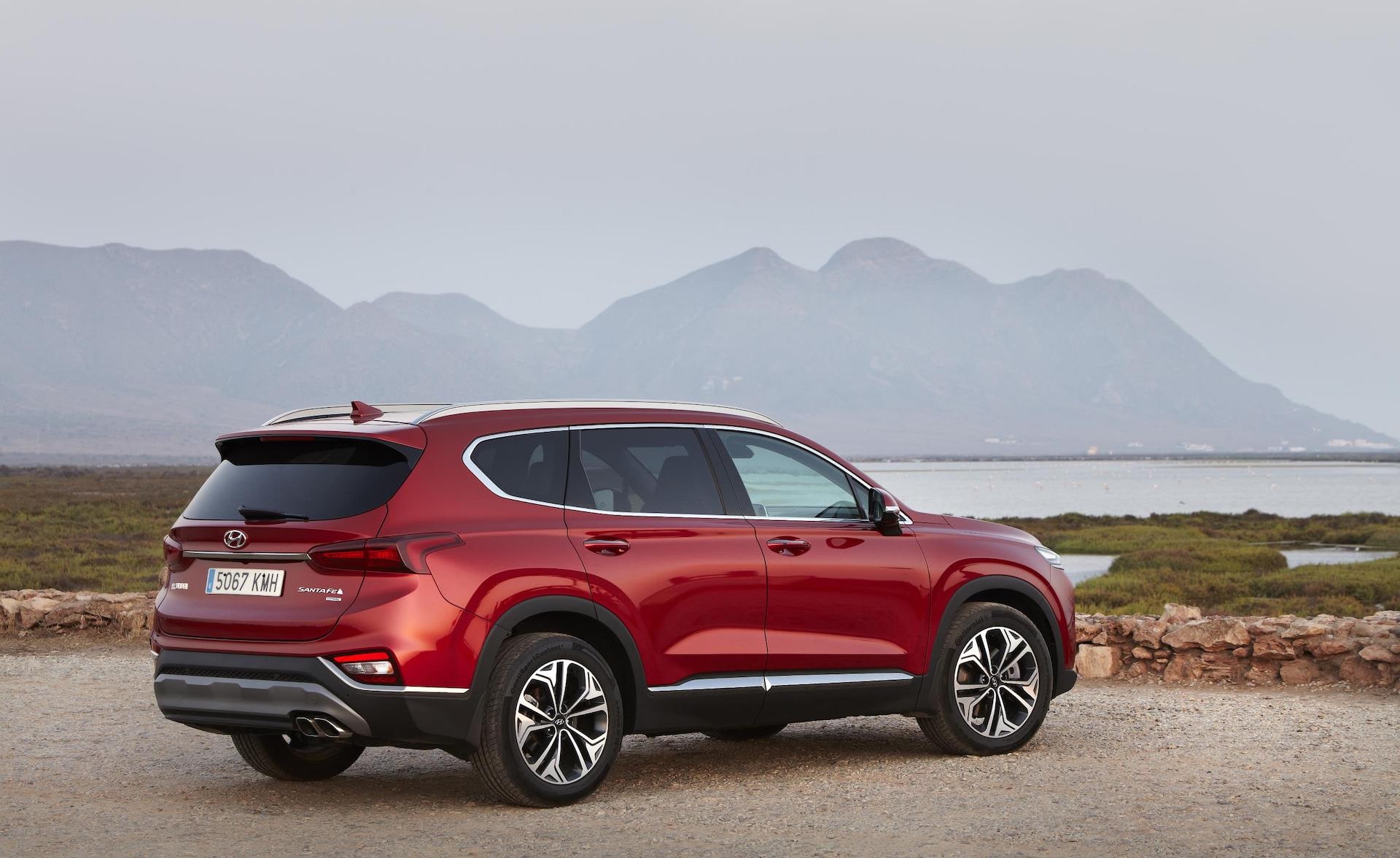
Hyundai Santa Fe Hybrid (from ~€48,000)
The new-generation Santa Fe plays the card of bold design and a boxy cabin. That box shape — criticised aesthetically by some — is exactly what gives it an edge in the third row: a high roofline all the way to the tailgate, which translates into a usable upright boot. It advertises around 628 litres with five seats and official 7-seat figures that do not drop as sharply as in rivals with a more fastback rear.
The mechanical package is a 1.6 T-GDi hybrid with 215 CV combined. Homologated consumption is around 6.3 l/100 km. Front-wheel drive or 4×4 depending on trim.
| Power | CV | WLTP consumption | Label | Fuel |
|---|---|---|---|---|
| 158 kW | 215 CV | 6.3 l/100 km | ECO | Hybrid |
Objective strength: boot geometry. Vertical tailgate, straight roofline and generous clear height when the third row is in use. In our view, it is the one that makes the best use of every advertised litre.
Kia Sorento Hybrid (from ~€50,500)
The Santa Fe’s cousin shares its platform and the 215 CV 1.6 T-GDi hybrid powertrain, but with a more conventional line and a roof that slopes slightly rearwards. The official boot capacity with 5 seats is around 604 litres; with the third row up it drops to roughly 175-180 litres, an honest figure for the segment but below the Santa Fe in usable shape.
Where the Sorento claws back ground is in the finish of the third-row access and the modularity of the second row. For families with two small children who only use the third row occasionally, it is more comfortable than the Hyundai.
| Power | CV | WLTP consumption | Label | Fuel |
|---|---|---|---|---|
| 158 kW | 215 CV | 6.4 l/100 km | ECO | Hybrid |
Objective strength: ease of access to the 3rd row and a 7-year warranty, unbeatable compared with the rest. If the Hyundai Santa Fe vs Kia Sorento comparison left you with doubts, the nuance here lies in the shape of the rear space.
Nissan X-Trail e-Power (from ~€44,500)
The X-Trail e-Power is the interesting outsider. Its peculiar powertrain — a 1.5 petrol engine acting purely as a generator, with electric drive — delivers a driving feel very close to an EV without plugging in. The 7-seat version exists on the Spanish market, and it is the most affordable of the trio by a significant margin (around 10-12% below the Sorento).
That said, the X-Trail pays for its compactness: it is about 20 cm shorter than the Korean rivals. Its third row is clearly an emergency one, suitable for children on short journeys, and boot space with all seven seated is a tiny 100-120 litres. For a weekend away with real luggage, it is not enough.
| Power | CV | WLTP consumption | Label | Fuel |
|---|---|---|---|---|
| 150 kW | 204 CV | 6.1 l/100 km | ECO | Hybrid |
Objective strength: entry price and an electric-like driving feel without depending on a plug. But as a frequently used 7-seater, it does not make the grade.
Summary table and scoring
| Model | Boot with 3rd row in use | Length | Starting price | Warranty | Real 7-seat score |
|---|---|---|---|---|---|
| Hyundai Santa Fe Hybrid | ~230 l (usable geometry) | 4.83 m | €48,000 | 5 years | 9/10 |
| Kia Sorento Hybrid | ~180 l | 4.81 m | €50,500 | 7 years | 8/10 |
| Nissan X-Trail e-Power 7-seat | ~120 l | 4.68 m | €44,500 | 3 years | 6/10 |
Verdict by use case
- Genuinely large family (5+ regular passengers with luggage): Hyundai Santa Fe Hybrid. It is the only one of the three that lets you travel all seven with suitcases without playing Tetris. The box shape gives it an objective advantage over the Sorento.
- Family that uses the 3rd row occasionally and values access and warranty: Kia Sorento Hybrid. Easier to get into, 7 years of warranty and a slightly finer finish. That said, it costs 5% more than the Hyundai while offering less usable boot space with all seven seated.
- Value for money and mostly used as a 5-seater: Nissan X-Trail e-Power. Cheaper, easier to handle in town and with a powertrain that convinces. As a regular 7-seater, no; as an occasional 5+2 at a good price, yes.
One final note: the price gap between the X-Trail and the Sorento exceeds 13%, but they are not playing the same game. They are cars from different categories forced to compete by offering three rows. Choosing on price without thinking about how many times a year the third row will really be used is the most common mistake in this segment.
Frequently asked questions
Which 7-seat hybrid SUV has the most boot space with all seats occupied?
Among the models on sale in Spain in 2026, the Hyundai Santa Fe Hybrid offers the greatest usable capacity with the third row up, thanks to the vertical geometry of its boot. Rivals such as the Kia Sorento Hybrid offer similar VDA figures but with less clear height.
Does a 7-seat PHEV SUV lose a lot of boot space compared with a HEV?
Yes. The 12-25 kWh battery of PHEVs is usually housed under the rear floor, raising the boot floor. In a 7-seater this takes away between 30 and 80 litres compared with the HEV equivalent on the same platform.
Is a 7-seater worth it if the third row is only used occasionally?
If you use it fewer than 10-15 times a year, probably not. A 5-seat SUV in the same segment offers more everyday boot space, better consumption thanks to lower weight and a lower price. A 7-seater is justified when the third row is in genuine weekly use or for families with three children.
Does the Plan Auto+ apply to these conventional hybrid SUVs?
The Plan Auto+ focuses on plug-in electrified vehicles and pure EVs; HEVs and e-Power models without an external charging socket usually fall outside the more generous incentives. It is advisable to check the current call on the plan’s official website to confirm the conditions that apply to the specific model.
