

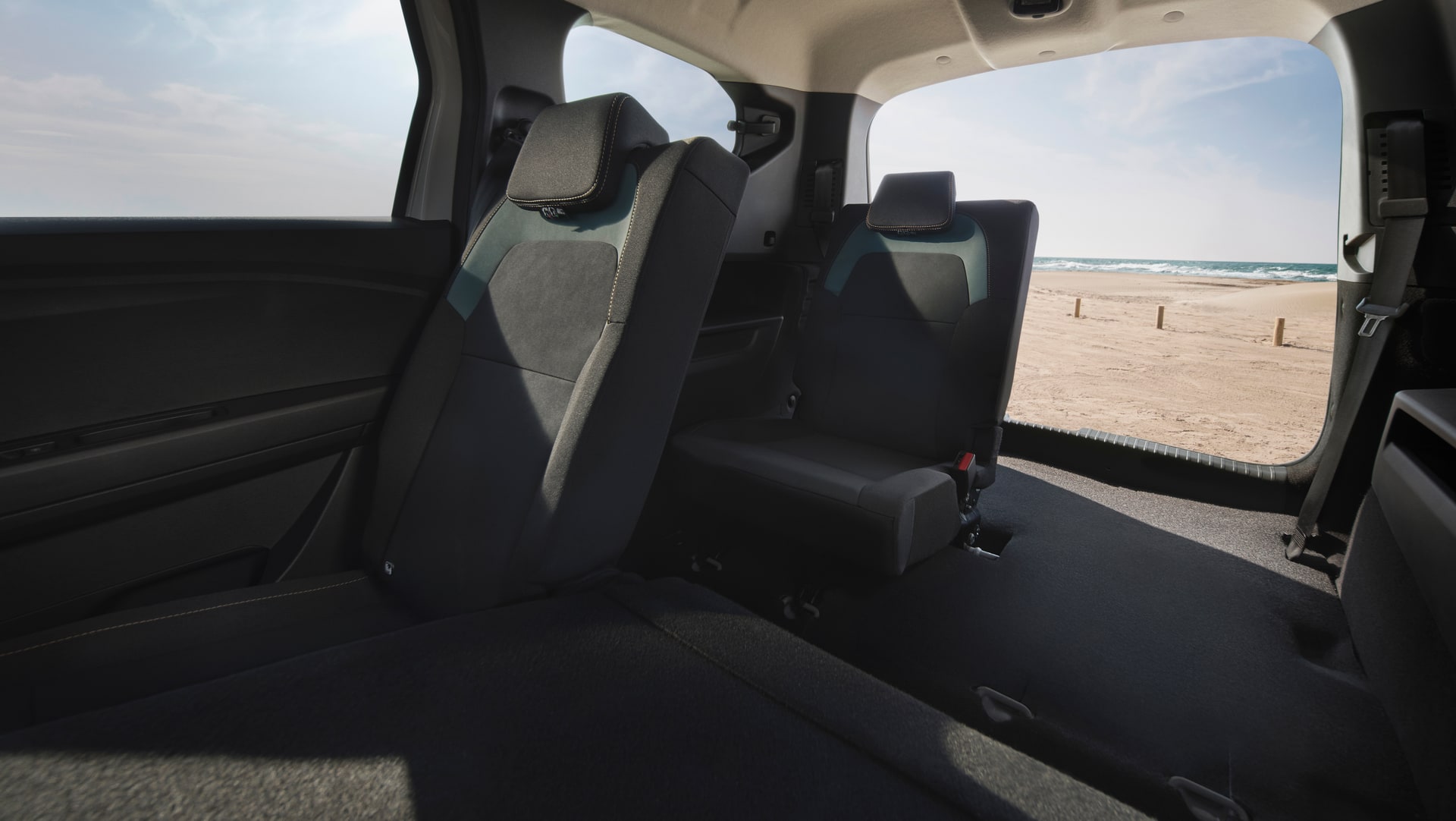
Seven people don’t fit in a car because a brochure says so. They fit, or they don’t, based on three very specific facts: how many real ISOFIX anchor points are available, how many litres of boot space are left with all seven seats occupied, and how you get into the third row without removing a child seat every time. The rest, trade names and brochure photos, is noise.
This guide compares three cars on sale in Spain in 2026 that genuinely solve the real problem of a family with five children, not that of two adults and a dog.
What a family with 5 children really needs when choosing a car
With five children and two adults we are talking about a minimum of seven seats, and in practice eight if one of the children still needs a child seat or if grandparents travel with you frequently. That immediately rules out almost every “7 seats” SUV that is really a 5+2 designed for short trips with small children in the third row. What this family needs is a car where the third row is habitable for a teenager, not just for an eight-year-old for twenty minutes.
Real ISOFIX: how many you need and where they should be
Here is the first marketing trap. A car can advertise “ready for child seats” and have only two ISOFIX anchor points in the second row and none in the third. For a family with five children, what you should demand is at least three homologated ISOFIX points in the middle row (something we already analysed in detail when reviewing the MPVs with the widest rear seat for three ISOFIX seats) and, if there are small children who will also travel in the third row, anchor points there too. Not every model in this article meets both requirements, and that changes the final recommendation.
Boot space with all seats occupied: the figure that really matters
The boot figure that manufacturers advertise almost always refers to the 5-seat configuration. With all seven seats occupied, that number plummets, sometimes leaving room for just a couple of backpacks. If your plan is to take all five children to school every day, that reduced boot is not a problem. If you take multi-day trips with luggage for seven, it is, and a big one.
Access to the third row with child seats installed
The third filter is the most underestimated: how you get to the third row. In an SUV with a conventional door and a folding seat, getting through with a child seat installed in the second row means removing it or performing contortions. In a passenger van with sliding doors and seats that slide forward without touching the ISOFIX anchor point, access is much more comfortable. This difference, which seems minor at the dealership, is noticeable every day of the year.
Dacia Jogger Hybrid 140 (from €19,900): the cheapest 7-seat option
The Jogger is the cheapest 7-seat car on the Spanish market and is still built on a city-car platform, not an MPV one. That comes with small print: the third row is narrow and the boot with all 7 seats up is only about 160 litres, just enough for school backpacks. In return, the price and the consumption are unbeatable in its segment.
| Version | Power (kW) | Power (CV) | Consumption | Label | Fuel |
|---|---|---|---|---|---|
| Jogger Hybrid 140 | 104 kW | 140 CV | 4.8 l/100 km | ECO | Hybrid |
Peugeot 5008 (from €39,900): compact SUV with a third row and standard equipment
The new generation of the 5008 offers a third row that is considerably more habitable than the segment average, with ISOFIX in the middle row and good standard equipment from the mid-range trims upwards. Access is still through a conventional door, so with child seats installed in the second row, getting to the back requires some manoeuvring. The boot with all 7 seats occupied barely exceeds 165 litres, a figure that disappoints in a car of this exterior size.
| Version | Power (kW) | Power (CV) | Consumption | Label | Fuel |
|---|---|---|---|---|---|
| 5008 Hybrid 136 | 100 kW | 136 CV | 5.3 l/100 km | ECO | Hybrid |
Volkswagen Multivan (from €54,900): real access and space for 7-8 occupants
The Multivan is the answer when the problem is not the family SUV but the large family itself. Sliding doors on both sides, individual sliding seats in the second row with ISOFIX, and a third row where an adult fits without any drama. Access with a child seat in place is, quite simply, in another category: you slide the adjacent seat without touching the child seat. The price is its big “but”: between 38% and 70% more expensive than the other two models on this list, something we already analysed in detail in the review of the Multivan as a tool for intensive use.
| Version | Power (kW) | Power (CV) | Consumption | Label | Fuel |
|---|---|---|---|---|---|
| Multivan 2.0 TDI 150 | 110 kW | 150 CV | 6.4 l/100 km | C | Diesel |
Other alternatives to consider: Hyundai Santa Fe and Citroen SpaceTourer
If your budget falls between the two extremes above, two options complete the picture. The Hyundai Santa Fe (from €47,000) is a large 7-seat SUV with a reasonable third row and an electric access lever, a middle ground between the 5008 and the Multivan in terms of space, although without sliding doors. The Citroen SpaceTourer (from €42,000) goes in the opposite direction: it is a passenger van with configurations of up to 8-9 real seats and access through sliding doors, designed more for carrying people than for showing off its design.
Summary comparison table
| Model | Starting price | Boot with 7 seats | 3rd-row access | Score (1-10) |
|---|---|---|---|---|
| Dacia Jogger Hybrid 140 | €19,900 | 160 l | Conventional door | 6.5 |
| Peugeot 5008 | €39,900 | 165 l | Conventional door | 7 |
| Volkswagen Multivan | €54,900 | 469 l | Sliding doors | 8.5 |
| Hyundai Santa Fe | €47,000 | ~130 l | Electric lever | 7.5 |
| Citroen SpaceTourer | €42,000 | Varies by configuration | Sliding doors | 7.8 |
Verdict: which car to choose for your situation
For daily urban use for school runs and activities, without frequent long trips: Dacia Jogger Hybrid 140. It is the only one that makes the monthly cost of moving seven people reasonable.
For those who want the look of an SUV and only use the third row occasionally: Peugeot 5008, although you should accept that the boot with everyone on board will be almost symbolic.
For the family that truly needs 7 or 8 comfortable seats every week, with child seats in place and travel luggage: Volkswagen Multivan. It costs more than double the Jogger, but it is the only one of the three where getting in and out of the third row with children is not a daily struggle.
Frequently asked questions
How many ISOFIX points does a family with 5 children really need?
At least three homologated points in the second row, and if there are small children who will occupy the third row, there too. Two ISOFIX points, the standard in many SUVs, fall short as soon as there are more than two small children.
Which 7-seat car has the most boot space with all seats occupied?
Of those compared, the Volkswagen Multivan, with figures far above conventional 7-seat SUVs, which typically end up between 130 and 170 litres with the third row up.
Is it worth paying more for sliding doors instead of conventional doors?
If child seats are installed and removed daily, yes. Access without touching the ISOFIX anchor point saves time and arguments every morning, something you can’t achieve in an SUV with a conventional door.
Are there public subsidies for buying a 7-seat car for a large family?
Yes, through the Plan Auto+, which provides support for purchasing vehicles that meet efficiency criteria. The amounts and requirements change frequently, so you should always check the plan’s official website before calculating your final budget.
