

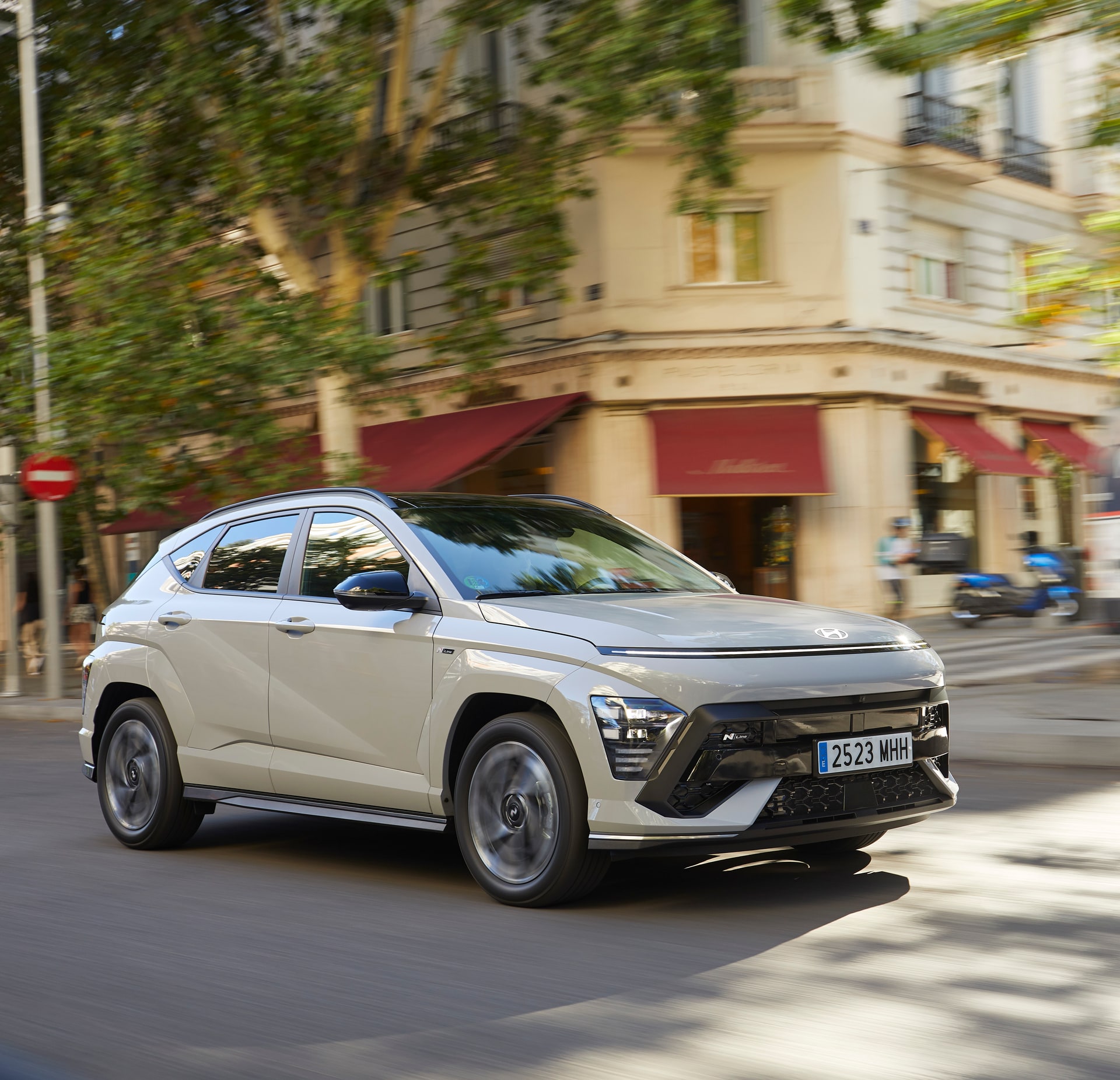
Buying a compact hybrid SUV in 2026 is no longer an act of faith in fuel savings. It is a calculation you can do with pencil and paper, crossing two figures: what the car costs at the official price list and what it really consumes, not on the WLTP cycle but in a mixed city and road test. The gap between the labelled consumption and the real-world consumption is what decides, in most cases, whether the hybrid pays off compared with an equivalent petrol car or whether the extra cost takes too many kilometres to recover.
What “compact hybrid SUV” means in 2026 and why real consumption matters more than the label figure
We are talking about self-charging models, without a plug, between 4.35 and 4.45 metres long, designed for a family of two or three that does city driving during the week and the occasional weekend trip. The ECO label applies to all of them, and that is already a common starting point. What is not common is the gap between homologated and real consumption: there can be almost one litre of difference every 100 km, and that litre, multiplied by 15,000 km a year, is real money leaving your pocket.
The methodology: how we calculate the cost per 100 km and the payback against an equivalent petrol car
The formula is simple and can be replicated with any model you want to compare. Cost per 100 km = real combined consumption (l/100 km) × price of a litre of 95-octane petrol (we take 1.65 €/l as the average reference in Spain). With that cost and the difference in purchase price against an equivalent petrol car of similar power (typically between 3,000 and 4,000 € of extra cost), you calculate how many kilometres are needed for the fuel saving to offset that initial difference. If you drive fewer than 10,000 km a year, the calculation changes radically compared with someone who drives 20,000.
Toyota C-HR Hybrid, from 31,900 €
The C-HR is the hybrid with the most commercial road time of the three. Its 1.8 engine has been refined over the years, and that shows in the smoothness of the transitions between combustion and electric power, something that in the first self-charging hybrids was noticeably rougher. The boot, however, is the smallest of the three, and in a car aimed at families that weighs heavily.
| Power | Real combined consumption | Boot | Warranty | Label | Fuel |
|---|---|---|---|---|---|
| 103 kW / 140 CV | 5.7 l/100 km | 388 litres | 3 years (extendable up to 10 with servicing at the official network) | ECO | Hybrid |
Hyundai Kona Hybrid, from 29,600 €
The Kona Hybrid enters with the lowest price of the three and a noticeably larger boot, 466 litres against the Toyota’s 388. Of the three, it is the one that best combines standard equipment and entry price, although its real consumption sits midway between its two rivals, neither the best nor the worst.
| Power | Real combined consumption | Boot | Warranty | Label | Fuel |
|---|---|---|---|---|---|
| 104 kW / 141 CV | 5.5 l/100 km | 466 litres | 5 years with no mileage limit | ECO | Hybrid |
Kia Niro Hybrid, from 29,950 €
The Niro is the largest of the three from the outside and the one that delivers the best real consumption in our mixed test. The 7-year, 150,000 km warranty is by far the longest in the segment, and that should weigh much more than it usually does in the purchase decision: it is money you will not have to spend on unexpected maintenance for almost a decade.
| Power | Real combined consumption | Boot | Warranty | Label | Fuel |
|---|---|---|---|---|---|
| 104 kW / 141 CV | 5.3 l/100 km | 451 litres | 7 years / 150,000 km | ECO | Hybrid |
Comparison table of price, real consumption and cost per 100 km
| Model | Price from | Real consumption | Cost per 100 km* | Boot |
|---|---|---|---|---|
| Toyota C-HR Hybrid | 31,900 € | 5.7 l/100 km | 9.41 € | 388 l |
| Hyundai Kona Hybrid | 29,600 € | 5.5 l/100 km | 9.08 € | 466 l |
| Kia Niro Hybrid | 29,950 € | 5.3 l/100 km | 8.75 € | 451 l |
*Calculated with 95-octane petrol at a reference price of 1.65 €/litre.
Where each one wins: objective strong points
The Toyota wins on long-term reliability reputation and on a e-CVT transmission response that feels more natural in town than that of its two rivals. The Hyundai wins on entry price and boot space, with almost 80 litres more than the C-HR, something you notice every time you fit two suitcases and a pushchair. The Kia wins on real consumption and warranty, and that combination is hard to argue with if your usage horizon exceeds eight years.
Payback against the petrol equivalent: how many km do you need to make the extra cost worthwhile?
Against an equivalent petrol car from a similar range (around 26,000 € and 6.8 l/100 km real), the Niro Hybrid recovers the extra purchase cost in a little under 70,000 km if you drive real mixed routes. The Kona does so in a similar range, slightly behind. The C-HR, starting from a higher price and a slightly higher consumption than its rivals, needs more kilometres to close that calculation, although for someone who keeps the car more than ten years the calculation matters much less.
Verdict: which compact hybrid SUV to choose according to your use
For urban use with short trips and little motorway: Kia Niro Hybrid, for the lowest real consumption of the three and a warranty that covers almost the entire reasonable service life of the car. For those who prioritise boot space and a tight entry price: Hyundai Kona Hybrid. For those who value above all confidence in the brand and don’t mind paying a little more for it: Toyota C-HR Hybrid, although its boot is a real drawback for families with regular luggage. If your use mixes city and road driving in equal parts, the family hybrid C-SUV may call for one size step up from these three, so it is worth checking before you decide.
Final summary table
| Model | Price from | Real consumption | Warranty | Score (1-10) |
|---|---|---|---|---|
| Toyota C-HR Hybrid | 31,900 € | 5.7 l/100 km | 3 years (up to 10 with servicing) | 7.5 |
| Hyundai Kona Hybrid | 29,600 € | 5.5 l/100 km | 5 years | 8.2 |
| Kia Niro Hybrid | 29,950 € | 5.3 l/100 km | 7 years / 150,000 km | 8.7 |
Frequently asked questions
Which compact hybrid SUV uses the least fuel in real conditions?
In our mixed test, the Kia Niro Hybrid delivered the lowest real combined consumption, 5.3 l/100 km, ahead of the Hyundai Kona Hybrid and the Toyota C-HR Hybrid.
Is it worth paying more for a self-charging hybrid SUV compared with an equivalent petrol car?
It depends on annual mileage. Below 10,000 km a year, the payback period stretches so far that the petrol car may end up being the more economical choice. Above 15,000 km a year, the hybrid usually recovers the extra cost within the car’s usual service life.
Are there public subsidies for buying a compact hybrid SUV in 2026?
The Plan Auto+ provides aid for certain electrified vehicles, with amounts and requirements that should be checked on the official website before closing the purchase, as they vary by autonomous community and type of vehicle.
What is the difference between a self-charging hybrid and a mild hybrid in terms of real consumption?
The self-charging hybrid can run in pure electric mode at low speed and recovers energy when braking, which noticeably reduces city consumption. The mild hybrid only assists the combustion engine and cannot move in pure electric mode, so its real saving is much smaller, especially in urban traffic.

1 Comment
Pingback: Los 5 SUV familiares híbridos más cómodos para viajar con niños por debajo de 45.000€ en 2026 – Comparativa de Coches