

Fitting three child seats in the back row sounds like a geometry problem. It is. And one that almost no sales brochure solves: manufacturers boast about “five certified seats” without telling you that between one seatbelt and the next there are 38 cm, or that your eldest daughter’s Group 2/3 seat measures 44 cm at the base. The result: you buy the fashionable compact SUV, get home with the three seats and they don’t fit.
This guide gets straight to the point. The deciding criterion is not the looks or the segment label, but three specific numbers: usable width of the rear bench, distance between the ISOFIX anchor points, and opening angle of the rear doors so bulky seats can be installed without twisting your elbows.
Why the typical compact SUV doesn’t work for three seats
The average compact SUV (Qashqai, Tucson, Sportage, Ateca) has roughly 140-145 cm of rear interior width. That is enough for two seats plus one narrow adult. It is not enough for three seats with backrests and side protection, unless you combine specific narrow seats (Multimac, Axkid Minikid or similar options) and accept that the middle child will be wedged in like a piece of Tetris.
The problem isn’t only width. It’s the inclination of the cabin sides (the door panels curve inward at shoulder height) and the shape of the side seats, which steal centimetres with their reinforcements. An MPV with straight sides and flat seats makes far better use of every measured centimetre.
Body styles that do work: pure MPV and van-derived people carriers
Two families solve the problem. The classic MPV (Touran, Jogger in its 7-seat layout used as 5+2) with a straight rear bench and high roof. And the van-derived passenger vehicle (Tourneo Connect, Caddy, Rifter, Berlingo), with sliding doors that open 90° and a flat floor.
Sliding doors change everything when you have three small children. You don’t have to park right up against the car next to you in the supermarket car park to open the door 60° and squeeze in a child seat. You slide it open and get in.
Let’s look at the three candidates that best solve the scenario of “three seats, a real family, and a budget that isn’t unlimited”.
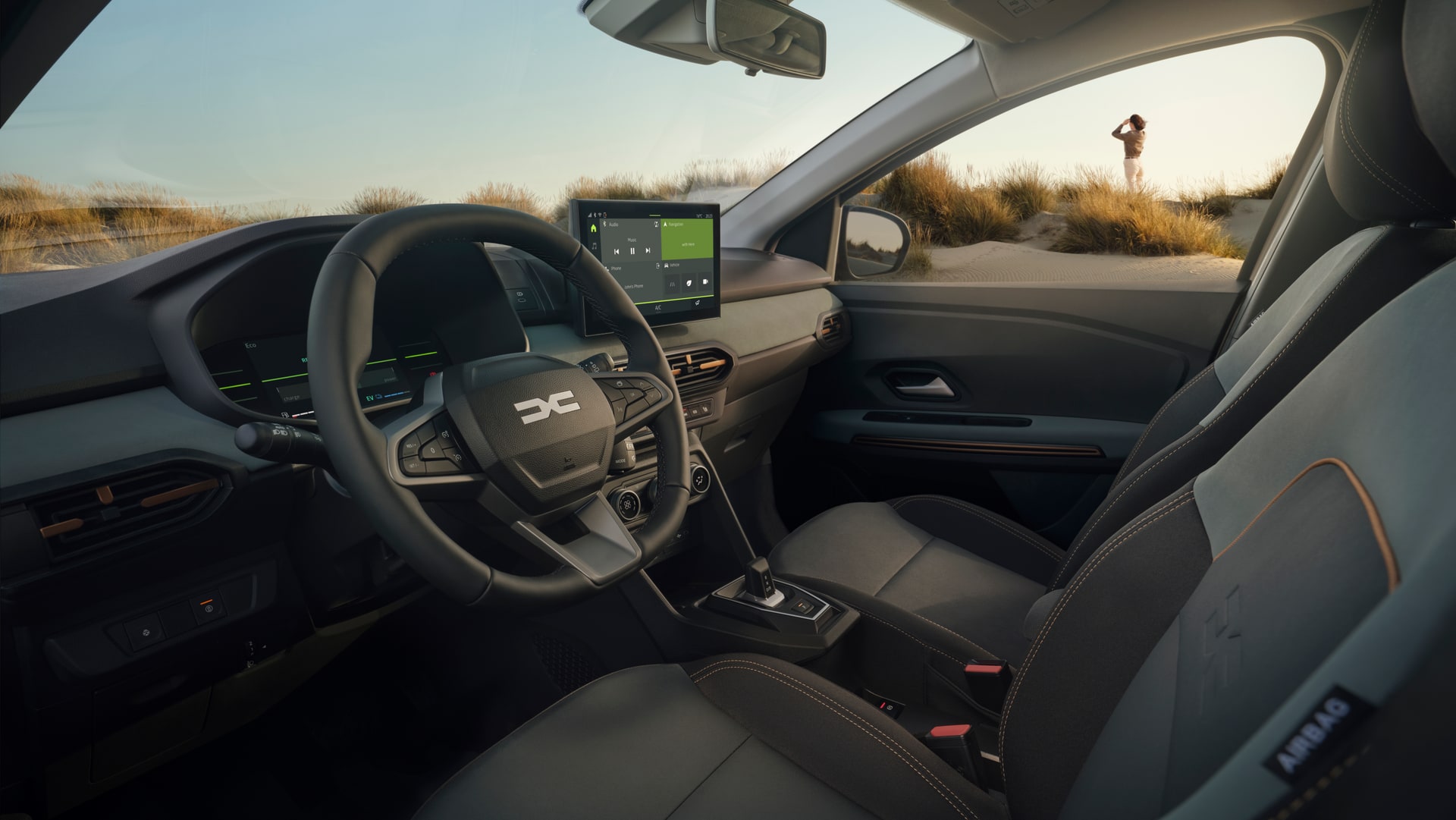
Dacia Jogger Extreme Hybrid 140 — from €22,400
The Jogger is the car that is disrupting the market for one reason: it gives you 4.55 m in length, 7 seats if you want them, and fits the budget of a city car. The second-row bench measures 145 cm usable, measured at seatbelt height, and the three ISOFIX anchorages (two side + centre with top tether) are reasonably spaced apart.
The small print? The plastics are hard, the sound insulation modest and access to the third row requires folding the second row. For three seats in the second row it more than meets the requirement; if you also occasionally need to carry a fourth or fifth passenger, seats 6 and 7 are for emergencies, not long journeys.
| Power kW | Power CV | Consumption | Label | Fuel |
|---|---|---|---|---|
| 103 kW | 140 CV | 4.8 l/100 km | ECO | Hybrid |
Volkswagen Touran Life 1.5 TSI 150 CV DSG — from €38,900
The Touran is the European benchmark MPV when it comes to “three seats, no question”. Three independent rear seats, sliding and with ISOFIX on all three. Not a bench with three anchorages, but three separate seats that you can move individually forwards or backwards. That independence is what makes the difference: you adjust the space to suit the seat, not the other way round.
The usable width is around 151 cm measured at the child’s shoulder height, and the roof height is ample for raised seats with high backrests. The doors open almost 80°. You pay for it, of course: almost €17,000 more than the Jogger in the same family scenario. The price jump exceeds 15%, and by a wide margin, so bear that in mind when deciding.
| Power kW | Power CV | Consumption | Label | Fuel |
|---|---|---|---|---|
| 110 kW | 150 CV | 6.2 l/100 km | C | Petrol |
Ford Tourneo Connect Titanium 2.0 EcoBlue 122 CV — from €35,500
The Tourneo Connect (the technical sibling of the Caddy, since Ford and Volkswagen share a platform in this segment) is the one that solves access. Optional electric sliding doors, a flat floor, a headroom that lets you get in without stooping, and a rear bench of 153 cm that accepts three seats with no trick required. Access for older children travelling independently (without parental help) is where it excels: the sliding door opens, the step is low and they climb in by themselves.
What it loses: van-like styling, soundproofing below a well-equipped Touran, and a diesel which, although efficient on the road, does not carry an ECO label. If you mainly drive in town with restrictions, the hybrid Jogger or the Touran TSI win on the environmental front. If you do a lot of motorway mileage, the diesel’s consumption makes up for it. A similar approach to the one we already saw when comparing the Tourneo Connect with the Caddy and the Rifter.
| Power kW | Power CV | Consumption | Label | Fuel |
|---|---|---|---|---|
| 90 kW | 122 CV | 5.6 l/100 km | C | Diesel |
Summary table and scoring
| Model | Bench width | Rear ISOFIX | Access | Boot | Price from | Overall score |
|---|---|---|---|---|---|---|
| Dacia Jogger Extreme Hybrid 140 | 145 cm | 2 + centre | Standard hinged door | 607 l (5 seats) | €22,400 | 8.5 / 10 |
| Volkswagen Touran Life 1.5 TSI DSG | 151 cm | 3 independent | 80° hinged door | 743 l | €38,900 | 8.8 / 10 |
| Ford Tourneo Connect Titanium 2.0 EcoBlue | 153 cm | 2 + centre | Sliding (optional electric) | 1,213 l | €35,500 | 8.3 / 10 |
Where each one wins, no half measures
- Jogger: unbeatable on price and on cost per seat. It is the only one that does what it does for under €25,000.
- Touran: the three independent seats with ISOFIX are a structural advantage that no rival in the segment offers today with such cleanliness.
- Tourneo Connect: the sliding doors and flat floor. For children who already get in and out on their own, it is in a different league.
Verdict by use case
- For a family on a tight budget with mixed city and motorway driving: Dacia Jogger Extreme Hybrid 140. The price is so low compared with the rivals that the trade-off in finish is painless to accept.
- For a family that travels a lot, with three seats in use at once and some budget room: Volkswagen Touran. The three independent seats and individual adjustment make it the most rational choice if the children are of very different ages.
- For an urban family with narrow car parks and children who get in and out by themselves: Ford Tourneo Connect. The sliding doors and access are decisive in day-to-day use.
Frequently asked questions
How many centimetres of width do I need to fit three child seats?
As a practical rule, 145 cm of usable width measured at belt height is the minimum for standard Group 1 seats. To combine a baby seat + Group 1 + Group 2/3, 150 cm gives comfortable margin. Below 140 cm you will need specific narrow seats.
Can a 7-seat SUV take three seats in the back?
It depends on whether all three go in the second row or are spread out. In the second row, many large SUVs (Sorento, Santa Fe, Tayron) do manage it because they exceed 150 cm. If you spread them 2+1 between the second and third rows, almost any 7-seater will do, but you lose boot space. There is a specific guide on hybrid 7-seat SUVs with boot space available with the third row in use.
Is it mandatory for all three ISOFIX anchorages to be independent?
No. The R129 (i-Size) regulation requires ISOFIX in at least two rear seats; the centre one can be seatbelt + top tether only. But if you are going to fit three real i-Size seats, three independent ISOFIX anchorages (as in the Touran) greatly simplify installation and reduce the margin for error.
Are sliding doors a real advantage or just marketing?
A real and measurable advantage. In a 2.30 m wide car park space (the Spanish standard), a hinged door opens only 40-50° without hitting the neighbouring car. Not enough to squeeze in a baby seat without difficulty. A sliding door opens fully straight in that same space. For families with young children, it is the difference between arriving patiently or not.

2 Comments
Pingback: Toyota C-HR vs Renault Symbioz vs Nissan Qashqai: qué SUV-C híbrido se mueve mejor en ciudad en 2026 – Comparativa de Coches
Pingback: Cómo elegir un coche para familia numerosa de 5 hijos en 2026 según plazas reales, maletero con todas ocupadas y acceso a la tercera fila – Comparativa de Coches