

The most expensive mistake when buying a family hybrid SUV is looking only at the WLTP figure. A HEV that claims an average of 5.1 l/100 km will suit you perfectly if 70% of your mileage is city and suburban driving, and will disappoint you if you live on the A-6 at 120 km/h. A PHEV that promises 1.5 l/100 km will drain your wallet on consumption if you never plug it in. The decision starts with understanding your own split of kilometres, not with the promises in the brochure.
Why the urban/motorway split matters more than any WLTP figure
Non-plug-in hybrids work like a small battery that recharges itself by braking and using the combustion engine when there is spare capacity. In town, with constant braking and low speeds, the system works in its sweet spot: the electric motor moves the car most of the time and the petrol engine kicks in only occasionally. On a sustained motorway run at 120 km/h that balance breaks down: the combustion engine carries almost all the work, and the extra weight of the hybrid system shows up in consumption.
That is why the same car can record 4.5 l/100 km around Madrid and rise to 6.5-7 l/100 km on a Madrid-Valencia trip without traffic. This is not a defect. It is physics.
The three mechanisms you need to tell apart: series HEV, parallel HEV and PHEV
- Classic parallel HEV (Toyota, Hyundai, Kia, Honda): the combustion and electric motors work together or separately as needed. A good urban-motorway compromise.
- Series HEV (Nissan e-Power): the wheels are always driven by the electric motor; the petrol engine acts only as a generator. It feels like an EV and urban consumption is very low, but it is more penalised on sustained motorway driving.
- PHEV: large battery (12-25 kWh) and a charging socket. 40-90 km of real electric range. It only makes sense if you plug in every day and make short trips between charges.
Toyota RAV4 Hybrid 2.5 140 kW Advance — from 42,950 €
The RAV4 is the benchmark because it has spent almost three decades refining the recipe. The entry-level hybrid version with front-wheel drive delivers 140 kW (190 CV) combined, and in mixed urban-interurban use it moves comfortably between 5.2 and 5.8 l/100 km in real conditions. On the motorway at 120 km/h it rises to 6.5-7 l/100 km. Nothing scandalous, but it stops being the consumption champion it is in town.
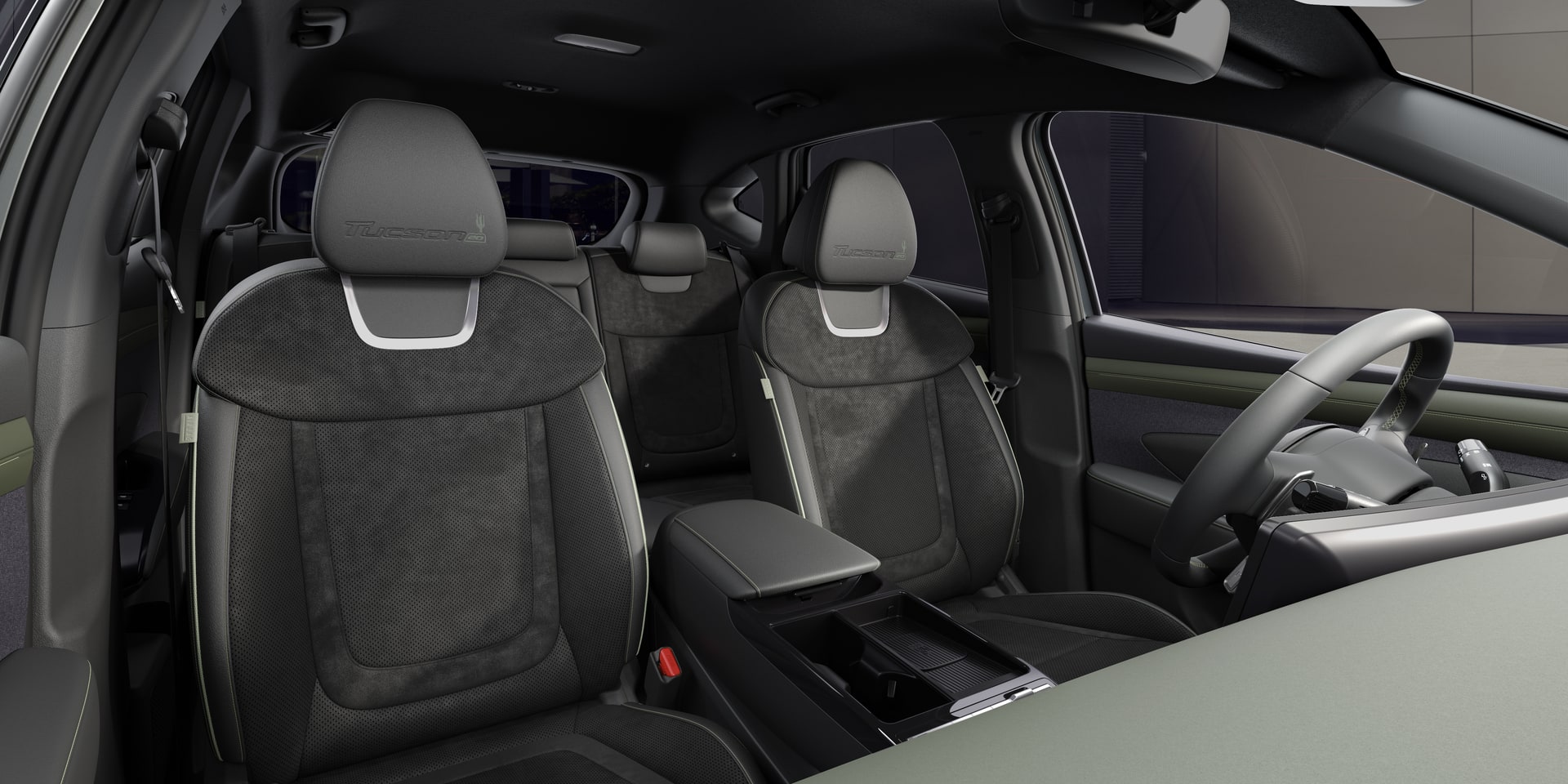
580-litre boot, comfortable rear legroom for three narrow child seats, and a powertrain nobody disputes any more. The interior finish is the step it has been lagging behind for years: functional, hard to the touch, far from the Tucson.
| Power kW | Power CV | WLTP consumption | Label | Fuel |
|---|---|---|---|---|
| 140 kW | 190 CV | 5.8 l/100 km | ECO | Hybrid |
Nissan X-Trail e-Power 150 kW N-Connecta — from 42,600 €
The X-Trail with e-Power system is a different animal: you are always driving in electric mode, with the 1.5 VC-Turbo acting as a generator. In town the sensation is of pure electric driving, consumption stays comfortably below 5 l/100 km, and acoustic comfort during take-offs is superior to any parallel HEV. This is where it shines.
The problem appears on long motorway runs at high speed: the combustion engine must constantly generate electricity at high revs and consumption rises to 7-7.5 l/100 km, above the RAV4 in that same scenario. 575-litre boot, an interior finish one step above the Toyota and quieter urban driving than any Japanese rival. For someone who does 80% city and 20% road, it is the most coherent of the trio. We cover it in depth in the full X-Trail e-Power review.
| Power kW | Power CV | WLTP consumption | Label | Fuel |
|---|---|---|---|---|
| 150 kW | 204 CV | 6.1 l/100 km | ECO | Hybrid |
Hyundai Tucson 1.6 TGDi HEV 215 CV Maxx — from 35,790 €
The hybrid Tucson is the most balanced of the group and, by a considerable margin, the one that offers the most car per euro. 158 kW (215 CV) combined, six-speed torque-converter automatic gearbox (without the CVT drone of Toyota), and an interior that plays in a different league in terms of perceived quality. Real consumption in mixed use of 5.5-6 l/100 km; on the motorway it behaves somewhat better than the e-Power, at around 6.3-6.8 l/100 km at 120 km/h.
620-litre boot, the largest of the trio, and seven years of warranty. The price difference with the two Japanese models exceeds 15%, which weighs heavily in the final verdict.
| Power kW | Power CV | WLTP consumption | Label | Fuel |
|---|---|---|---|---|
| 158 kW | 215 CV | 5.7 l/100 km | ECO | Hybrid |
When a PHEV does pay off (and when it doesn’t)
If your real pattern is 40 km of city driving a day, with a charger at home or at work and a couple of long trips a month, a PHEV such as the Kia Sportage PHEV or Ford Kuga PHEV can keep you away from the petrol station for weeks. If you rarely plug in, or your trips are mostly motorway, you are carrying 300 kg of unused battery and paying 6,000-8,000 € extra for the privilege.
Alternatives worth a look
Beyond the protagonist trio, the segment has three solid options worth keeping on the radar: the Kia Sportage HEV (technical sibling of the Tucson, with a different styling and an equally long warranty), the Renault Austral E-Tech full hybrid (competitive urban consumption and a carefully finished interior) and the Honda CR-V e:HEV, technically close to the Nissan concept but more restrained on the motorway. For anyone who prioritises pure price above all else, the Dacia Bigster with the Hybrid 155 powertrain enters the picture for considerably less money, although it drops a step in finish and refinement.
Summary table and score
| Model | Price from | Boot | City consumption | Motorway consumption | Warranty | Score /10 |
|---|---|---|---|---|---|---|
| Toyota RAV4 Hybrid Advance | 42,950 € | 580 L | 5.2 l | 6.8 l | 3 years + Relax up to 15 | 8.0 |
| Nissan X-Trail e-Power N-Connecta | 42,600 € | 575 L | 4.8 l | 7.3 l | 3 years | 7.8 |
| Hyundai Tucson HEV Maxx | 35,790 € | 620 L | 5.5 l | 6.5 l | 5 years | 8.5 |
Verdict by use case
- 70-80% urban use (large suburbs, daily traffic jams, short trips): Nissan X-Trail e-Power. The electric feel and real urban consumption are not matched by any parallel HEV.
- Mixed 50/50 city-motorway use with frequent family trips: Toyota RAV4 Hybrid. The balance of consumption and proven reliability win in the most common scenario.
- Price-performance ratio and a complete family car: Hyundai Tucson HEV. Between 7,000 and 7,200 € cheaper than the Japanese models in equivalent trim, a difference above 15% which, combined with the five-year warranty and the larger boot, makes it the rational choice for most families without an extreme usage profile.
If the real pattern is 40 km a day with a charger at home, the picture changes: a PHEV comes into play and the analysis is different.
Frequently asked questions
Can a modern HEV handle a motorway run at 130 km/h well?
Yes, but it consumes about the same as an equivalent petrol car: between 7 and 8 l/100 km depending on the model. The HEV advantage fades above 110 km/h sustained; it still carries the ECO label and tax benefits, but do not expect urban consumption figures in that scenario.
Does a PHEV make sense if I don’t have a charger at home?
No. Without the option to charge daily, a PHEV becomes a heavy hybrid that consumes more than an equivalent HEV. It only makes sense with a home or workplace charger and daily trips shorter than the car’s real electric range.
Is Nissan’s e-Power system an extended-range electric car?
Technically yes: the wheels are always driven by the electric motor and the petrol engine only generates electricity. For DGT labelling purposes it is ECO (hybrid), not CERO, because it cannot be plugged in and cannot cover significant distances in pure electric mode from the battery.
Do the Plan Auto+ grants apply to non-plug-in hybrid SUVs?
The Plan Auto+ focuses on plug-in electrified vehicles and pure electric cars; non-plug-in HEVs such as the RAV4, X-Trail e-Power or Tucson Hybrid are generally excluded. For current amounts and specific conditions, check the official plan website before closing the purchase.

1 Comment
Pingback: Los 5 SUV-C híbridos más recomendables para familia que combina ciudad y viajes largos en 2026 – Comparativa de Coches