

Choosing a minivan in 2026 has become a strange exercise. The segment has almost disappeared, swallowed up by the seven-seat SUV, and what remains sits somewhere between the civilised van and the traditional family MPV. But there is one question that no family SUV answers well and that the minivan does: how much boot space is left when we travel all seven, with the dog and without the little one’s backpack on his lap? That is where the purchase is decided.
Most comparisons give you litres with the third row folded down. A magic trick. If you carry three children every day, that figure is useless. What matters is the real gap behind the last row. And in this segment, that number changes everything.
Two variables that matter: number of children and usable boot space with all seats in use
Let’s simplify. With one or two children, any compact or C-segment SUV is enough and a minivan is oversized. With three children, you enter seven-seat territory (two rear ISOFIX seats plus the little one’s or a supporting adult’s), and the usable boot space with everything occupied drops to ridiculous figures on almost every SUV. With a large family or four children, the seven-seat SUV simply won’t do and you need to look at van-type bodies.
The other axis: litres with the third row in use. A Peugeot 5008 has around 230 litres there; a Dacia Jogger, about 160. A Ford Tourneo Custom exceeds 1,000. It is not the same car, and it is not the same life.
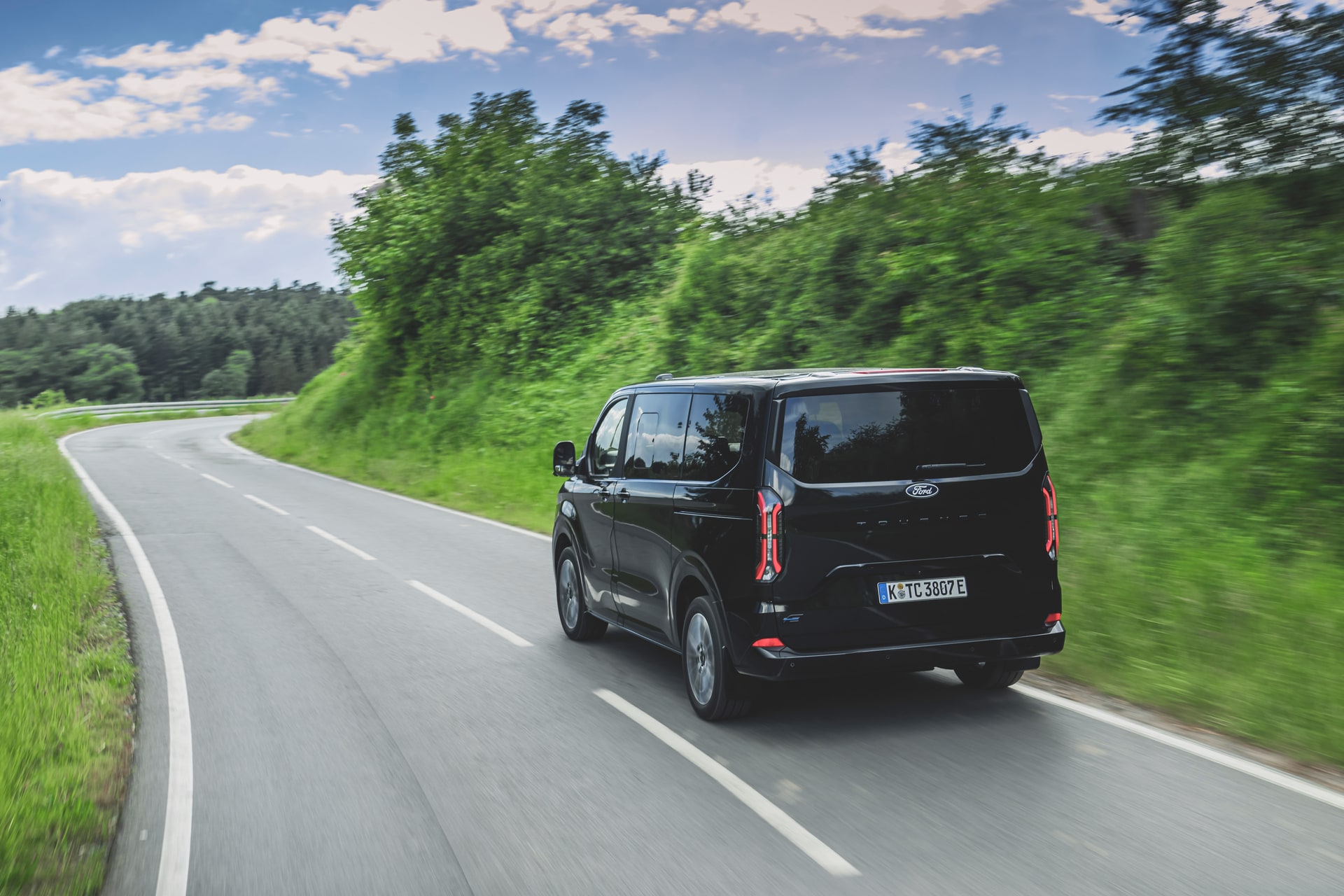
Ford Tourneo Custom — from around €45,000
The Tourneo Custom is the honest answer when you need real space with all seats in use. It is derived from the Transit, yes, and that shows in the elevated driving position and in a styling that fools no one: this is a civilised van, not a minivan with coupé pretensions. And precisely for that reason it works.
We are talking about up to 9 seats in L2 configuration, an optional high roof, electric sliding doors on both sides and a boot that, with all three rows fitted and occupied, sits comfortably above 1,000 litres. No seven-seat D-segment SUV comes close. The usual engine in Spain is the 2.0 EcoBlue diesel in 136 or 170 PS, with an 8-speed automatic gearbox on the upper trims, and there is an interesting PHEV variant if your daily routine allows plugging in.
What doesn’t quite convince me is the price. Starting from an indicative €45,000 (including VAT and for the short Trend version) places the Tourneo in a bracket where it competes with premium SUVs. And the dynamics, let’s not kid ourselves, are what they are: a tall body, soft steering, real-world consumption of 8-9 L/100 km on the motorway with the diesel.
Volkswagen Multivan — from around €62,000
The Multivan (T7 generation) is the more refined alternative. MQB platform, the same base as a Golf or a Tiguan, which translates into surprisingly car-like driving for the volume it moves. There is an eHybrid PHEV version with up to 50 km of homologated electric range, longitudinal rails that allow the rear seats to be moved, rotated and removed, and an interior finish a step above the Ford.
The catch? The price. Starting at an indicative €62,000 for the short version is a lot of money, and realistic configurations easily climb to €70,000-80,000. In return you get a car that, in our view, is the best for covering kilometres with seven on board if budget is not tight.
Dacia Jogger — from around €17,500
At the other end of the spectrum, the Jogger. Seven seats for less than €20,000 in base trim, with the TCe 110 petrol or the self-charging HYBRID 140 engine (the one we recommend for families), and a pragmatic formula: stretched body on the Sandero base, usable roof height, and reasonable access to the third row for children.
The boot with all seven seats in use is 160 litres. Enough for the shopping or three school backpacks, not for a week at the beach with everyone on board. But for this money, there is no rival. In fact, it is probably the best family car for 3 children if budget is the priority and long trips with the whole family are occasional.
Peugeot Rifter and Citroën Berlingo — from around €26,000
Two cousins from the Stellantis group on the EMP2 platform. Both offer a 5- or 7-seat configuration, rear sliding doors, a generous boot with five seats (around 775 litres) and the electric option e-Rifter / ë-Berlingo with about 280 km WLTP of range.
The Rifter comes with somewhat more standard equipment in the Allure trim; the Berlingo plays the comfort card and has slightly more contained prices. As we already analysed in other head-to-heads within the group, the real difference between the two is more about personality than engineering. Mind you: with 7 seats deployed, the boot drops to 322 litres. Better than the Jogger, far from the vans.
Comparison: boot space with all seats in use
| Model | Max. seats | Boot with all seats in use | Main engine | Emissions label | Price from |
|---|---|---|---|---|---|
| Ford Tourneo Custom | 8-9 | >1,000 L | 2.0 EcoBlue diesel / PHEV | C / ECO | ~€45,000 |
| Volkswagen Multivan | 7 | ~469 L | 1.5 TSI / 2.0 TDI / eHybrid | C / ECO | ~€62,000 |
| Dacia Jogger | 7 | 160 L | TCe 110 / HYBRID 140 | C / ECO | ~€17,500 |
| Peugeot Rifter | 7 | 322 L | PureTech 110 / BlueHDi / electric | C / CERO | ~€26,000 |
| Citroën Berlingo | 7 | 322 L | PureTech 110 / BlueHDi / electric | C / CERO | ~€26,000 |
Manufacturer’s recommended retail prices (RRP), without dealer discounts, campaigns or public aid such as the Plan Auto+. Boot litres according to each brand’s official data; it is advisable to measure at the dealership with your actual child seats.
Scoring by use case
| Model | Family with 3 children, daily use | Long trip with 7 on board | Price-to-seats ratio | Driving | Overall score |
|---|---|---|---|---|---|
| Ford Tourneo Custom | 9 | 10 | 7 | 6 | 8.0 |
| Volkswagen Multivan | 8 | 9 | 5 | 8 | 7.5 |
| Dacia Jogger | 8 | 5 | 10 | 6 | 7.3 |
| Peugeot Rifter | 7 | 7 | 8 | 6 | 7.0 |
| Citroën Berlingo | 7 | 7 | 8 | 6 | 7.0 |
Verdict: which is the best family minivan for 2026 for your case
No “it depends”. Let’s commit.
- If you carry 3 children daily and make long trips with everyone on board (or you are a large family): the Ford Tourneo Custom has no real rival. It is the only one that gives you serious luggage space with all seats in use. Accept that you are driving a civilised van, not a car.
- If budget is the main constraint and seven-seat trips are occasional: the Dacia Jogger HYBRID 140. Seven seats, ECO label and an unbeatable price. The boot with everything occupied is its weak point, but for this money there is no alternative.
- If you want refinement and a budget above €65,000: the Volkswagen Multivan eHybrid. The most car-like of the five, the most expensive, and the one that ages best. The RRP gap with the Jogger exceeds 250%: they are different worlds.
- If you need 5 roomy seats with occasional use of 7 and a generous boot for everyday life: the Peugeot Rifter or the Citroën Berlingo, interchangeably. The Rifter with better equipment, the Berlingo with better net price.
FAQ
Which minivan should I buy for 3 children with child seats and usable boot space?
If you travel with all three daily and need real luggage space, the Ford Tourneo Custom is the most sensible option. For mixed use with occasional long trips, the Dacia Jogger HYBRID 140 meets the need for a fraction of the price, accepting that the boot drops to 160 litres with the seven seats in use.
How much boot space does a 7-seat minivan really have with all seats occupied?
It varies enormously. A Dacia Jogger offers 160 litres, a Peugeot Rifter or Citroën Berlingo around 322, a Volkswagen Multivan close to 470 and a Ford Tourneo Custom over 1,000. The typical brochure figures (700-2,000 L) correspond to the third row folded down, which is a different thing.
Is a minivan still worth it over a 7-seat SUV in 2026?
If you regularly transport more than two children and make trips with serious luggage, yes. A D-segment 7-seat SUV such as the Hyundai Santa Fe or Kia Sorento offers touring comfort, but the boot with the three rows deployed barely exceeds 200 litres. The minivan wins on usable space per euro.
Are there CERO-label minivans for large families?
Yes, but limited. The electric e-Rifter and ë-Berlingo versions offer the CERO label with about 280 km WLTP; the Volkswagen Multivan eHybrid adds PHEV electric range with a CERO label. For medium-to-long range with seven on board, diesel remains the pragmatic option today.

2 Comments
Pingback: Los 5 monovolúmenes de 7 a 9 plazas con mejor equipamiento de serie por debajo de 45.000€ en 2026 – Comparativa de Coches
Pingback: Cómo elegir un coche familiar con 3 sillas infantiles ISOFIX en 2026 según ancho real de la banqueta trasera – Comparativa de Coches