

Choosing a van for private hire in 2026 is no longer about the brochure. It comes down to hard numbers: M1-approved seats the passenger can legally occupy, real litres of boot space when eight travel with large luggage, and the cent per kilometre that decides whether the service makes a margin or diesel eats it. Everything else — screen, panoramic roof, upholstery colour — is noise.
What a passenger van for private hire actually needs
The private hire operator does not buy a car: they buy a work tool that rotates between 60,000 and 100,000 km a year. What matters is type approval (M1 is mandatory for private hire, never a disguised N1), drivetrain reliability at high mileage, parts cost and residual value at 4-5 years. Everything else is secondary.
M1 approval: the entry condition
Without M1 approval there is no private hire licence. Full stop. That rules out Panel Van or Combi versions with undocumented later conversions. The Tourer, Caravelle, Tourneo, Zafira Life and Traveller are sold as M1 from the factory — that is what you must ask for explicitly at the dealership, with the reduced specification sheet in hand.
Real seats vs catalogue seats
There is a difference between “9 seats” in a brochure and an adult in the back fitting with knees free without touching the front seatback. In practice, the third row of most of these vans is comfortable up to 1.80 m if the second row gives up 10-15 cm of travel. With eight adult passengers and a driver, only the Vito Tourer Extra-Long, the long-wheelbase Caravelle and the Tourneo Custom L2 provide civilised space for journeys longer than 30 minutes.
The boot problem with all 8 seats occupied
This is where half the market falls down. With all rows in place, the space behind the third row ranges from insufficient (under 200 litres, not even one cabin bag per person) to decent (500+ litres on the long wheelbase). The rule we use: if the operator runs airport transfers with 7-8 pax and checked luggage, the long wheelbase is not optional, it is mandatory.
Cost per kilometre: the metric that decides
The real cent/km in 2026 for these vans with a 150-170 hp 2.0 diesel ranges between €0.22 and €0.30 (fuel + maintenance + tyres + estimated residual). The plug-in hybrid PHEV only pays off if the operator charges at base every night and does mostly urban journeys; otherwise the battery weight penalises motorway consumption and the saving evaporates.
Mercedes-Benz Vito Tourer Pro Extra-Long 116 CDI — from €54,900
The sector benchmark for one reason: residual value. At 4 years and 200,000 km, a Vito Tourer resells 15-20% better than its French rivals. The 163 hp 2.0 diesel with 9G-Tronic gearbox is smooth, the chassis absorbs bumps well and the interior, even without luxuries, takes punishment. With 8 seats, it leaves about 550 litres of boot in the Extra-Long version. Weak point: Mercedes parts prices and expensive official maintenance.
| Power | Fuel | Label | WLTP consumption |
|---|---|---|---|
| 120 kW / 163 CV | Diesel | C | 7.5-8.2 l/100 km |
Volkswagen Caravelle T7 2.0 TDI 150 CV long wheelbase — from €58,200
We already analysed the Multivan in its duel with the Tourneo Custom, but the Caravelle T7 is its more pragmatic sister for fleets. Ride comfort above the Vito, better-finished interior, similar consumption. The drawback: the T7 is aimed more at premium leisure than intensive service, and some operators report that its electrical reliability is not at the level of the T6.1 it replaced. Boot with 8 seats: around 470 litres.
| Power | Fuel | Label | WLTP consumption |
|---|---|---|---|
| 110 kW / 150 CV | Diesel | C | 7.2-7.8 l/100 km |
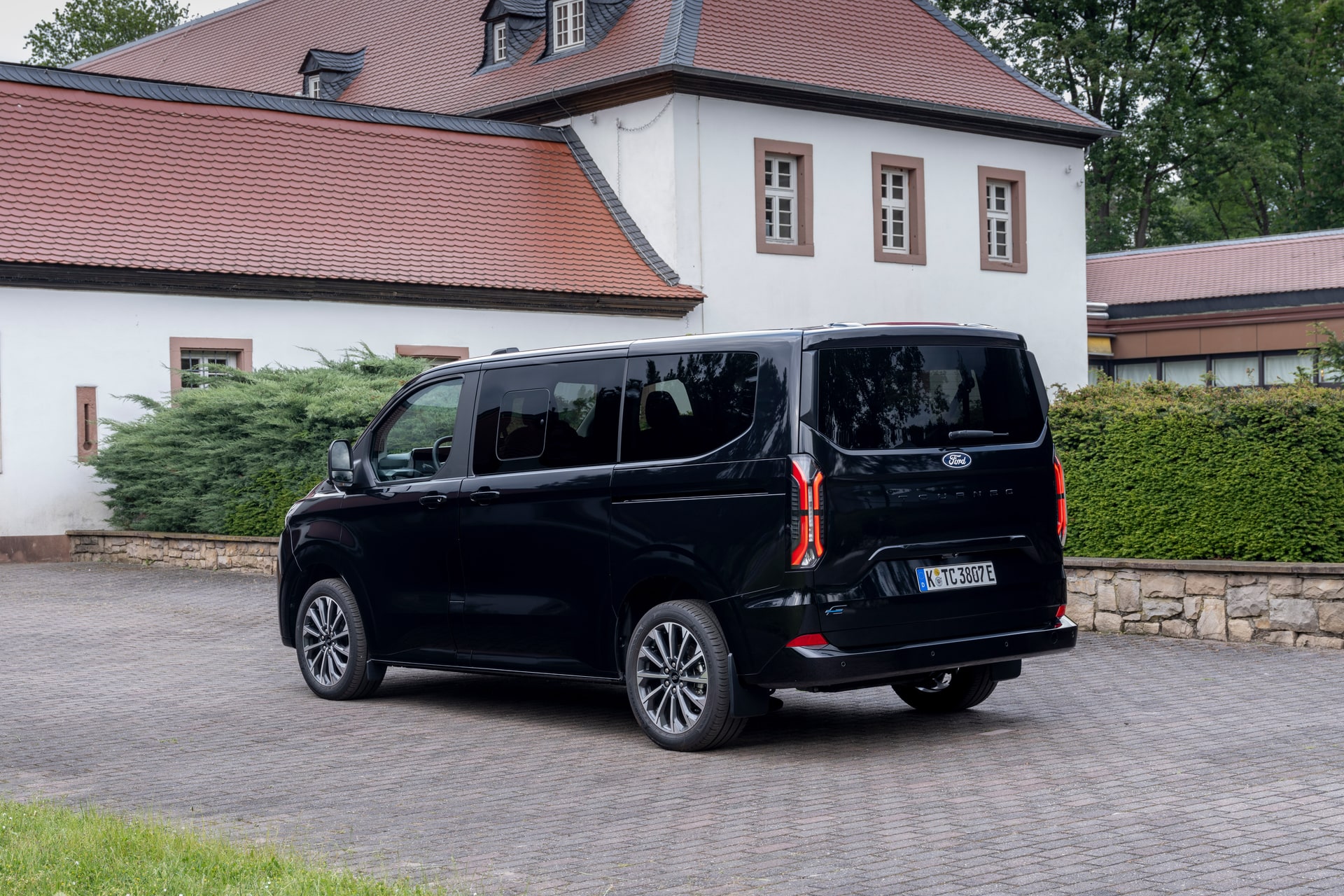
Ford Tourneo Custom Titanium L2 2.0 EcoBlue 150 CV — from €49,800
The useful surprise of 2025-2026. Completely redesigned, the new Tourneo Custom offers the most comfortable access in the group (MPV-style low floor), good sound insulation and a generous boot — around 600 litres with 8 seats in L2. Entry price clearly below the Vito and Caravelle. Its historic Achilles heel is residual value, lower than the Mercedes, although the new generation looks better.
| Power | Fuel | Label | WLTP consumption |
|---|---|---|---|
| 110 kW / 150 CV | Diesel | C | 7.4-8.0 l/100 km |
Opel Zafira Life and Peugeot Traveller: the Stellantis alternative
Same EMP2 platform, same 145 hp BlueHDi 2.0 engine, different bodywork and finish. They are the lowest entry-price option in the segment (from €42,500 for the Zafira Life Business L, somewhat more for the Traveller). Boot with 8 seats is tighter (350-400 litres in L), the third row is less comfortable and residual value is worse than Mercedes or VW. For an operator with short urban routes and little luggage, the equation works. For airport transfers, they fall short.
Diesel vs plug-in hybrid in private hire: the honest calculation
The e-Vito, e-Caravelle and e-Tourneo electric versions exist, but 300-350 km of real-world range does not cover an average private hire day without an intermediate fast charge — and DC at 100 kW on these vans is still slow. The PHEV is not offered in this specific segment with conviction today. The Euro 6e diesel, with a C label, remains the rational choice for 2026. If the operator works only in the city and can charge at 11 kW every night, the electric starts to make sense; in any other scenario, the numbers favour diesel.
Summary table and scoring
| Model | Price from | Usable seats at 1.80 m | Boot with 8 pax | 4-year residual | Overall score |
|---|---|---|---|---|---|
| Mercedes Vito Tourer Extra-Long | €54,900 | 8 | ~550 L | Very high | 9.0 |
| VW Caravelle T7 long wheelbase | €58,200 | 8 | ~470 L | High | 8.2 |
| Ford Tourneo Custom L2 | €49,800 | 8 | ~600 L | Medium | 8.5 |
| Opel Zafira Life Business L | €42,500 | 7 (8 tight) | ~380 L | Medium-low | 7.2 |
| Peugeot Traveller Long | €43,900 | 7 (8 tight) | ~380 L | Medium-low | 7.2 |
Verdict by use case
- Operator who amortises through residual value and does intensive airport work (150,000+ km/year): Mercedes-Benz Vito Tourer Extra-Long. Pays more upfront, recovers it on resale.
- Best space-price balance with 8 pax and luggage: Ford Tourneo Custom L2. The most generous boot and an RRP 10-12% below the Vito.
- Urban fleet with short journeys and a tight budget: Opel Zafira Life Business L. Entry below €43,000, familiar mechanics, cheap maintenance.
- Premium passenger comfort without leaving private hire logic: Volkswagen Caravelle T7. The most pleasant for rear passengers, although it costs 6% more than the equivalent Vito and its residual is lower.
The RRP difference between the Zafira Life and the Caravelle T7 exceeds 35%: they are not in the same service tier and should not be compared as equals. They are tools for different operators.
Frequently asked questions
Can I register an N1 Combi van for private hire?
No. Spanish private hire regulations require M1 approval (passenger car). N1 versions are industrial vehicles and do not meet private hire authorisation requirements, even if they have rear seats.
Does an electric private hire van make sense in 2026?
Only if the operator works almost exclusively in the city, has private charging at base and accepts shorter shifts or a charging break. For mixed service or airports, diesel still wins on cost per kilometre.
How many real litres of boot space do I need for an airport transfer with 7 passengers?
At least 450 usable litres behind the third row to carry 7 large suitcases plus hand luggage. Below that, bags must go inside the cabin, which reduces comfort and, with 8 seats sold, is not viable.
What realistic cost per kilometre should I budget for in 2026?
Between €0.22 and €0.30/km for a well-maintained 150-170 hp 2.0 diesel, including fuel, maintenance, tyres and depreciation/residual. The figure rises with aggressive driving and frequent tolls.

1 Comment
Pingback: Ford Tourneo Custom review: hasta dónde llega el monovolumen de 8-9 plazas como vehículo de traslados privados en 2026 – Comparativa de Coches