

Buying a passenger van in 2026 is no longer just a choice between eight or nine seats. It means deciding which energy source suits you best, and there is no single answer: it depends on how many kilometres you drive each day, whether you have an accessible charging point and how much you can afford to outlay upfront. Let’s put numbers to that decision, using models you can order today at a Spanish dealership.
The three variables that decide before you look at models
Before comparing technical specifications, there are three questions to answer. How many kilometres do you cover on average per day? Do you have regular access to a charging point, whether at home, at work or along your route? And how much budget can you allocate over the first four years, adding up purchase, energy and maintenance? These three variables, not the catalogue starting price, are what truly separate those who should buy diesel from those who should go electric.
Daily mileage: the 80 km threshold
Below 80 km per day, almost any electric passenger van covers the route with plenty of margin and recharges overnight without relying on fast-charging infrastructure. This is the profile for school transport, company shuttles or urban VTC routes. Above that figure, especially if you drive it every day without guaranteed charging access, the calculation becomes more complicated: you need to plan stops, and that costs time, which in a transport business translates into money.
Charging access: why 200 real-world km marks the boundary
Here is the uncomfortable truth many salespeople don’t mention: the homologated WLTP range is not what you will get in winter, with the climate control running and a full load. It drops by between 15% and 25% depending on the model. If your electric van promises 420 km WLTP, in real winter conditions you will manage around 320-340 km. That is why the useful threshold is not the 400 km on the brochure, but 200 real-world km between charges: if your daily operations stay below that figure with a charging point at your destination or base, the electric van works without friction. If you exceed it and the fast-charging network in your area is limited, diesel remains the option without surprises.
4-year TCO: where each technology wins
The total cost of ownership is where the electric van starts to pay back its upfront investment, but not automatically. With domestic or business energy at off-peak rates, the cost per kilometre of an electric van can be half that of an equivalent diesel. The problem is that the entry price gap between a diesel Ford Tourneo Custom and a Volkswagen ID. Buzz easily exceeds 30%, and that is not recovered within four years unless you drive enough kilometres. The Plan Auto+ aid can narrow that initial gap; it is worth checking the current amount on the official website before closing the deal, as it changes over time.
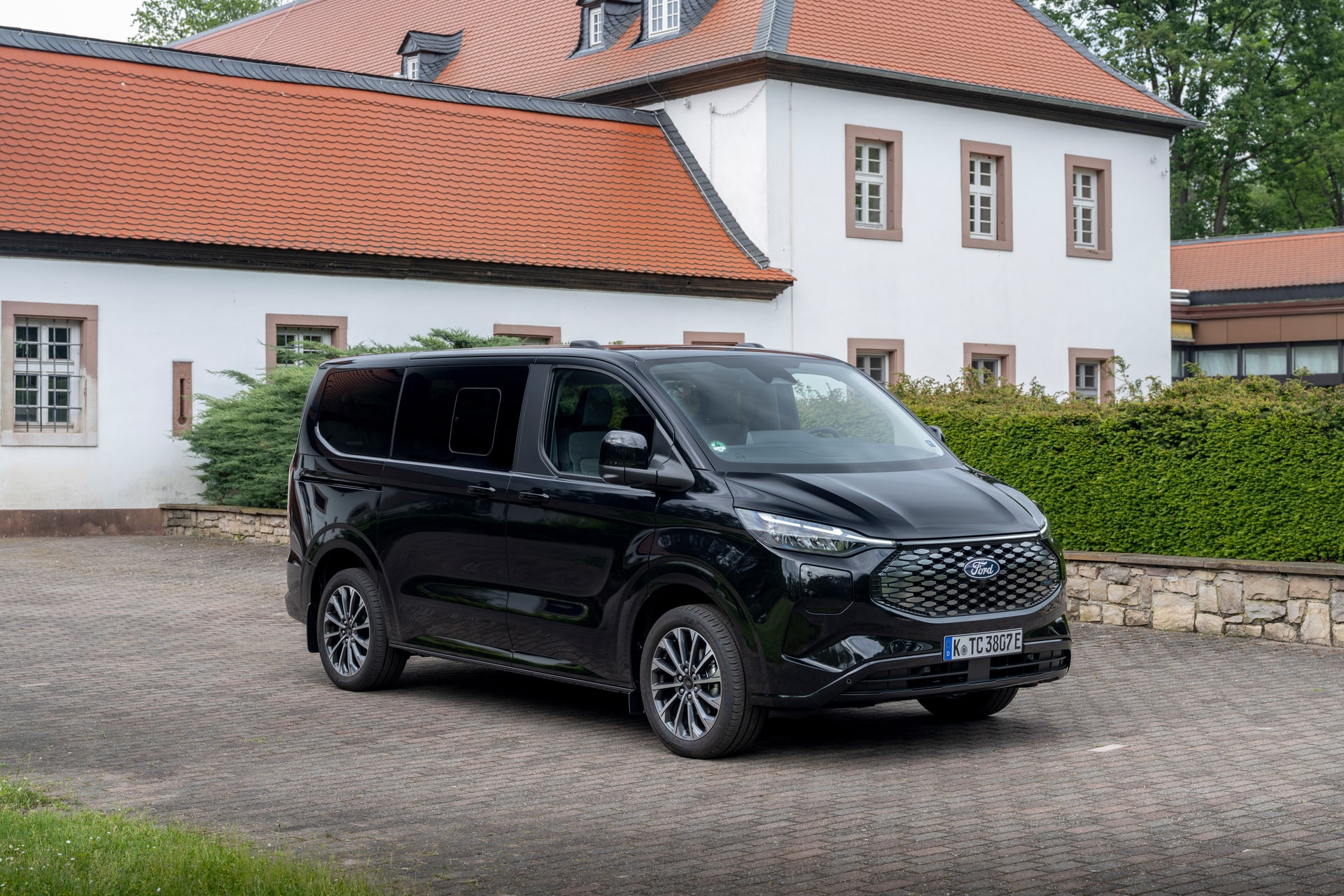
Ford Tourneo Custom, the diesel thermal benchmark (from €42,900)
It is the most solid diesel passenger van in its segment in terms of real-world range and replacement cost. Its 2.0 EcoBlue 136 CV engine moves the whole vehicle comfortably even with eight occupied seats and luggage, and its homologated consumption is around 7.0 l/100 km, which on a loaded motorway stays very manageable for anyone covering long routes without planning stops. We have already analysed the Ford Tourneo Custom as an alternative to premium vans, and where it convinces most is precisely in that intensive road use where the electric van still has to stop to charge.
| Model | Power (kW) | Power (CV) | Consumption | Label | Fuel |
|---|---|---|---|---|---|
| Ford Tourneo Custom 2.0 EcoBlue 136 CV | 100 kW | 136 CV | 7.0 l/100 km | C | Diesel |
Volkswagen ID. Buzz, the reference electric van (from €59,990)
It is the electric van that best handles daily urban and medium-distance use, with a homologated range of 420 km that drops to a realistic 330-350 km in winter. That is enough to cover the 200 real-world km threshold with margin, provided you have somewhere to plug it in overnight. In its direct comparison with the Mercedes-Benz EQV we already saw that it wins on efficiency, although it loses out on boot volume to the German rival.
| Model | Power (kW) | Power (CV) | Range | Label | Fuel |
|---|---|---|---|---|---|
| Volkswagen ID. Buzz Pro | 150 kW | 204 CV | 420 km WLTP | 0 | Electric |
Mercedes-Benz EQV and Peugeot e-Traveller, the premium and accessible electric alternatives
The Mercedes-Benz EQV targets executive transfer fleets: a 90 kWh battery, a homologated range of 363 km and an interior finish with no electric rival in the segment. Its fine print is the price, well above the rest. The Peugeot e-Traveller, by contrast, is the most affordable entry point into electric, with 329 km WLTP and a more utilitarian approach; without the Mercedes’ luxury, but with an entry cost much more digestible for an SME.
| Model | Power (kW) | Power (CV) | Range | Label | Fuel |
|---|---|---|---|---|---|
| Mercedes-Benz EQV 300 | 150 kW | 204 CV | 363 km WLTP | 0 | Electric |
| Peugeot e-Traveller | 115 kW | 156 CV | 329 km WLTP | 0 | Electric |
Overall comparison table
| Model | Fuel | Power | Range/Consumption | Price from | Label | Score |
|---|---|---|---|---|---|---|
| Ford Tourneo Custom 2.0 EcoBlue | Diesel | 136 CV | 7.0 l/100 km | €42,900 | C | 8/10 |
| Volkswagen ID. Buzz Pro | Electric | 204 CV | 420 km WLTP | €59,990 | 0 | 8.5/10 |
| Mercedes-Benz EQV 300 | Electric | 204 CV | 363 km WLTP | €75,200 | 0 | 7.5/10 |
| Peugeot e-Traveller | Electric | 156 CV | 329 km WLTP | €54,800 | 0 | 7/10 |
Verdict: which van to choose depending on your case
For urban or medium-distance routes below 80 km per day with guaranteed charging at base: Volkswagen ID. Buzz. It best balances real-world range, equipment and running cost.
For motorway transfers, high mileage and zero tolerance for planning charging stops: Ford Tourneo Custom. It remains the friction-free option, and its price gap with electric vans, which in some cases exceeds 30%, is especially noticeable if your activity does not allow you to amortise the investment over four years.
For executive transfer fleets where budget is not the limiting factor: Mercedes-Benz EQV. And if budget is the priority but you still want to go electric: Peugeot e-Traveller, the most reasonable of the three zero-emission options. We have already set out this city-versus-motorway dilemma and the conclusion does not change: there is no van that is better in the abstract, only one that is better for your specific operation.
Frequently asked questions
From how many daily kilometres does an electric passenger van pay off in 2026?
Below 80 km per day with overnight charging available, the electric van almost always pays off. Above that, it depends on whether there is a fast-charging network along your usual route.
How much does the real-world range of an electric van drop compared with the homologated WLTP figure?
Between 15% and 25% in winter, with climate control running and a full passenger load. An ID. Buzz rated at 420 km WLTP realistically manages around 330-350 km.
Does diesel pay off if I only make short city trips?
Not particularly. Diesel performs poorly on short cycles with many stops, and that is where the electric van gains the most advantage in both consumption and maintenance.
Do Plan Auto+ aid schemes apply to electric passenger vans?
Yes, they usually include electric commercial vehicles among the eligible vehicles. The exact amount changes with each call for applications, so it is worth checking the official website before completing the purchase.

1 Comment
Pingback: Cómo elegir una furgoneta de pasajeros en 2026 según la frecuencia de uso en zonas de bajas emisiones – Comparativa de Coches