


Hyundai and Kia share platforms, engines and even suppliers, but for years they have sold their hybrid SUVs as if they were lifelong rivals. And in a way they are: the Kona Hybrid and the Niro Hybrid come from the same Hyundai Motor Group family, share the same naturally aspirated 1.6 GDi block assisted by an electric motor, and yet they reach the dealership with quite different personalities. One bets on bold design and a slightly lower entry price. The other stretches its power and cultivates an image geared more towards efficiency. Which one really deserves your money? Let’s look at the details.
Hyundai Kona Hybrid (from 33,500 €): the B-SUV that prioritises design and the city
The Kona Hybrid uses the 1.6 GDi with 90 kW (130 CV) and 270 Nm of torque, enough to move with ease around town but without showing off on motorway overtakes: the 0-100 km/h sprint takes around 12 seconds, a figure that makes its natural habitat clear. With a length of 4,350 mm and a weight of 1,490 kg, it handles roundabouts and tight car parks with agility, which is exactly where this type of car earns its keep in everyday Spanish driving.
Its homologated consumption is 4.5 l/100 km, with 100 g/km of CO₂, figures that in practice come quite close to reality if most of your journeys are urban. The design, with that pixelated light signature and the angular lines we already analysed in our full Hyundai Kona review, remains its strongest selling point: it is quite simply the B-SUV that least goes unnoticed in a car park.
| Power (kW) | Power (CV) | Torque | 0-100 km/h | Top speed | Consumption | Label | Fuel |
|---|---|---|---|---|---|---|---|
| 90 kW | 130 CV | 270 Nm | ≈12 s | 160 km/h | 4.5 l/100 km | ECO | Hybrid |
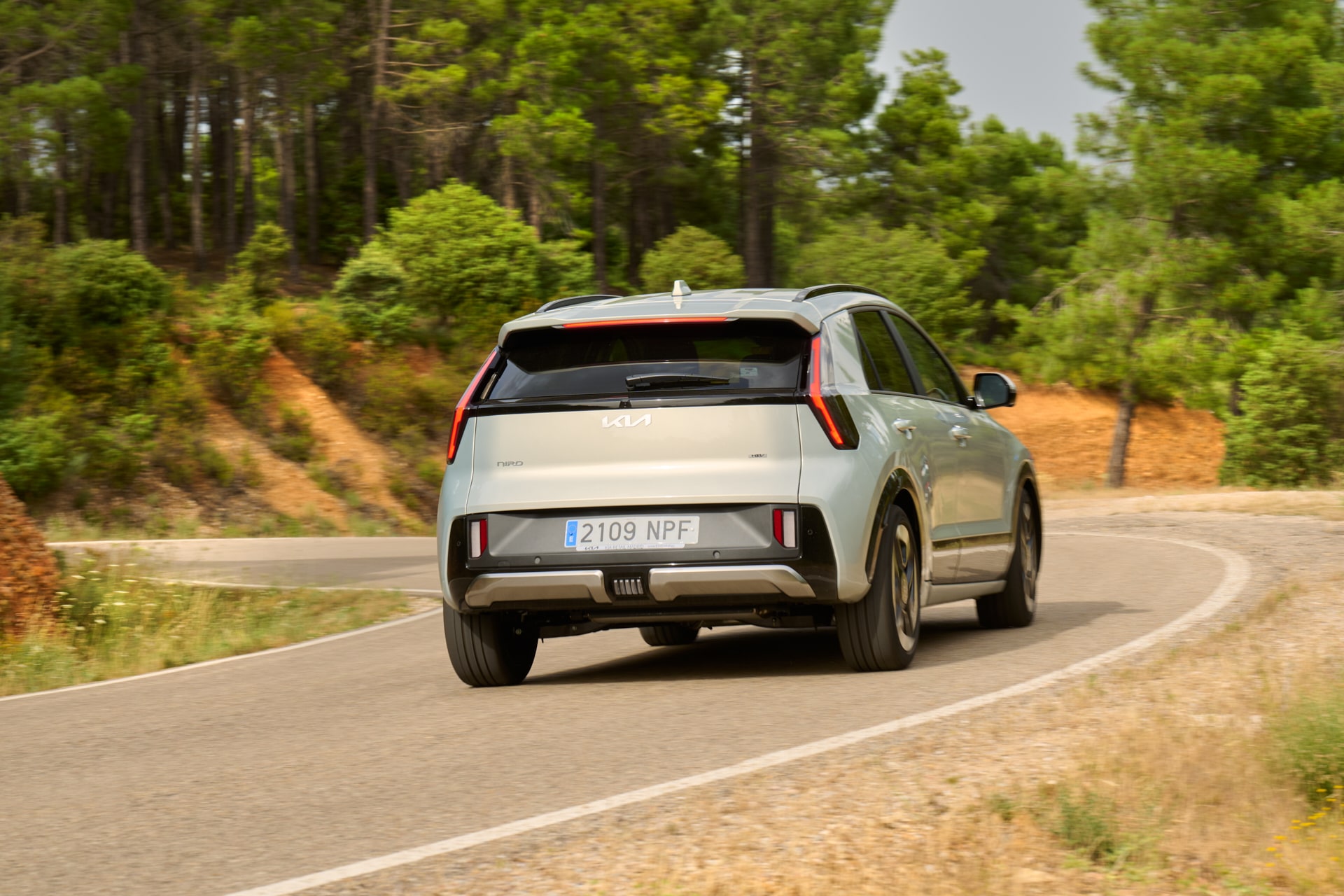
Kia Niro Hybrid (from 34,200 €): more power and an eco focus
The Niro Hybrid, in its Concept 5p S/S DCT trim, makes the most of the same hybrid setup but with a different tuning: 100 kW (140 CV) combined, ten horsepower more than the Kona, with a top speed of 170 km/h versus the Hyundai sibling’s 160. Its homologated consumption is identical, 4.5 l/100 km, and emissions also stay at 100 g/km of CO₂, which confirms that the difference between the two is not in efficiency but in how they distribute that extra power.
Kia has spent years building its brand image around its 7-year warranty, an argument that really carries weight when compared with the 5 years Hyundai offers on the Kona. For a buyer who plans to keep the car for a decade, that difference is no minor detail.
| Power (kW) | Power (CV) | Top speed | Consumption | Label | Fuel |
|---|---|---|---|---|---|
| 100 kW | 140 CV | 170 km/h | 4.5 l/100 km | ECO | Hybrid (petrol/electric) |
Where the Kona wins, where the Niro wins
The Kona Hybrid clearly wins on entry price: it starts at around 33,500 € versus the Niro’s 34,200 €, a difference of about 700 € which, although it does not reach the 15% that would warrant highlighting it in the verdict, is noticeable in such a tight price bracket. It also wins on distinctive design, a point that for many B-SUV buyers is not an accessory but the main reason to buy.
The Niro Hybrid, for its part, wins on power (140 CV versus 130 CV) and on top speed, which translates into slightly more relaxed motorway driving and overtaking with less strain. And above all it wins on warranty: 7 years is a commercial argument that Hyundai does not match with the Kona.
| Model | Power | Consumption | Price from | Warranty | Score |
|---|---|---|---|---|---|
| Hyundai Kona Hybrid | 130 CV | 4.5 l/100 km | 33,500 € | 5 years | 7.8/10 |
| Kia Niro Hybrid | 140 CV | 4.5 l/100 km | 34,200 € | 7 years | 8.1/10 |
Verdict: which Korean hybrid SUV to choose depending on your case
For purely urban use, with short trips and difficult parking, the Kona Hybrid is the most sensible option: it weighs less, costs less and its design remains a real differentiator against any rival in the segment, including those we already compared in the Hyundai Kona Hybrid against the Toyota C-HR and Renault Captur E-TECH.
For those who regularly combine city and motorway driving, the Niro Hybrid justifies the extra cost: the 10 extra CV are noticeable when overtaking, and the 7-year warranty reduces long-term risk in a way the Kona cannot match.
In terms of value for money, the technical tie is real, but if a choice must be made: the Niro Hybrid comes out slightly ahead thanks to that combination of power and warranty, although the Kona Hybrid remains the cheapest entry point into the Korean hybrid range. Remember that both prices are the manufacturer’s recommended retail price (RRP), without dealer discounts or special offers, and that if the purchase fits the current requirements it is worth checking the current conditions of the Plan Auto+ before signing.
Frequently asked questions
Which is cheaper, the Hyundai Kona Hybrid or the Kia Niro Hybrid?
The Kona Hybrid starts from an indicative price of 33,500 €, about 700 € below the Niro Hybrid, which is around 34,200 €. Both figures are RRP without discounts.
Which Korean hybrid SUV has more power?
The Kia Niro Hybrid, with 100 kW (140 CV), outperforms the 90 kW (130 CV) of the Hyundai Kona Hybrid.
Which one offers a better warranty?
Kia offers a 7-year warranty on the Niro Hybrid, compared with the usual 5 years from Hyundai on the Kona Hybrid.
Do the Kona Hybrid and the Niro Hybrid consume the same?
Yes, both are homologated at 4.5 l/100 km and 100 g/km of CO₂, as they share the same hybrid architecture from Hyundai Motor Group.

5 Comments
Pingback: Qué es realmente un SUV-B híbrido autorrecargable y en qué se diferencia de un mild hybrid en consumo real – Comparativa de Coches
Pingback: Omoda 5 SHS vs Hyundai Kona Hybrid: qué SUV-C híbrido ofrece más coche por menos de 28.000€ – Comparativa de Coches
Pingback: Skoda Kodiaq vs Volkswagen Tayron vs Hyundai Santa Fe: qué SUV familiar de 7 plazas viaja más cómodo con niños y equipaje – Comparativa de Coches
Pingback: Hyundai Kona Hybrid vs Toyota Corolla Cross: qué SUV-C híbrido convence más como coche familiar único por menos de 32.000€ – Comparativa de Coches
Pingback: Hyundai Kona Hybrid vs Nissan Juke Hybrid: qué SUV-B híbrido urbano ofrece mejor confort diario por su precio – Comparativa de Coches