

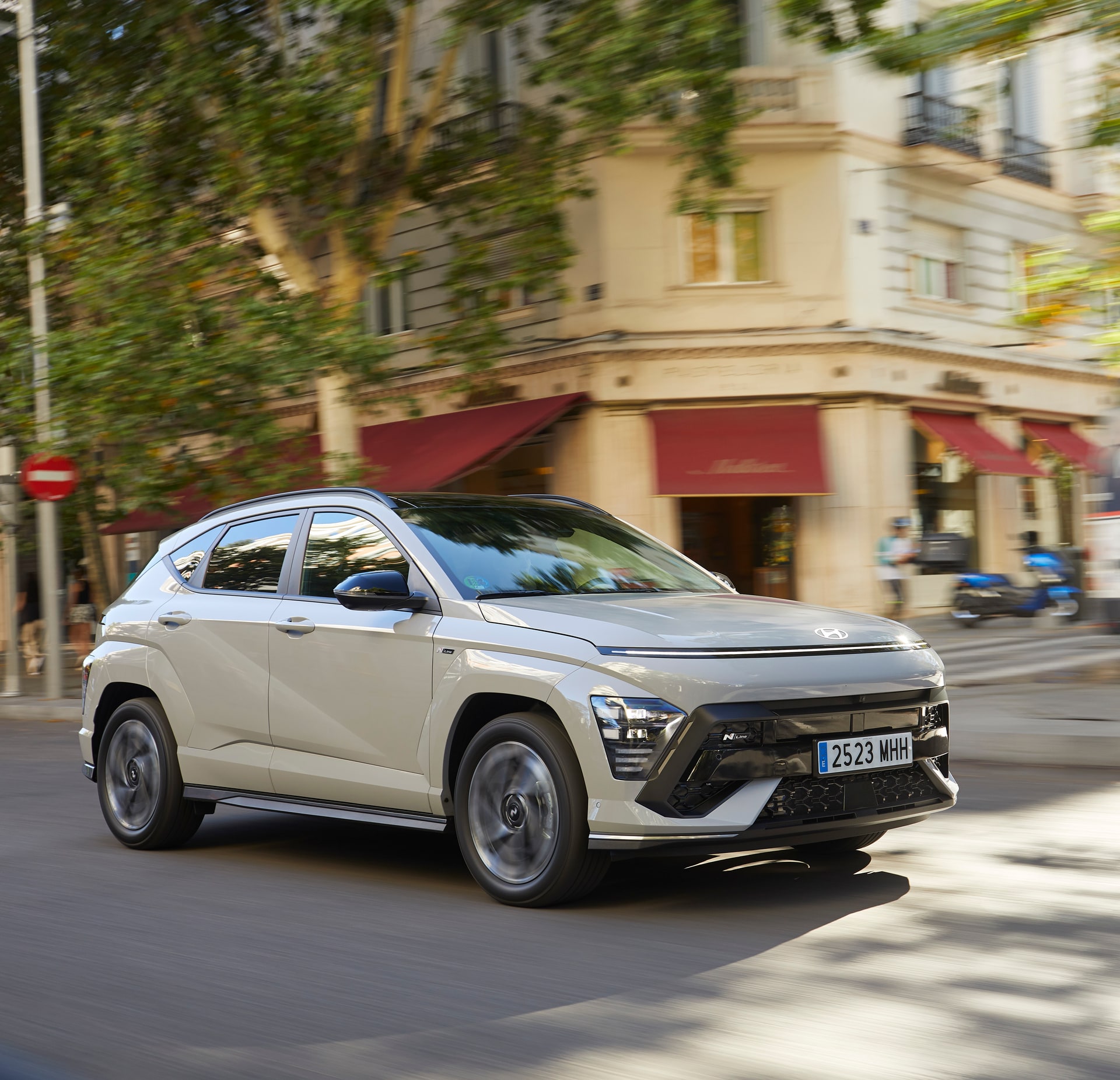
Looking for a family hybrid compact SUV for less than €32,000 in 2024 is, to be honest, an exercise in managing expectations. Neither of the two cars we are going to compare drops below that figure in its official RRP. But they are the two names that keep coming up when a reader asks about a single car, with no plug-in complications, to take the kids to school during the week and make the weekend getaway without thinking about petrol stations every 400 km. The Hyundai Kona Hybrid and the Toyota Corolla Cross 140H represent two different philosophies for solving the same problem, and the buyer’s real budget ends up being just as decisive as the technical specification sheet.
Hyundai Kona Hybrid, from approximately €33,500: technology and a sharp price
The Kona Hybrid uses Hyundai’s well-known 1.6 GDi hybrid engine, with around 90 kW (130 CV) and 270 Nm of combined torque. It is not a rocket: the 0-100 takes around 12 seconds, a figure that makes clear this engine prioritises consumption over punch. Its homologated consumption is around 4.5 l/100 km, with emissions of about 100 g/km of CO₂, and it measures 4,350 mm in length, a size that handles easily both in the city and in a shopping centre car park.
| Engine | Power kW | Power CV | Torque | 0-100 km/h | Top speed | Consumption | CO₂ | Label | Fuel | Price from |
|---|---|---|---|---|---|---|---|---|---|---|
| 1.6 GDi Hybrid | 90 kW | 130 CV | 270 Nm | ≈12 s | 160 km/h | 4.5 l/100 km | 100 g/km | ECO | Hybrid | €33,500 |
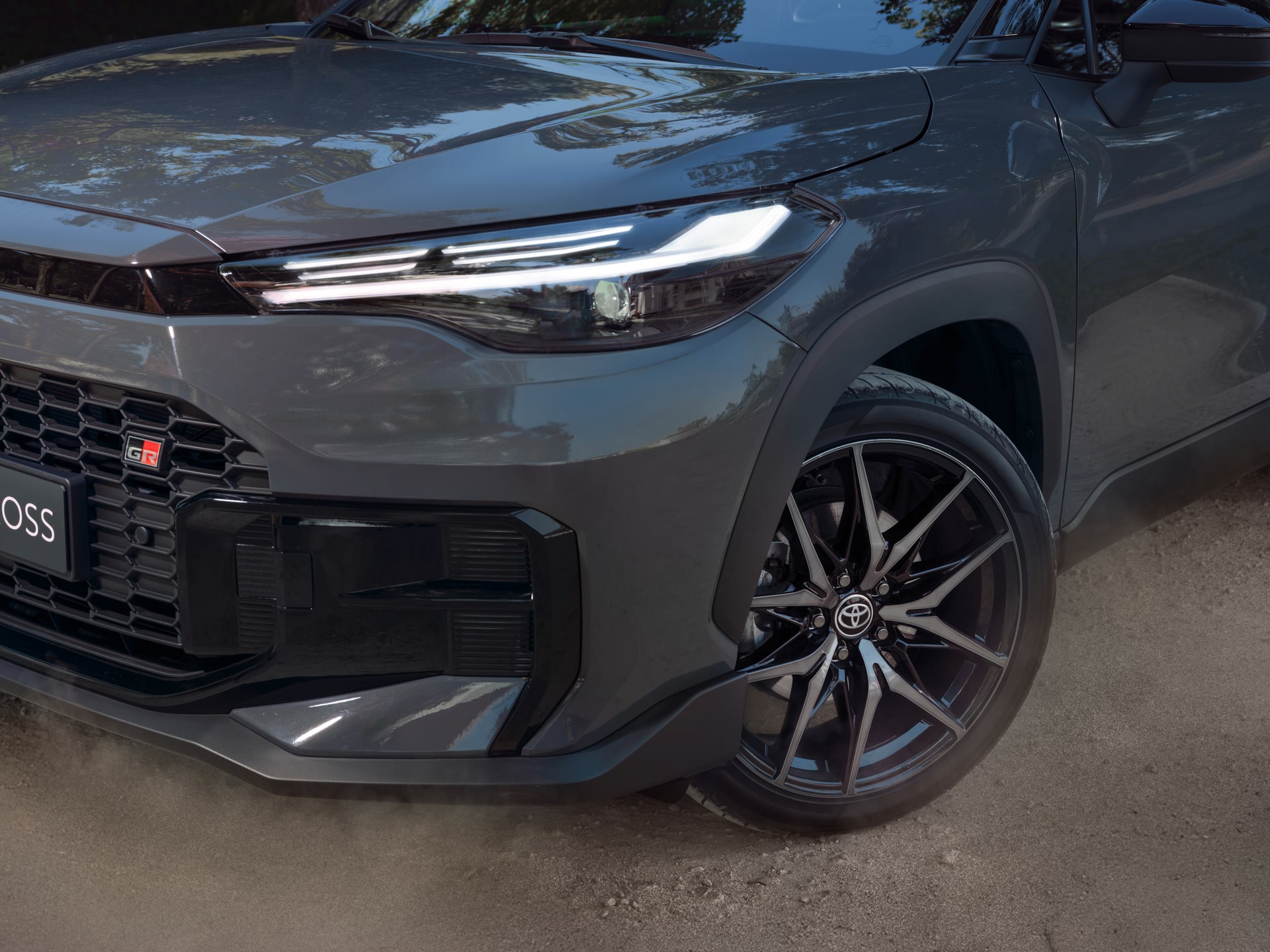
Toyota Corolla Cross 140H, from approximately €41,000: the bet on hybrid reliability
The Corolla Cross we are comparing is the 140H 140 Style 5-door S/S e-CVT version, with the petrol-electric hybrid delivering around 100 kW (140 CV). It is, by a long way, the more powerful of the two versions presented here, and you notice it when joining a motorway or overtaking on a conventional road. Its homologated consumption is around 5 l/100 km, with emissions of about 110 g/km of CO₂, and it reaches a top speed of 170 km/h.
| Version | Power kW | Power CV | Top speed | Consumption | CO₂ | Label | Fuel | Price from |
|---|---|---|---|---|---|---|---|---|
| 140H 140 Style e-CVT | 100 kW | 140 CV | 170 km/h | 5 l/100 km | 110 g/km | ECO | Hybrid | €41,000 |
Head to head: where the difference shows
On paper, the difference in power is clear: the Corolla Cross outperforms the Kona by about 10 real CV, and that gap is felt above all in overtaking manoeuvres and with a full load of four passengers and a full boot. The Kona, on the other hand, responds with slightly lower consumption on paper (4.5 versus 5 l/100 km) and, above all, with a much more accessible entry price.
That is the data point that really shapes the decision: the Corolla Cross starts at around €41,000, compared with the €33,500 of the Kona Hybrid. That is a difference of more than 20%, not a small matter for a buyer already stretching their budget to €32,000. It is worth remembering that these prices are the manufacturer’s recommended RRP, without dealer discounts, one-off campaigns or aid such as the Plan Auto+, which can bring both figures closer to what the buyer actually pays in the contract.
| Model | Power | Consumption | Price from | Warranty | Score |
|---|---|---|---|---|---|
| Hyundai Kona Hybrid | 130 CV | 4.5 l/100 km | €33,500 | 5 years with no mileage limit | 8/10 |
| Toyota Corolla Cross 140H | 140 CV | 5 l/100 km | €41,000 | 3 years, extendable up to 10 with servicing at the official network | 7.5/10 |
The warranty, in fact, is another area where it is worth not being swayed by brand prestige: Hyundai offers 5 years with no mileage limit as standard, while Toyota starts at 3 years but can be extended up to 10 if servicing is kept up within its network, which demands discipline from the owner but in return gives long-term peace of mind that is hard to match.
Where each one wins, no half measures
The Hyundai Kona Hybrid clearly wins on entry price and homologated consumption, two weighty arguments for anyone who does a lot of urban mileage and wants to pay off the car quickly. If you already know the Korean range, our comparison between the Kona Hybrid and the Kia Niro Hybrid looks in more depth at how that same engine behaves in another body style.
The Toyota Corolla Cross wins on real power and on the peace of mind that Toyota’s hybrid system provides, with more than two decades of accumulated mileage in fleets and taxis. If budget is not the variable that pinches most, it is worth also reviewing our comparison of the Corolla Cross against other Japanese hybrid SUVs to see how it stacks up against direct rivals of Asian origin.
Verdict: which to choose depending on your case
For urban use and a tight budget: Hyundai Kona Hybrid. Its entry price, almost €7,500 below the Corolla Cross, and its lower consumption make it the more rational car if your day-to-day is city driving and short trips.
For long journeys and motorway driving with a full load: Toyota Corolla Cross. Its 140 CV are noticeable on the motorway, and Toyota’s hybrid system has a reliability track record that nobody in the segment has yet matched.
Price-to-performance ratio: Hyundai Kona Hybrid. It delivers almost the same efficiency with a considerably smaller upfront outlay, and its 5-year warranty offsets much of the power gap against the Japanese rival.
Frequently asked questions
Can you get the Hyundai Kona Hybrid or the Toyota Corolla Cross for less than €32,000?
The official RRP of both exceeds that figure (€33,500 for the Kona and €41,000 for the Corolla Cross), but with dealer discounts, financing or current aid such as the Plan Auto+, the Kona Hybrid can get reasonably close to that threshold. Always check the up-to-date conditions with the dealership.
Which one uses less fuel in day-to-day driving, the Kona Hybrid or the Corolla Cross?
According to homologated data, the Kona Hybrid is around 4.5 l/100 km compared with 5 l/100 km for the Corolla Cross, a difference that remains reasonably stable in real urban use.
Which has more power, the Kona Hybrid or the Corolla Cross?
The Toyota Corolla Cross 140H delivers around 140 CV compared with the 130 CV of the Hyundai Kona Hybrid, a difference that is noticeable above all when overtaking and with the car fully loaded.
What warranty does each brand offer?
Hyundai covers the Kona Hybrid with a 5-year warranty with no mileage limit. Toyota offers a base 3-year warranty on the Corolla Cross, extendable up to 10 years if servicing is carried out at its official network.

1 Comment
Pingback: Cómo elegir un SUV familiar en 2026 según cuántos niños llevas y los kilómetros reales de autovía al año – Comparativa de Coches