

That a SUV-B could be the only car for a family with children, work and the occasional weekend trip no longer sounds far-fetched. The Hyundai Kona has been one of the standout names in this segment in Spain for years, and the electric EV 135 Black Line version we tested raises a very specific question: is it enough to be the only car in the garage, or is it still better as a second urban vehicle?
Hyundai Kona EV 135 49kWh Black Line: specs and price from 38,100 €
The version we are looking at uses an electric motor of 100 kW (140 CV), a 51 kWh gross battery and a homologated range of around 380 km. The starting price is around 38,100 € RRP, not counting dealer offers, occasional discounts or aid such as the Plan Auto+, which should always be checked on its official website because the amounts change.
| Version | Power | Top speed | Range | Battery | Fuel | Price from |
|---|---|---|---|---|---|---|
| Hyundai Kona EV 135 Black Line | 100 kW / 140 CV | 160 km/h | 380 km | 51 kWh | Electric | 38,100 € |
These are honest figures, neither spectacular nor disappointing. It is not the electric SUV-B with the most range on the market, but it does not fall short for the profile it targets.
Interior space and boot: does it work as a single family car?
Here is the first important nuance. The Kona has grown compared with earlier generations, and that shows in the rear seats: two ISOFIX child seats fit without fighting the front headrest. The centre rear seat is another story, as in almost every SUV-B. For a family of four with two young children, the rear space does the job without luxury.
The boot is generous for the segment, although the underfloor space is reduced by the placement of the electronics, which is common in electric cars on this platform. A large pushchair and a sports bag fit without a puzzle, but three large suitcases for a long trip start to squeeze.
Real-world range ≈380 km: is it enough for everyday family use?
The homologated 380 km, in mixed use with cold weather and motorway driving, drops considerably in practice, as happens with any electric car in this category. For urban journeys and short trips between nearby cities, it is more than enough. For a 400 km trip to the beach in August, you need to plan a charging stop, something we already analysed in detail in the review focused on the electric Kona as a single urban family car.
Power and handling: 140 CV, is it enough?
The 140 CV do not impress on paper, but in town and on the motorway they feel livelier than the figure suggests, thanks to the instant torque typical of electric cars. Overtaking on conventional roads is no problem. What you will not get is the sense of surplus power that other electric SUV-Bs with more generous motors do provide.
Black Line equipment: what is standard
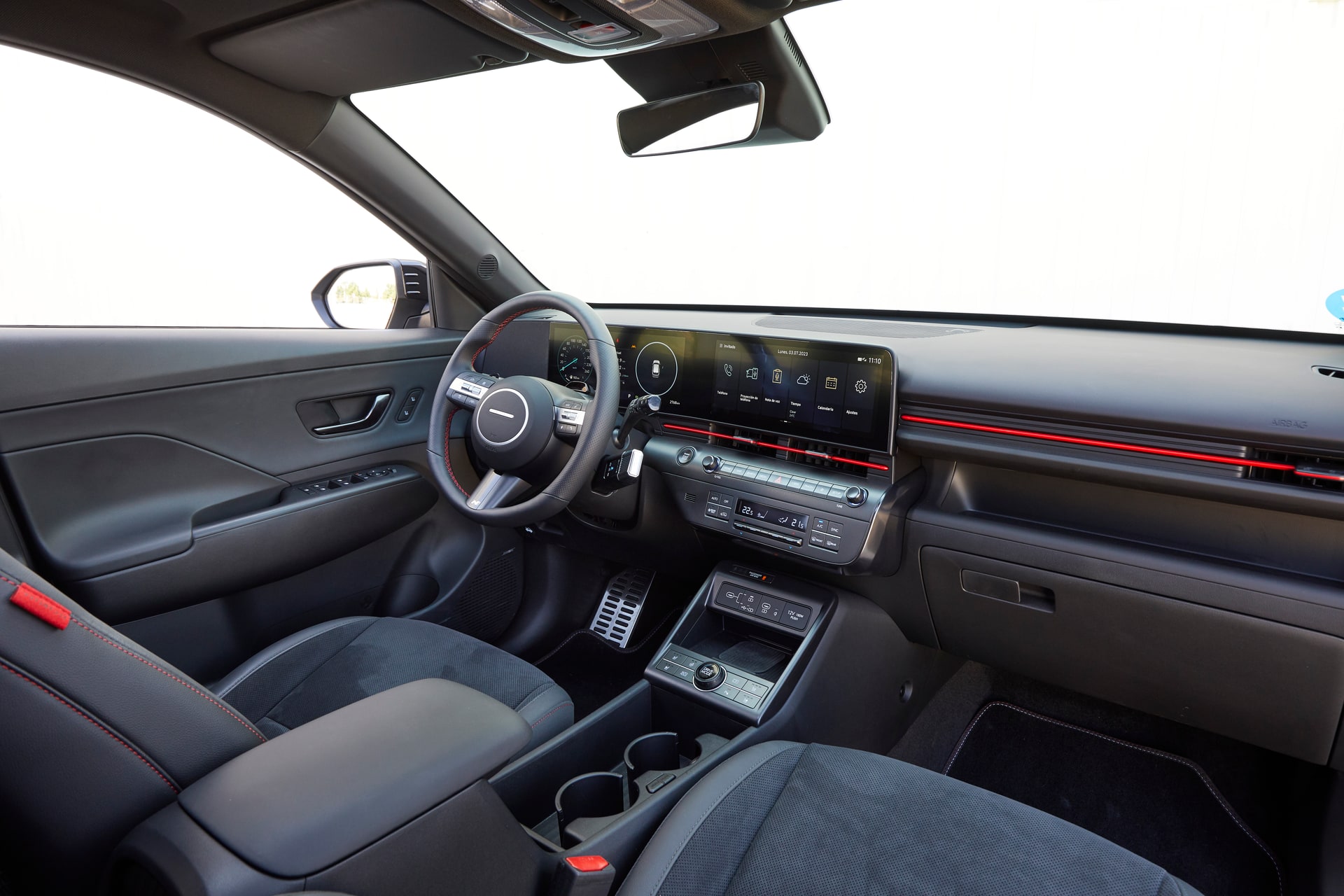
The Black Line trim adds black styling details, specific alloy wheels and a level of safety and comfort equipment that already comes close to what is expected in 2026: driver assistance systems, automatic climate control, wireless charging and digital screens of good size. It is not the most luxurious trim in the Hyundai range, but it covers what a family needs without feeling that anything basic is missing.
Price from 38,100 €: is it worth it against segment rivals?
At around 38,100 €, the electric Kona sits in the upper band of the electric SUV-B market, a space where it competes with options such as the Kia Niro EV or the Peugeot e-2008, both with similar range and space approaches. We have already compared those options head to head in Kona Electric vs Kia Niro EV vs Peugeot e-2008, and the conclusion holds: the Kona is not the cheapest of the group, but it does not fall behind in equipment or finish.
Competitive context: family SUV-Bs in Spain 2026
Within Hyundai’s own range, the Kona coexists with hybrid versions that lower the entry price and extend real-world range without depending on a charger. For anyone without a wallbox at home or regular charging at work, the hybrid version remains the most sensible option as a car to be the only one; the electric version makes more sense once home charging is already sorted.
Who it suits and who it doesn’t: verdict
For an urban family with a wallbox and short daily journeys: the electric Kona more than covers it, with enough space for two child seats and a boot that handles the weekly shop and the pushchair.
For those who often make long journeys: real-world range forces you to plan stops, something not every family wants to take on as a routine.
Equipment-to-price ratio: the Black Line trim is convincing, but at 38,100 € you should compare carefully against the Niro EV before signing.
| Dimension | Rating (1-10) |
|---|---|
| Family space | 7 |
| Real-world range | 6.5 |
| Power and dynamics | 6.5 |
| Standard equipment | 7.5 |
| Price-performance ratio | 6.5 |
FAQ
Does the Hyundai Kona electric work as a single family car?
Yes, as long as the family can charge regularly at home or at work and long trips are not constant. For urban use and medium-distance journeys, its space and range are sufficient.
How much real-world range does the Hyundai Kona have?
The homologated figure is around 380 km, although on the motorway with climate control running the number drops noticeably, as with any electric car in this segment.
How much does the Hyundai Kona cost in 2026?
The EV 135 Black Line version starts at around 38,100 € RRP, not counting dealer discounts or aid such as the Plan Auto+.
Which rivals should I compare before buying a Hyundai Kona?
Mainly the Kia Niro EV and the Peugeot e-2008, with very similar range and price approaches within the electric SUV-B segment.

2 Comments
Pingback: Hyundai i20 vs Renault Clio: qué utilitario B gasolina ofrece mejor relación equipamiento-precio en 2026 – Comparativa de Coches
Pingback: Cómo elegir un SUV compacto urbano en 2026 según el tamaño real para aparcar y el maletero útil – Comparativa de Coches