

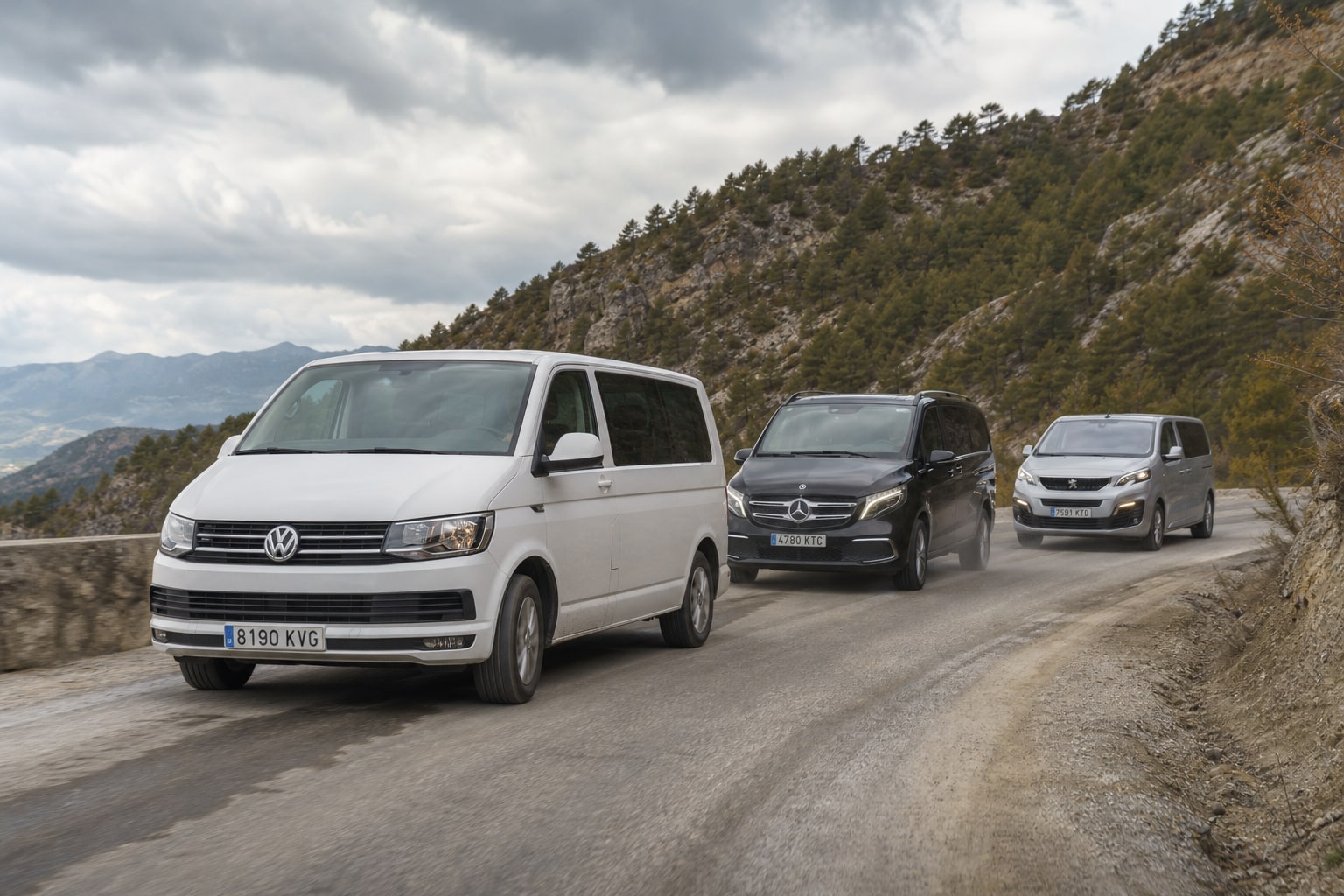
Any passenger van will not do for VTC. Some people buy an attractive vehicle with a good boot and a premium finish, and months later discover that the technical inspection for the licence rejects it for failing a requirement nobody explained to them before they signed. This happens more often than it seems, especially with fleets that renew quickly and trust that “if it’s a passenger van, it’s fine”. It isn’t. Here is what the regulations really require and which models meet them without surprises.
What Taxi/VTC approval is and the legal framework that governs it
There is no single “VTC approval” stamp that the manufacturer applies to the vehicle. What exists is a combination of three regulatory layers that the vehicle must meet simultaneously: the European category approval (M1), the Land Transport Planning Law (Ley de Ordenación de los Transportes Terrestres) with its 2015 reform for VTC authorisations, and the municipal ordinances of the large cities (Madrid and Barcelona above all), which add their own conditions on emissions and comfort. The vehicle has to pass all three filters at once. Passing just one is not enough.
Mandatory technical requirements in 2025
Seats and interior configuration
The VTC authorisation is linked to a vehicle with between 5 and 9 seats, including the driver’s, registered as a car or as a van derivative (M1). Established fleets often opt for 7- or 8-seat configurations because they allow group services without changing vehicle, but the extra seat is not free: it adds weight, reduces the available boot space and, on some models, requires giving up the foldable third row to gain luggage room.
ADAS systems and the General Safety Regulation (GSR2)
Since July 2024, all new cars registered in the EU must include as standard the safety package of Regulation (EU) 2019/2144, known as GSR2: autonomous emergency braking, lane departure warning, driver drowsiness detector and intelligent speed limiter, among others. For a van intended for VTC this is no longer an optional extra: it is imposed by law, and any unit registered after that date has it as standard. If you buy a stock unit registered before that date, it is advisable to check it line by line before signing.
DGT environmental label
Madrid and Barcelona restrict the circulation of VTCs without an ECO or CERO label in their low-emission zones, and some municipal ordinances already make licence renewal conditional on having one of those two labels. A recent Euro 6 diesel obtains a C label, which still allows you to work today, but you should check the restriction calendar of the city where you operate before planning to amortise the vehicle over eight years.
Independent rear air conditioning
Several VTC ordinances, Madrid’s among them, require independent rear air conditioning in vans with more than 5 seats. It is not a comfort whim: it is a requirement that inspection checks, and its absence is a common reason for rejection in units that arrive through imports or poorly configured renting.
Access and interior height
Sliding doors on both sides, sufficient interior height to get in without stooping, and a clear passage from the cabin to the passenger area are conditions valued both by inspection and, above all, by the customer who boards with luggage or reduced mobility. This is where the difference between a van designed for VTC from the factory and a last-minute adaptation is most noticeable.
M1 versus N1 approval: why it conditions the choice
Before looking at models, it is worth being clear about a nuance that confuses many first-time buyers: not every passenger van is M1 approved. Some light-cargo versions converted for passengers are registered as N1, and that category does not qualify for VTC. We already explained this in detail in our analysis of M1 versus N1 approval in passenger vans, and it is the first piece of information to request from the dealership, even before discussing price.
Mercedes-Benz Vito Tourer, from €44,900
The option with the most track record in professional VTC fleets. Proven reliability, a wide service network and a 2.0 CDI diesel with three power levels that covers everything from urban use to motorway driving without strain.
| Version | Power | Fuel | Label |
|---|---|---|---|
| Vito Tourer 116 CDI | 120 kW / 163 CV | Diesel | C |
Ford Tourneo Custom, from €42,400
The best balance between price and equipment in the segment. It also includes a Plug-in Hybrid version, interesting for those who operate in low-emission zones and want room to manoeuvre in the face of future restrictions.
| Version | Power | Fuel | Label |
|---|---|---|---|
| Tourneo Custom 2.0 EcoBlue 136 | 100 kW / 136 CV | Diesel | C |
| Tourneo Custom Plug-in Hybrid | 112 kW / 152 CV | PHEV | CERO |
Volkswagen Multivan, from €54,900
It is no longer a van in the classic sense: the current Multivan, T7 generation, is approved as a car and targets an executive VTC profile, with a more refined finish than its rivals and an eHybrid powertrain that makes it easier to comply with any low-emission ordinance. We cover it in detail in our analysis of the Volkswagen Multivan as a work tool for premium transfer self-employed drivers.
| Version | Power | Fuel | Label |
|---|---|---|---|
| Multivan eHybrid | 160 kW / 218 CV | PHEV | CERO |
Other vans approved on the Spanish market
The list of models that meet M1 approval and VTC requirements does not end with the three above. Peugeot Traveller, Citroën SpaceTourer and Opel Zafira Life share the Stellantis group platform and offer a cheaper alternative with very similar equipment. Renault Trafic SpaceClass completes the picture with a finish aimed specifically at paid passenger transport. None of the four offers a clear technical advantage as standard over the three models analysed in depth, which is why they do not feature in the main comparison, although they are valid options and, in the case of the Stellantis vans, usually more aggressive on price.
Summary comparison table
| Model | Price from | Fuel | Label | VTC score |
|---|---|---|---|---|
| Mercedes-Benz Vito Tourer | €44,900 | Diesel | C | 8/10 |
| Ford Tourneo Custom | €42,400 | Diesel / PHEV | C / CERO | 8.5/10 |
| Volkswagen Multivan | €54,900 | PHEV | CERO | 8/10 |
Verdict: which van to choose depending on your case
For a standard VTC fleet with high mileage and a focus on maintenance costs: Mercedes-Benz Vito Tourer. The widest workshop network and proven reliability under intensive use.
For the self-employed driver who needs leeway against future emissions restrictions without blowing the budget: Ford Tourneo Custom, especially in its Plug-in Hybrid version, with a CERO label and an entry price 23% below the Multivan.
For executive VTC service where the customer pays for perceived quality: Volkswagen Multivan. It is the most expensive of the three, but in this segment the interior finish justifies a good part of the premium.
Frequently asked questions
Does any passenger van work for VTC in Spain?
No. It must be approved as M1, not N1, and also meet the regional and municipal conditions (environmental label, rear air conditioning, ADAS) of the city where the service is provided.
Is GSR2 ADAS mandatory on VTC vans?
Yes, for any unit registered after July 2024, under Regulation (EU) 2019/2144, regardless of whether it is used as a VTC or privately.
What DGT label does a VTC van need in Madrid or Barcelona?
It depends on the ordinance in force at each moment; today licences with a C label coexist with progressive restrictions towards ECO and CERO in the low-emission zones, so it is advisable to check the updated municipal regulations before buying.
Are there public grants to buy an approved VTC van?
Yes, through the Plan Auto+ framework, which covers professional-use vehicles among the eligible beneficiaries. The exact amounts and conditions change with each call, so it is best to consult the plan’s official website before calculating the saving.
